Clocking It: The Political Rundown — The Verdict
This week’s Halfway Clocked exposed the rot beneath the surface: a million mentions of Donald Trump in the Epstein files, a Department of Justice more interested in optics than justice, and a president who keeps trying to bury the truth under redactions and distractions. Now, the economic data has caught up and it’s damning.
The Numbers Don’t Lie — But Trump Does
The U.S. economy didn’t just stumble in 2025. It was presented as something stronger than it actually was.
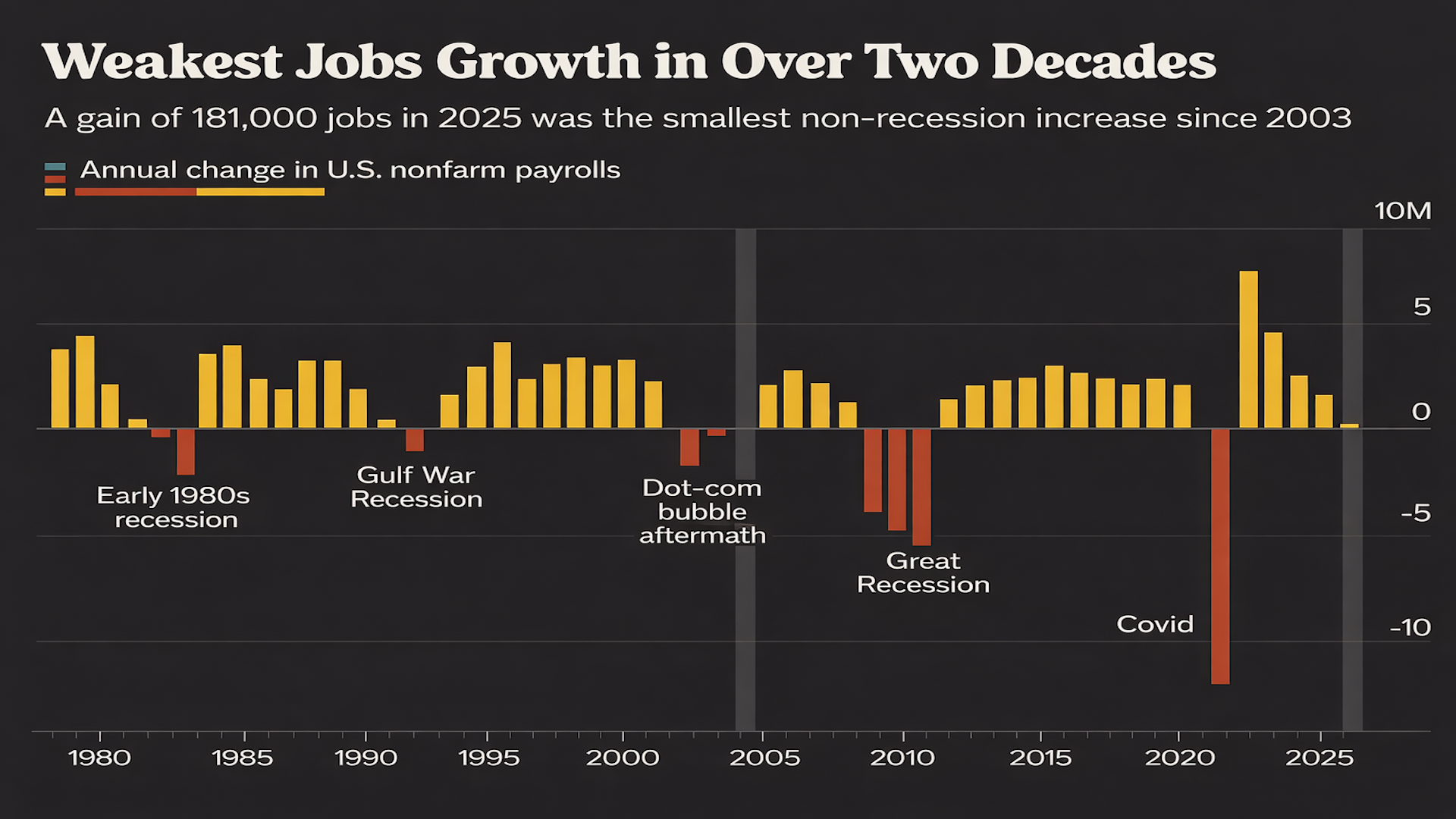
The Bureau of Labor Statistics quietly revised its 2025 job creation numbers downward by 862,000, the largest negative correction since the 2009 financial crisis. What had been celebrated as a year of resilience is now officially one of the weakest non-recession job performances since 2003. The revised total: just 181,000 jobs.
Graphic: Andrew Greene Decked Out Magazine
That’s not statistical housekeeping. It’s a credibility collapse. For months, Americans were told the economy was booming. But prices remain elevated, paychecks remain strained, and now even the employment growth used to justify the optimism has been dramatically reduced. The foundation of the “strong economy” narrative is thinner than advertised.
And the pattern of economic storytelling built on perception rather than substance doesn’t end with job numbers.
The Phantom Tariff Check Machine
But there is no law authorizing such payments. Tariffs themselves remain entangled in legal challenges. And no president has the authority to independently send money to the public without congressional action.
The messages are not government communications; they are fundraising solicitations connected to the Trump/Vance campaign. Variations of the same promise have circulated repeatedly for months, each using urgency, official tone, and visual cues of financial reward while ultimately directing recipients into a political donation pipeline.
In other words, while economic strength is proclaimed from the podium, financial relief is being marketed through campaign email; relief that does not exist in law, policy, or budget.
The same gap between narrative and reality is now showing up somewhere else… in campaign fundraising.
According to a Friday reporting by MeidasTouch Network, the president’s political operation has been repeatedly promoting the idea of “tariff rebate checks” supposedly waiting to be signed and distributed to supporters. Emails framed with official-style language urge recipients to confirm their information before deadlines expire, sometimes accompanied by imagery implying cash is already being prepared.
It is the same model seen in the economic data itself: perception first, verification later… if ever.
Tariffs, Tantrums, and a Cracking GOP
Even Trump’s own party is starting to flinch. This week, House Republicans joined Democrats to rebuke tariffs imposed on Canada, a rare act of defiance against a president who has long enforced party unity through pressure and political threats. The vote was symbolic, but the message was not: economic instability is beginning to outweigh partisan loyalty.
The tariffs were justified under a declared emergency tied to fentanyl flows, despite consistent evidence showing most fentanyl enters the United States through Mexico, not across the northern border.
According to Yahoo!finance, the financial impact is measurable. Analysts estimate tariff costs added roughly $1,000 to the average American household in 2025, with projections climbing higher if the policy continues.
When Congress challenged the policy, the president warned dissenting Republicans they would face consequences at election time. Leadership attempted to block the vote. They failed. Republicans defected. The resolution passed.
The grip remains powerful, but no longer unchallenged.
The Debt Bomb Trump Lit
The fiscal outlook is deteriorating just as quickly as the political one.
The Congressional Budget Office, a nonpartisan entity, now projects the national debt could surge to $64 trillion within a decade. The drivers are clear: large tax cuts paired with sustained spending commitments whose long-term costs far exceed projected tariff revenue.
Deficits are expanding. Interest payments are accelerating. Credit downgrades have already arrived.
The response from the White House has been to pressure the Federal Reserve to lower interest rates, not to correct the structural imbalance, but to soften the visible consequences.
The debt is no longer theoretical. It is a trajectory already underway.
The Political Fallout
Public sentiment is shifting alongside the economic indicators.
According to an AP-NORC poll, Approval ratings are sliding deeper into negative territory. Voters are growing more skeptical of economic claims and more sensitive to financial pressure.
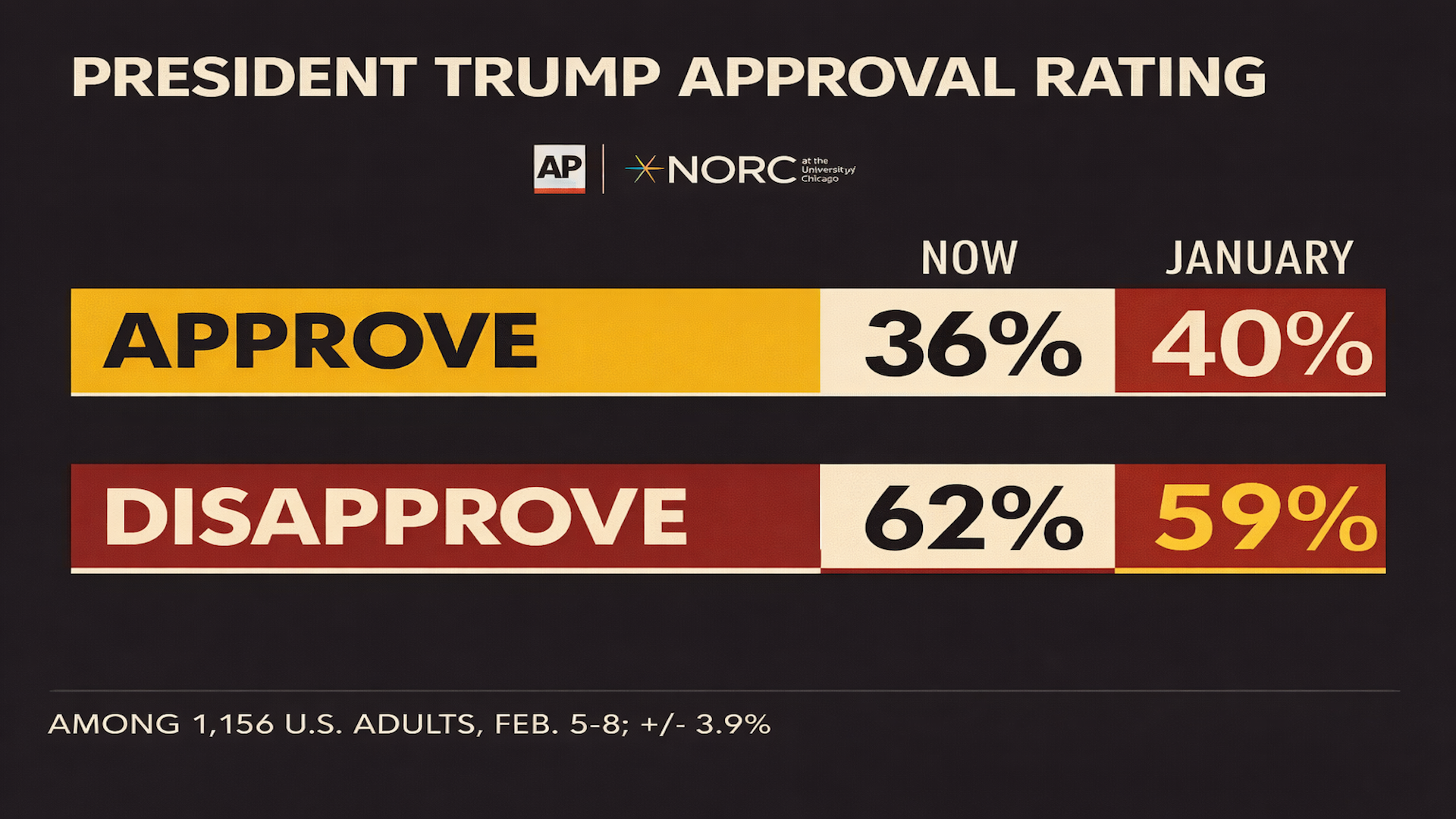
Photo: Andrew Greene Decked Out Magazine
Even Joe Biden, once portrayed as the embodiment of national decline, is now polling more favorably in multiple comparisons. According to a Rasmussen poll (Feb. 2-4), 48% say Biden did a better job as president, versus 40% who chose Trump.
Inside Washington, tensions are rising. Confrontations with Congress. Escalating attacks on courts. Intensified pressure on the media. A governing environment defined less by stability than by reaction.
The economy is weakening. The party is fracturing. And the political temperature continues to climb.
The Verdict
Let’s stop pretending this is ordinary politics.
What we are watching is not standard policy disagreement. It is not routine partisan governance. And it is not recognizable as conventional behavior from the Republican Party at any point in its modern history.
This is something else entirely.
Job growth was inflated, then revised into near-irrelevance.
Tariffs were framed as strength while functioning as a direct tax on Americans.
Debt is exploding on a scale that will burden generations.
And now fictional financial benefits are being dangled in front of supporters as political bait.
That is not economic leadership. That is systemic deception.
Under Donald Trump, reality is treated as negotiable, statistics are promotional material, emergency powers are branding tools, and public policy is indistinguishable from campaign marketing. Even the promise of money itself has been transformed into messaging, used to extract loyalty while delivering nothing tangible in return.
This is not governance grounded in ideology.
It is not conservatism.
It is not fiscal policy.
It is power maintained through distortion: repeated, amplified, and monetized.
The pattern is now undeniable: create the narrative, repeat it relentlessly, revise the facts when they contradict it, and pressure anyone who refuses to participate. Economic data gets rewritten. Institutions get attacked. Supporters get promised rewards that exist only in emails and speeches.
And the country is expected to accept all of it as normal.
It is not normal.
It is not standard Republican politics.
It is not hardball governance.
It is not even conventional demagoguery.
It is a political machine sustained by illusion, where perception replaces performance, and belief is treated as a substitute for proof.
The Epstein files showed how far Trump’s name reaches.
The economic revisions showed how fragile his claims are.
The phantom payments show how far the manipulation now extends.
And the growing resistance inside government shows that even the system designed to absorb shock is nearing its limit.
Call it what it is: not leadership, not policy, not strategy, but extraction. Extraction of trust. Extraction of money. Extraction of institutional stability.
A presidency built on fiction can only survive as long as people agree to pretend the fiction is real.
That pretense is collapsing.
This isn’t a presidency. It’s a protection racket. And the bill is coming due.
Clocked. That’s the tea.
Author Bio
Andrew Greene is a quality-obsessed, results-driven powerhouse with nearly two decades of experience transforming complexity into clear, actionable solutions. His secret weapon? A mix of analytical sharpness, problem-solving precision and a communication and leadership style that’s equal parts clarity and charisma. From Quality Assurance to political data analysis, you can think of him as the Swiss Army knife of operational excellence, minus the corkscrew (unless it’s a team celebration).