
While the world remembers 1993 for the allegations, the shift in This file audits the 1990-1992 era—a period where the press pivoted from celebrating an icon to dissecting a ‘specimen.’ Part of our 2024 MJ Series, re-engineered for Decked Out ahead of the book launch.
Now seems like an especially great time to take a deeper look into the media’s mistreatment of Jackson in the late 1980s/1990s. Now, why is this important, you ask? Because times were different in previous decades in terms of the media’s power to influence the general public and their individual perceptions of a person or subject. While the media does still hold a reasonable amount of power, as somebody who has worked directly in the field, I can tell you that their heavyweight status is dwindling with each passing day, as the advancement of the internet and social media has presented people with the opportunity of finding other sources for their interests and information. This is, of course, much different than back in the day when you pretty much had no additional options outside of the news, newspapers, and magazines. Since the media’s point of view was the only one being presented on a national (or even global) level, their ability to impact what people thought of somebody or something was at a zenith during the ’80s, ’90s and ‘00s, and once the media decided to push the narrative of Jackson being “weird,” “eccentric” or whatever other term they decided for the day, unfortunately a lot of other people adapted that same mindset (even if they were a fan of his talent and music).
This is critical because it led (and in some cases still leads) people to automatically believe Jackson was capable or even guilty of the allegations presented against him, and of course, these notions only intensified with the media storm that hit upon the allegations being brought against him. We will be covering how the media handled the allegations and the 2005 trial down the line, but for now, let’s take a look at their treatment of him just before late 1993.
RELATED: The Cascio Betrayal: A $213 Million Reckoning With the Truth
Table of Contents
Late 1980s/1990s Media Treatment
Ladies and gentlemen, I’m going to let the actual newspapers/editors do the talking here because, well, they’re the ones who wrote and published it:
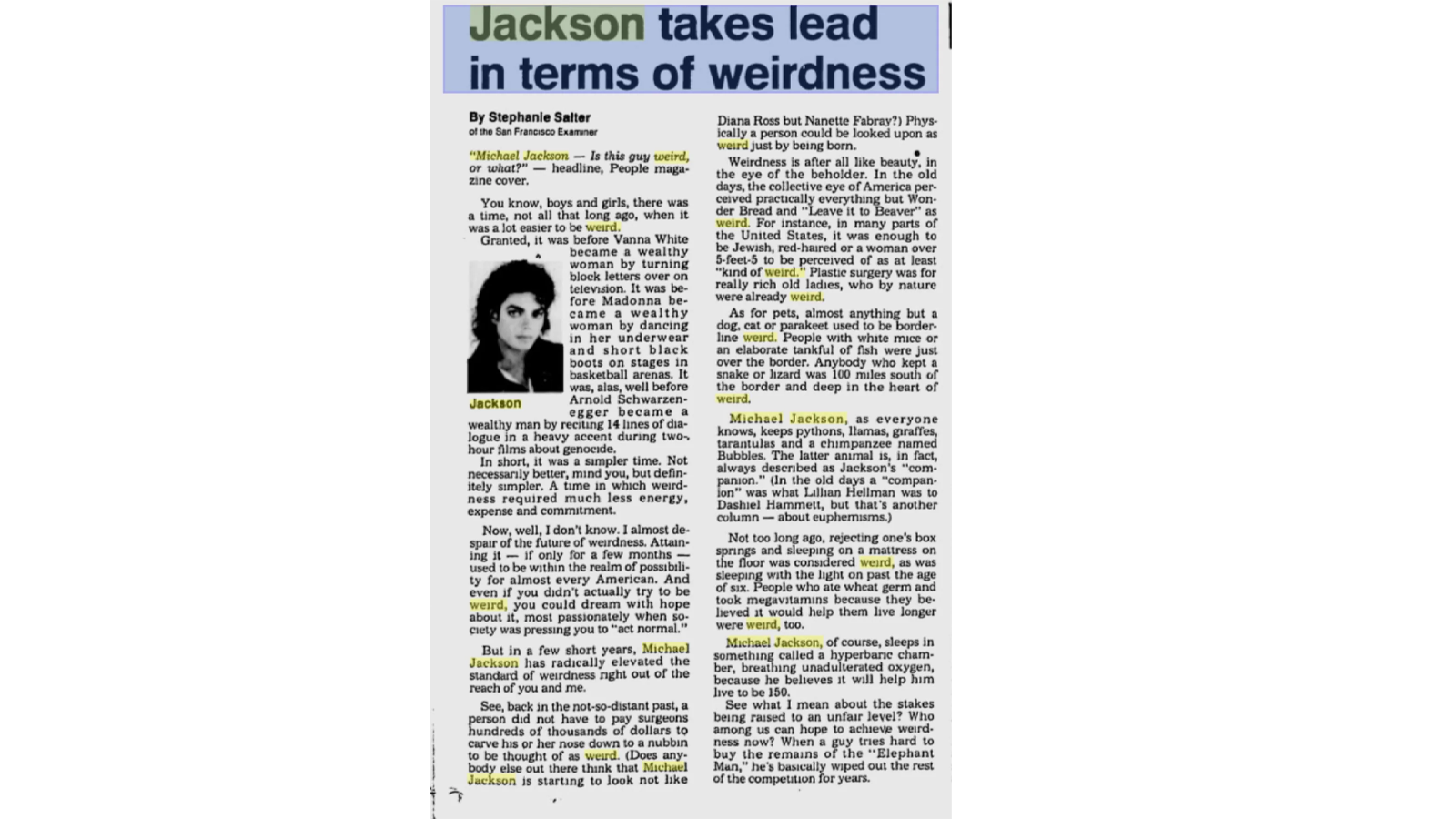
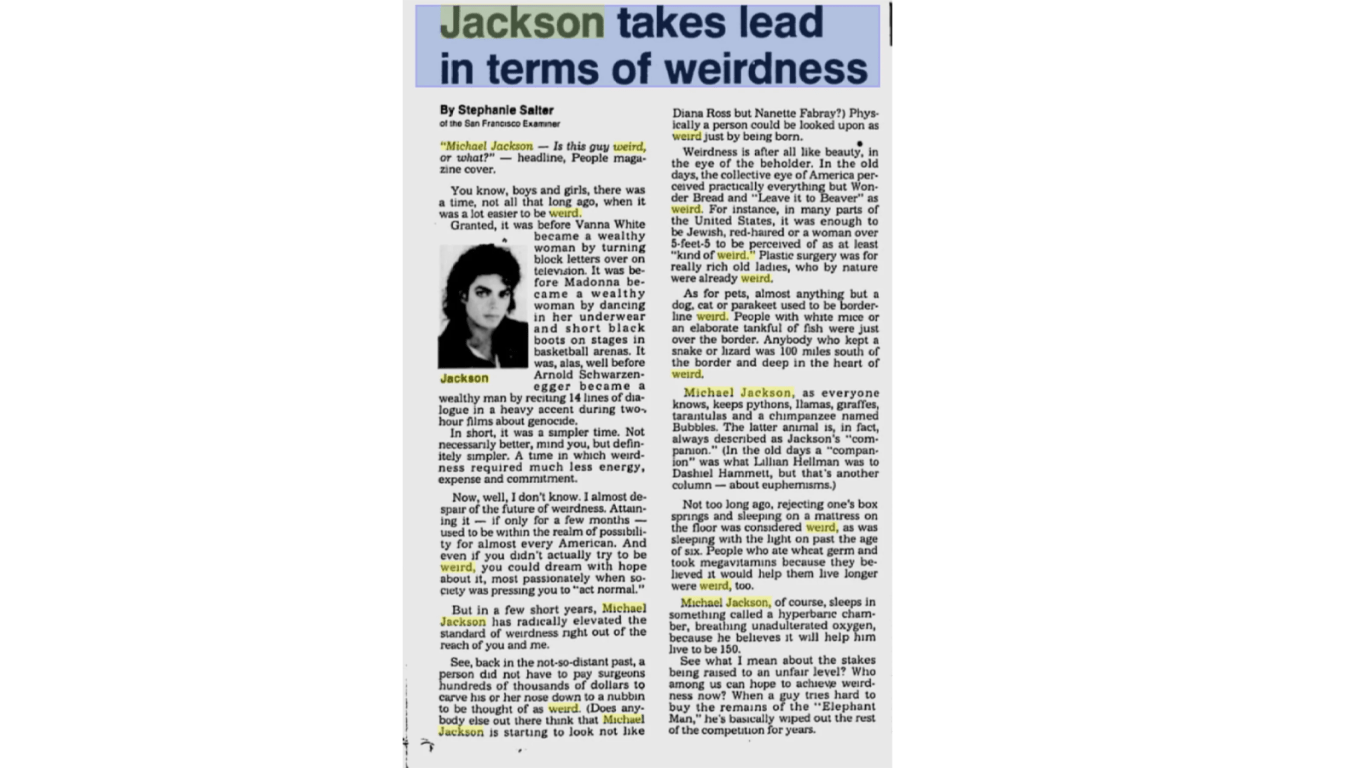
Photo: Google News Archives
Written by Stephanie Salter of the San Francisco Examiner in 1987. Not only was “weirdness” in the title, but Salter used the word “weird” eleven times. She also said that Jackson had “radically elevated the standard of weirdness right out of the reach of you and me,” and that he was “starting to look like Diana Ross,” amongst other horrible things.

Photo: Google News Archive
Written by Jeffrey Heller of the Manila Standard in 1988, who claimed Jackson was “living down the freakish image presented of him,” and chose to talk about his appearance instead of his concert the night before.

Photo: Google News Archive
The New Straits Times chose to ignore the impact of Jackson’s 1992 Dangerous concert in Bucharest, how he visited orphanages and ultimately donated the entirety of his earnings that night to a Romanian charity, to still call him… “Wacko Jacko.”
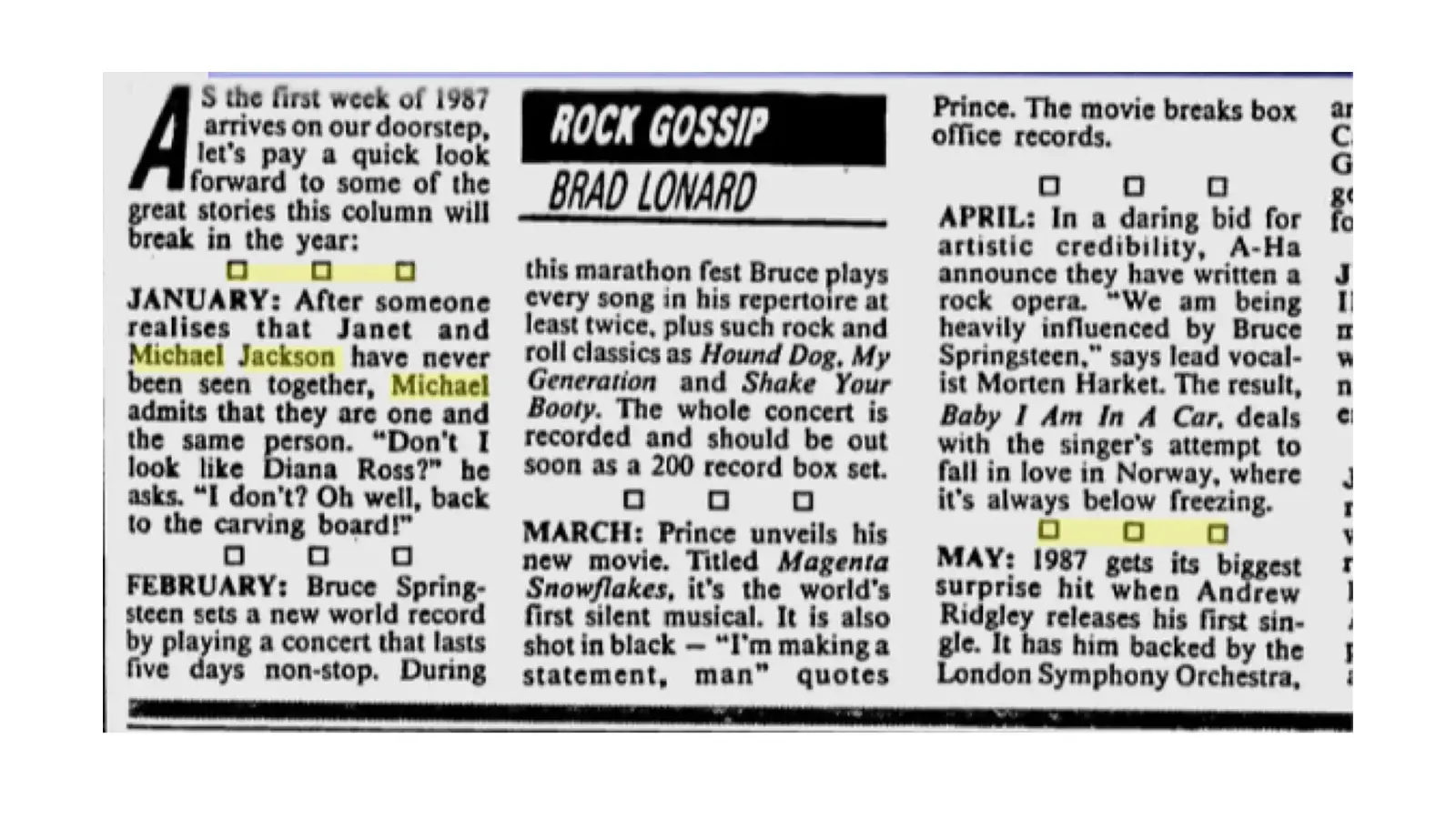
Photo: Google News Archive
Gossip columnist Brad Lonard of the Sydney Morning Herald published this “joke” disguised as a diss in 1987:
“After someone realizes that Janet and Michael Jackson have never been seen together, Michael admits that they are one and the same person. “Don’t I look like Diana Ross?” he asks. “I don’t?” Oh well, back to the carving board.”
Now, to be fair, this columnist sort of made disses to all of the artists on this list, but they were playful jokes that referenced their music. Guess who got the harsh personal joke that once again aimed at the notion of him “wanting to look like Diana Ross?” Michael Jackson. Just to put it in perspective, Jackson and his musical colleague Prince had similar appearances during this time period with the longer hair and “guyliner”/makeup, but only one of them (Jackson) got the joke of “wanting to be a woman.”
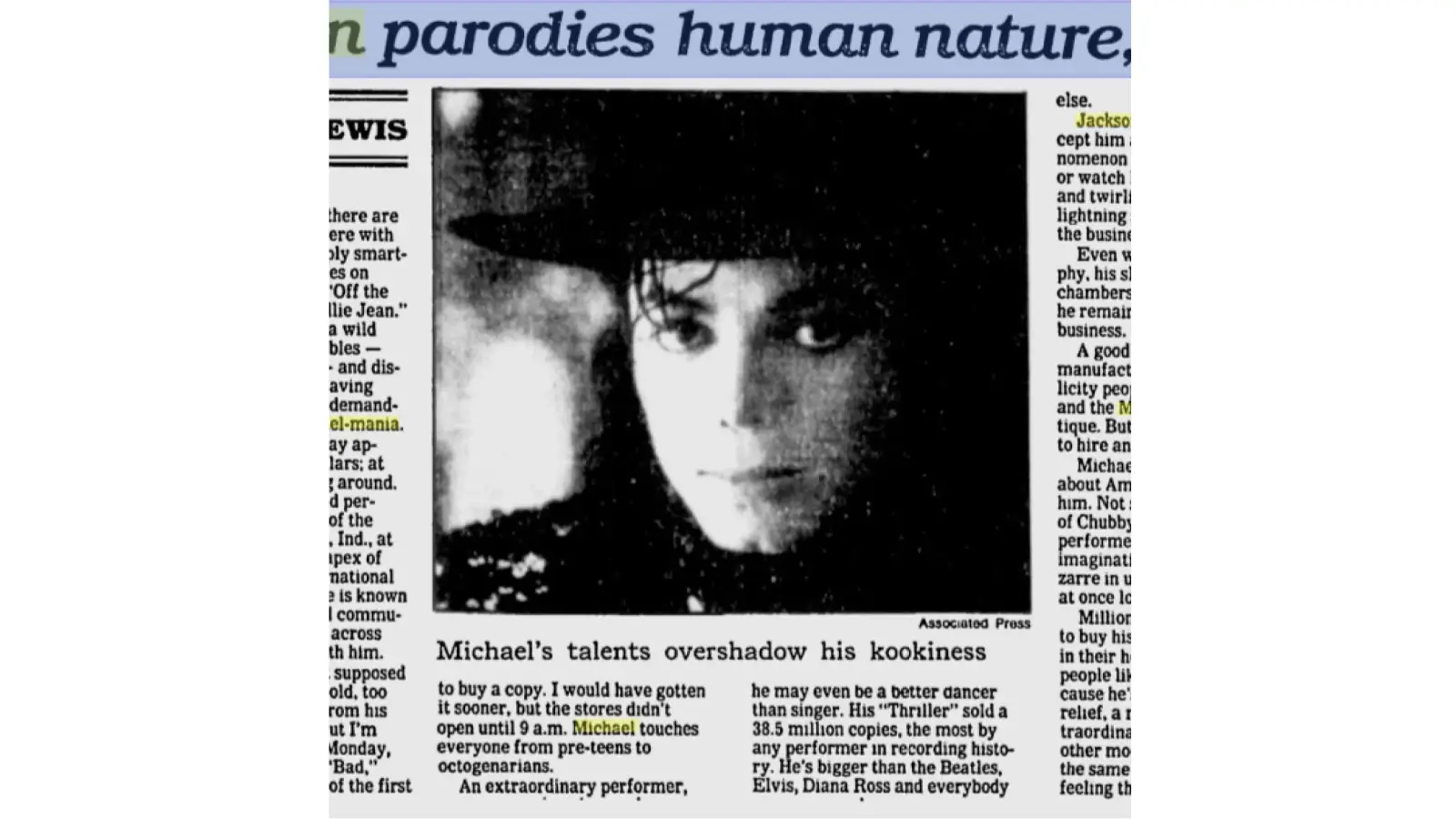
Photo: Google News Archive
While this 1987 article from The Pittsburgh Press, written by Claude Lewis, acknowledged Jackson’s musical talent and influence, they also made sure to put in there that “his talents overshadowed his kookiness.” The article further stated: “Even with his strange philosophy, his sleeping bags, oxygen chambers, and chiseled features, he remains the best in the business.”

Photo: Google News Archive
He legitimizes our greedy search for sensation, but protects by assuring us we won’t find anything too terrible. We look for scandal and discover none. I’m told he’s not addicted to drugs, has never displayed a penchant for violence; there have never been no significant skeletons. The meanest thing we can say about him is he’s odd, different or kooky. He is a study in contrast.
So, you see, Lewis admitted even in 1987 that they (the media) were looking for scandals even back then, but that they couldn’t find anything despite their digging. Not much was different with Jackson from 1987 to 1993, so what changed from the media’s perspective? Is it that they really believed he was capable of the allegations, or that they had been waiting for years for a major scandal to hit him because it meant more notoriety and money in their pockets? I think it was the latter, considering Lewis flat-out admitted they were on the hunt for any negative scandal they could use against him:

Photo: Google News Archive
From The Telegraph Herald in 1988…So Michael Jackson was one of the people who “put cosmetic surgery on the map,” but not any of the other public figures who’d had cosmetic work done way before him? They could have conducted their study without using Diller or Jackson’s name at all, but of course, that would have meant less attention on their part.
Additional Examples

Photo: Google News Archive
This July 1992 report from The Daily Sentinel chronicled Jackson’s lawsuit against The Daily Mirror, which claimed that he (Jackson) had been disfigured by plastic surgery. The article quotes the report as saying:
Jackson is a scarred phantom whose face is covered with scar tissues, with a hole in his nose, one cheek higher than the other and an oddly saggy chin.
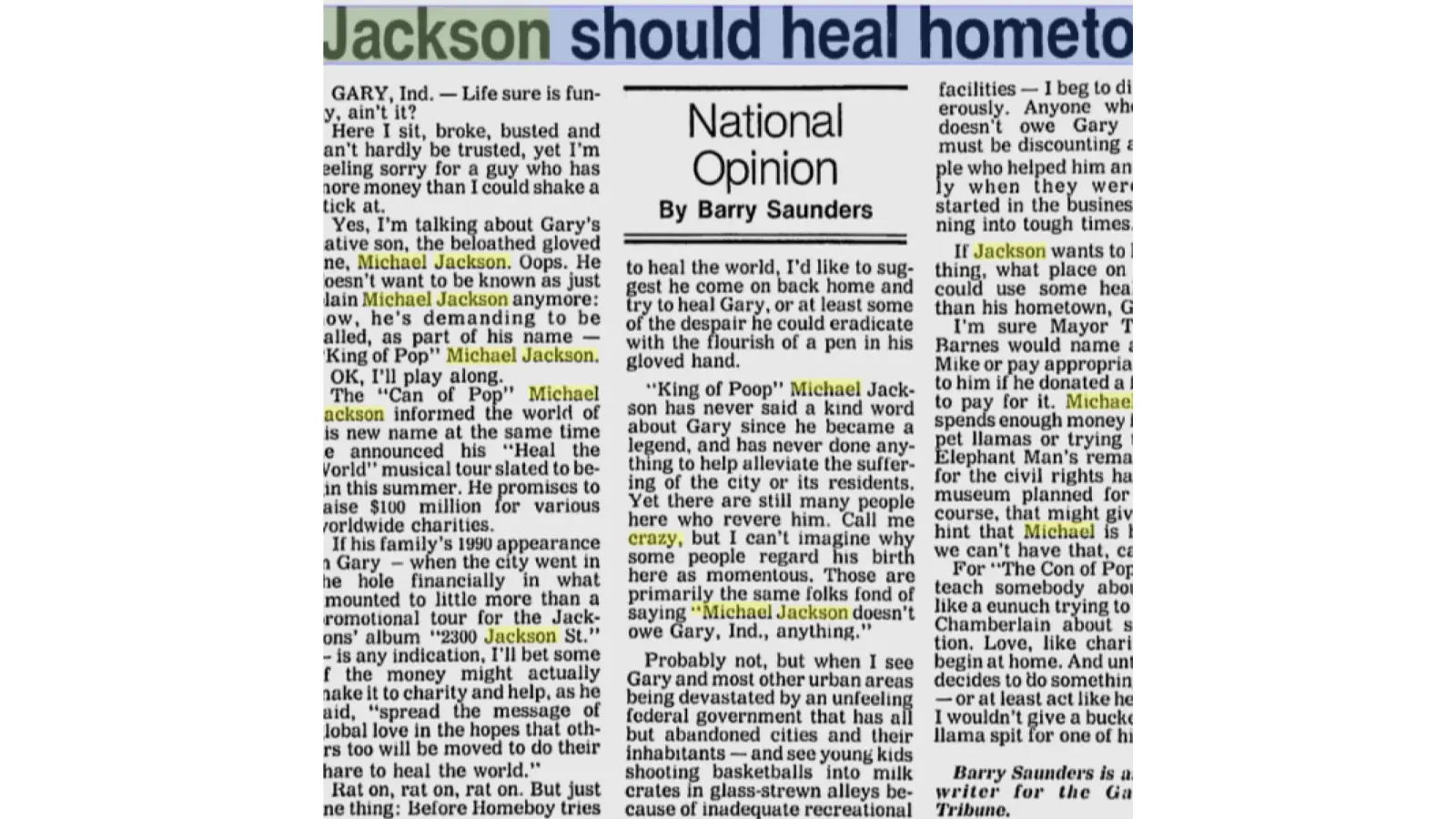
Photo: Google News Archives
And if it wasn’t any of the above, it was ridiculous pieces like this one written by Barry Saunders in February 1992, who couldn’t even hide his jealousy with the opening statement that he was “broke, busted and could hardly be trusted,” but somehow needed to “feel sorry for Jackson.” Uh…what did Saunders’ issues have to do with Michael Jackson or any of the Jacksons, for that matter? Perhaps if he’d been a more professional and skilled journalist (he calls Jackson the “King of Poop”), somebody might have been willing to pay him more.
And majority of Jackson’s charitable initiatives (which has become even more clear in the aftermath of his passing) were done privately as he didn’t believe in publicizing his work in that regard (Jackson cited the Bible for this stance) for a round of applause, so what made Saunders so sure that Jackson or his family members hadn’t “done anything for Gary” (which wasn’t their responsibility in the first place)? This article reeked of unprofessional jealousy…eew.
Ladies and gentlemen, I could keep going on because these types of articles were never-ending (and I’m only focusing on a specific period), and this doesn’t even count what was being said on television and the radio. For now, though, I will leave you with two quotes from Jackson himself about his treatment from the media:
1993 Grammy Awards
In the past months, I’ve gone from ‘Where is he?’ to ‘Here he is again,’ but I must confess, it feels good to be thought of as a person, not as a personality. Because I don’t read all the things written about me, I wasn’t aware that the world thought I was so weird and bizarre. But when you grow up as I did, in front of one hundred million people since the age of five, you’re automatically different. The last few weeks, I have been cleansing myself, and it’s been a rebirth for myself. It’s like a cleansing spirit.
Michael Jackson In 1995
People will believe anything about me…In fact, why not just tell people I’m an alien from Mars? Tell them I eat live chickens and that I do a voodoo dance at midnight. They’ll believe anything you say because you’re a reporter. But if I, Michael Jackson, were to say, ‘I’m an alien from Mars and eat live chickens and do a voodoo dance at midnight,’ people would say, ‘Oh, man, that Michael Jackson is nuts. He’s cracked up. You can’t believe a damn word that comes out of his mouth.’ People don’t know what it’s like for me. No one knows really. No one should judge what I’ve done in my life, not unless they’ve been in my shoes every horrible day and every sleepless night.
RELATED: Hell Freezing Over: How the Epstein Case Shifted the Conversation on Michael Jackson
Author Bio
Jael Rucker is the founder of Decked Out Magazine. She has previously worked as the Associate Commerce Editor at PureWow, focusing on analytics and trends to pitch stories and optimize articles that build and engage their audience. Her work has also been seen in Footwear News and WWD. Prior to 2024, she was the style and pop culture editor at ONE37pm for over three years, contributing numerous product reviews, brand profiles and fashion trend reports, which included interviewing Steph Curry, Snoop Dogg and more.


![[THE FILES] : Confessions of a Teenage Drama Queen (2004)](https://deckedoutmagazine.com/wp-content/uploads/2026/04/confessions_of_a_teenage_drama_queen_hero.webp)
![[THE FILES]: A Cinderella Story (2004)](https://deckedoutmagazine.com/wp-content/uploads/2026/04/a_cinderella_story_hero_image.png)