

May 20, 2026
Back in early April, Decked Out Magazine posed a question that sparked debate among our readers: Is “Who Is It” Michael Jackson’s greatest deep cut? Today, we return with another contender, one that trades the paranoid R&B of the Dangerous era for something some will say is far more desolate, far more confessional, and far more cinematic.
“Stranger in Moscow” is that song. And this time, we’re asking: Is it the King of Pop’s ultimate hidden masterpiece?
Table of Contents
The Song’s History & Release
Written by Michael Jackson in September 1993 while on the Dangerous World Tour in Moscow, “Stranger in Moscow” was born from a moment of profound loneliness. According to Jackson, he gets lonely while on tour, but Moscow was the worst case of this. At that time, Jackson was in the midst of the first round of child sexual abuse allegations, and the media scrutiny was relentless. Surrounded by fans and fame, he felt utterly alone.
The song was recorded in January 1994 at Neverland Ranch, The Hit Factory in New York City, and Sony Music Studios. It appears on his ninth studio album, HIStory: Past, Present and Future, Book I (1995), and was released as the album’s sixth and final single worldwide on November 4, 1996. In the United States, however, it wasn’t released until much later, on July 7, 1997.
Commercially, the song was a study in contrasts. It reached the top 10 in numerous countries worldwide, including Austria, the Czech Republic, Denmark, Hungary, Italy, New Zealand, Spain, Sweden, and the United Kingdom. In the UK, it peaked at No. 4. Yet on the US Billboard Hot 100, it stalled at No. 91, becoming Jackson’s lowest-charting song on that chart. It remains, for many, the most underrated single of his career.
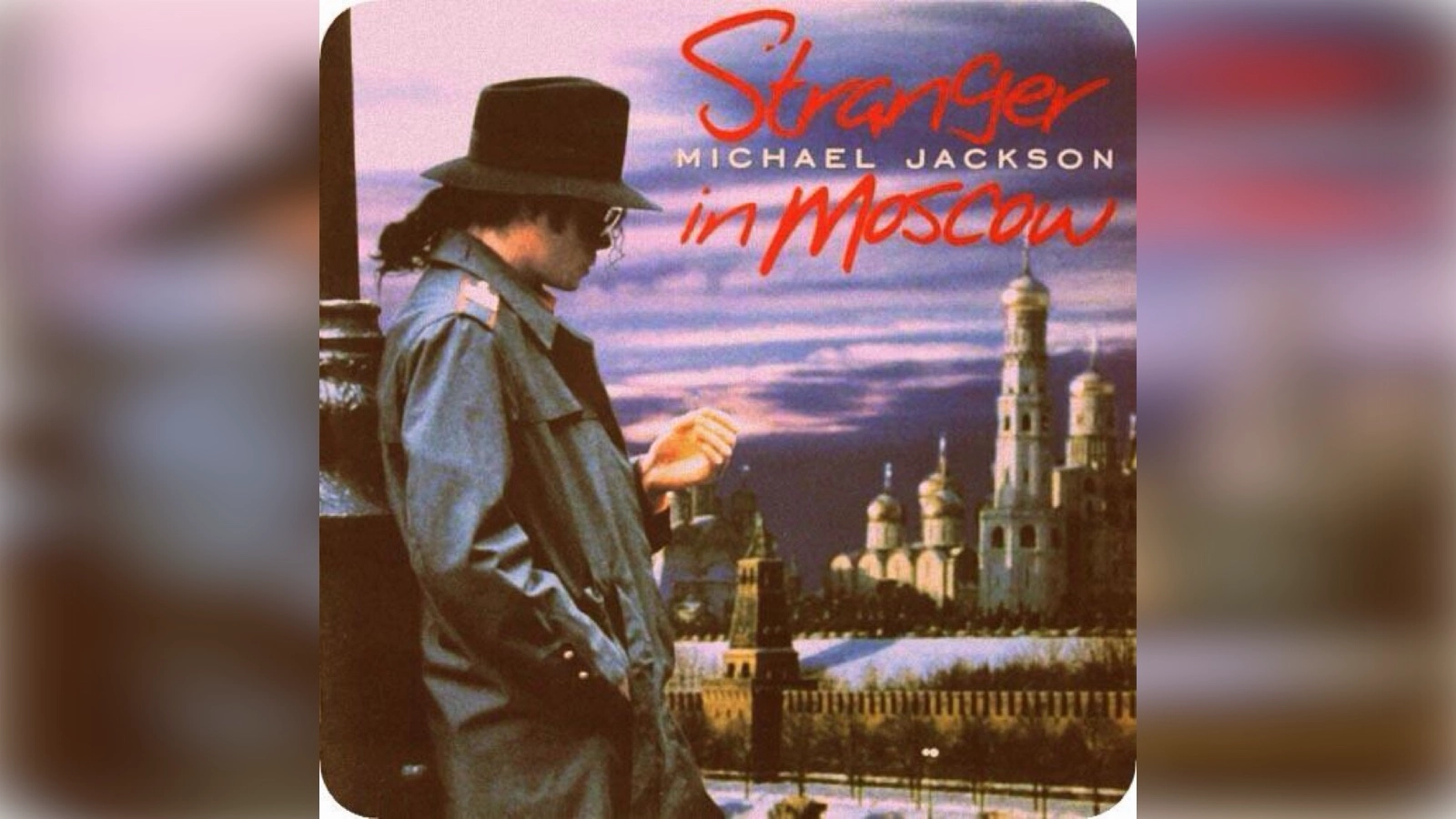
Michael Jackson stands in profile wearing a dark trench coat and hat against a moody Moscow skyline with onion‑domed architecture, under twilight skies, with the title ‘Stranger in Moscow’ above him for the song’s single cover.
The Sound of Isolation
“Stranger in Moscow” is not a typical Michael Jackson single. There are no funky basslines, no aggressive percussive hooks, no danceable grooves. Instead, Jackson crafted a downtempo, trip-hop-tinged R&B ballad that unfolds like a melancholy diary entry set to music. The track opens with the sound of rainfall, a pregnant pause, and then a slow, hypnotic beat that mirrors the feeling of aimless drifting. The tempo sits around 67 BPM, one of Jackson’s slowest tracks, yet it maintains a fluid rhythm through sampled beatboxing and ambient synths.
Lyrically, the song is sparse but devastating. Jackson’s voice doesn’t cry out; it aches in quiet agony. He sings of wandering in the rain, of a “swift and sudden fall from grace,” of being belittled by the Kremlin’s shadow and haunted by Stalin’s tomb. The chorus is a repeated, chant-like question: “How does it feel / when you’re alone and you’re cold inside?” It is a question that requires no answer because the feeling is the answer.
“Armageddon of the Brain”: A Lyric That Cuts Deep
Before the song reaches its breaking point, Jackson delivers one of the most arresting images in his entire catalog. In the second verse, after describing himself as “abandoned in my fame,” he sings: “Armageddon of the brain”. It is a phrase that feels almost surreal for a pop song, yet it perfectly captures the psychological toll of relentless public scrutiny. He then references the KGB (“KGB was doggin’ me”) — a metaphor for the media and authorities he rightly felt were hounding him.
But then, a glimmer of humanity appears: “Then a beggar boy called my name… Happy days will drown the pain.” In that brief moment, Jackson acknowledges the possibility of redemption through human connection, a small, fragile hope that makes the surrounding darkness all the more haunting.
The Climax: A Breakdown of Pure Agony
The song’s true emotional explosion arrives not in the verses or the chorus, but in the breakdown — when the instrumentation pulls back, and Jackson lets loose a torrent of raw, unfiltered anguish.
Here, he abandons melody for something closer to a desperate prayer. His voice cracks, strains, and repeats:
Like a stranger in Moscow
Lord, have mercy
Like a stranger in Moscow (Hee)
Lord, have mercy
We’re talkin’ danger
We’re talkin’ danger, baby
Like a stranger in Moscow
We’re talkin’ danger
We’re talkin’ danger, baby
Like a stranger in Moscow
I’m livin’ lonely
I’m livin’ lonely, baby
Stranger in Moscow
This is not a polished performance. It is a man crying out from the depths of isolation. The repeated calls for mercy, the staccato “Hee,” the acknowledgment of “danger” — all of it builds to a moment of catharsis that feels almost uncomfortable in its intimacy. This is the climax of the song, and it is arguably the most vulnerable moment Jackson ever committed to tape.
The Nick Brandt Music Video
Directed by Nick Brandt, who had previously worked with Jackson on the “Earth Song” music video, the short film for “Stranger in Moscow” is a black-and-white masterpiece of slow-motion cinematography. Filmed at an abandoned airport in Los Angeles, the video depicts six individuals, including Jackson, a waitress, a homeless man, and a businessman, each isolated and disconnected from the world around them. Jackson wanders through rain-soaked streets, seemingly invisible, while everything around him moves at a glacial pace. The video climaxes with a thunderstorm washing over Jackson, a symbol of both cleansing and despair. Decades after its release, the video remains one of Jackson’s most artistic and emotionally resonant works.
Why Stranger in Moscow Matters in 2026
Today, nearly 30 years after its release, “Stranger in Moscow” feels more relevant than ever. In an era defined by mental health awareness and emotional openness, the song offers a gentle space to feel understood. It speaks directly to those navigating depression, existential doubt, or the crushing weight of being “alone in a crowded room,” a feeling amplified by social media and digital overstimulation.
Moreover, as the world is still enjoying the biopic MICHAEL, in theaters now, a new generation is rediscovering Jackson’s catalog and finding in “Stranger in Moscow” a side of the artist rarely seen onstage: vulnerable, introspective, and painfully human. The official music video has quietly accumulated over 94.8 million YouTube views, a testament to its enduring power.
While “Who Is It” gave us a man unraveling in real time, “Stranger in Moscow” gives us a man who has already unraveled, and is trying to find his way back through the rain. It is not a song designed for radio or stadiums. It is a confessional for those who truly listen.
And that is precisely why it belongs in the conversation for Michael Jackson’s underrated song.
POLL
About the Author
Andrew Greene is a quality-obsessed, results-driven powerhouse with nearly two decades of experience transforming complexity into clear, actionable solutions. His secret weapon? A mix of analytical sharpness, problem-solving precision and a communication and leadership style that’s equal parts clarity and charisma. From Quality Assurance to political data analysis, you can think of him as the Swiss Army knife of operational excellence, minus the corkscrew (unless it’s a team celebration).