
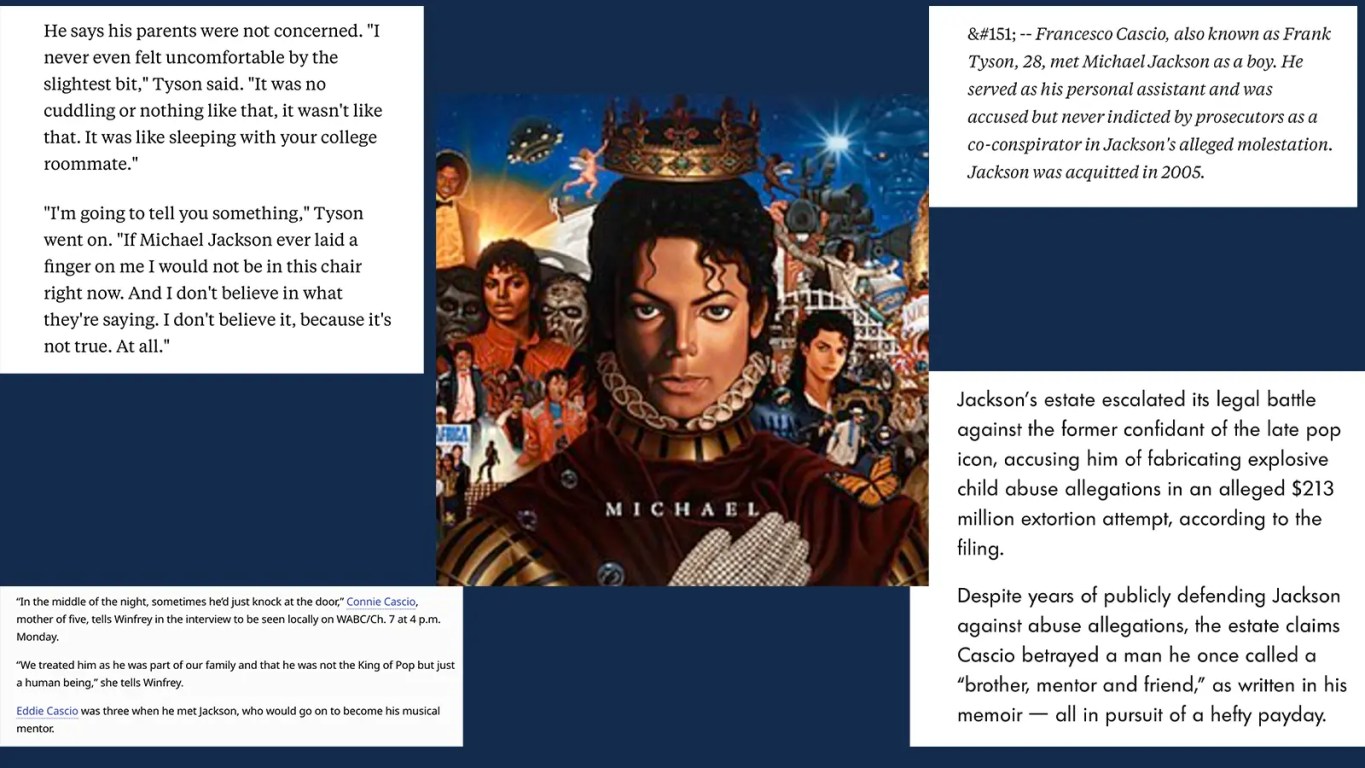
There are few relationships in the annals of pop culture more tragic, or more instructive, than the friendship between Michael Jackson and the Cascio family. For decades, they were presented as his “second family”: a sanctuary of normalcy in an otherwise chaotic existence, a New Jersey refuge where the King of Pop could simply be human. Frank Cascio was not just an employee or an assistant; he was a confidant, a brother figure, and, according to his own words in a 300-page tribute book, a protector of Michael’s legacy against what he called “liars” and “opportunists”.
But as new court documents filed on February 27, 2026, reveal, that legacy of loyalty has been traded for a federal complaint alleging sex trafficking, negligence, and fraud. It is a staggering reversal that forces us to ask a difficult question: When does a “shakedown,” as the Estate’s legal team calls it, become a betrayal not just of a man, but of historical fact?
Decked Out has reviewed the filings, the history, and the data. We have analyzed the 2020 contract, the 2026 lawsuit, and the decades of public statements that now hang in the balance. Here is the story of a family’s fall from grace, and the legal reckoning that awaits them.
Part I: The King Who Could Never Rest
To understand what this moment meant, you need to understand who Michael Jackson actually was. Not the tabloid version, not the punchline. The man who made a generation of kids moonwalk across kitchen floors. Who made grown men cry in stadiums on six continents. Whose death stopped traffic, literally, in cities that had nothing to do with America.
His achievements border on the mythological. Thriller remains the best-selling album of all time, a record that has held for over four decades against every shift the music industry has thrown at it. He made music videos into cinematic events, breaking racial barriers on MTV and forcing a segregated industry to reckon with itself in real-time. “Billie Jean,” “Beat It,” “Man in the Mirror” – these were anthems that pulled audiences of every background into the same room, united under the spell of pure performance.
Years after his passing, children born long after his death still practice the moonwalk in their living rooms. His estate continues to generate hundreds of millions of dollars annually, proof that genius doesn’t have an expiry date. As dancer Jeffrey Daniel, who taught Jackson the move that would become his signature, once put it: “His record speaks for itself.“
But Michael Jackson’s life was also a study in paradox, a tragedy of trust in a world that did not deserve his openness. The man who preached unity in “Black or White” and healed the world in song was himself a target: of tabloid scrutiny, of opportunistic lawsuits, and of a system that often seemed intent on tearing down what it could not understand. Throughout the 1993 allegations, a tape surfaced of Evan Chandler, the father of the first accuser, bragging that he would “destroy” Jackson and that Jackson’s “career will be over.” Chandler’s words were prophetic, but they also revealed a grim truth: Jackson was not just an artist; he was a walking ATM for those who saw his kindness as a vulnerability and his fortune as a prize.
That target has never been removed. Even in death, the man cannot rest.
Michael Jackson gave the world his art. He gave his trust to people like the Cascios. And in return, even from the grave, he is handed another subpoena. The allegations have been litigated, investigated, and rejected. The FBI files yielded nothing. The jury acquitted on all counts in 2005. And still, the lawsuits come, each one a fresh wound on a legacy that should be celebrated, not litigated.
Part II: The Decades of Defense: A Paper Trail of Truth
Before we analyze the current legal battle, we must establish the historical record. The Cascios did not just know Michael Jackson; they defended him with a ferocity that was well-documented across decades of media appearances.
For over thirty years, the Cascio siblings were among Jackson’s most passionate defenders. In 2005, during the peak of the trial that would ultimately exonerate him, Frank Cascio (using the name Frank Tyson) sat for an interview with CourtTV. While the jury deliberated, ultimately acquitting Jackson on all charges, Frank made a statement that should serve as the cornerstone of this entire saga:
I wouldn’t be here if I thought that man was a pedophile.
That wasn’t a soundbite taken out of context. It wasn’t a carefully worded legal statement. It was the raw conviction of a man who claimed to know the real Michael Jackson and was willing to stake his reputation on it.
In 2011, Frank doubled down with a 300-plus-page tribute, My Friend Michael: An Ordinary Friendship with an Extraordinary Man, dedicated “To Michael, my teacher, thank you for being a father, a brother, a mentor, and a friend.” He wrote with “absolute conviction” that he saw nothing in Jackson’s interactions with children that raised any red flags. He called the allegations “bullshit” and dismissed the accusers as “liars” after the singer’s money.
The family’s defense extended to the Oprah Winfrey Show, where multiple Cascio siblings sat on national television in 2010 and, when asked directly if there were any improprieties, resoundingly answered in unison: “Never.” They told Oprah and her audience that they decided to speak out because they “wanted to show the world who Michael really was.” Connie Cascio, the matriarch, described Jackson as “part of our family” and said they “treated him as he was not the King of Pop but just a human being.”
The same man who wrote a book defending Michael is now alleging that Michael groomed and abused him. The family that invited Oprah into their home to show home videos of Christmas with Jackson now asks a federal court to believe that those same holidays were scenes of predation.
Part III: The Fake Songs and the First Breach of Trust
To understand the current litigation, one must look back to 2010, just a year after Jackson’s death. The Estate released the posthumous album Michael, which included three tracks credited to Eddie Cascio and James Porte: “Breaking News,” “Keep Your Head Up,” and “Monster.”
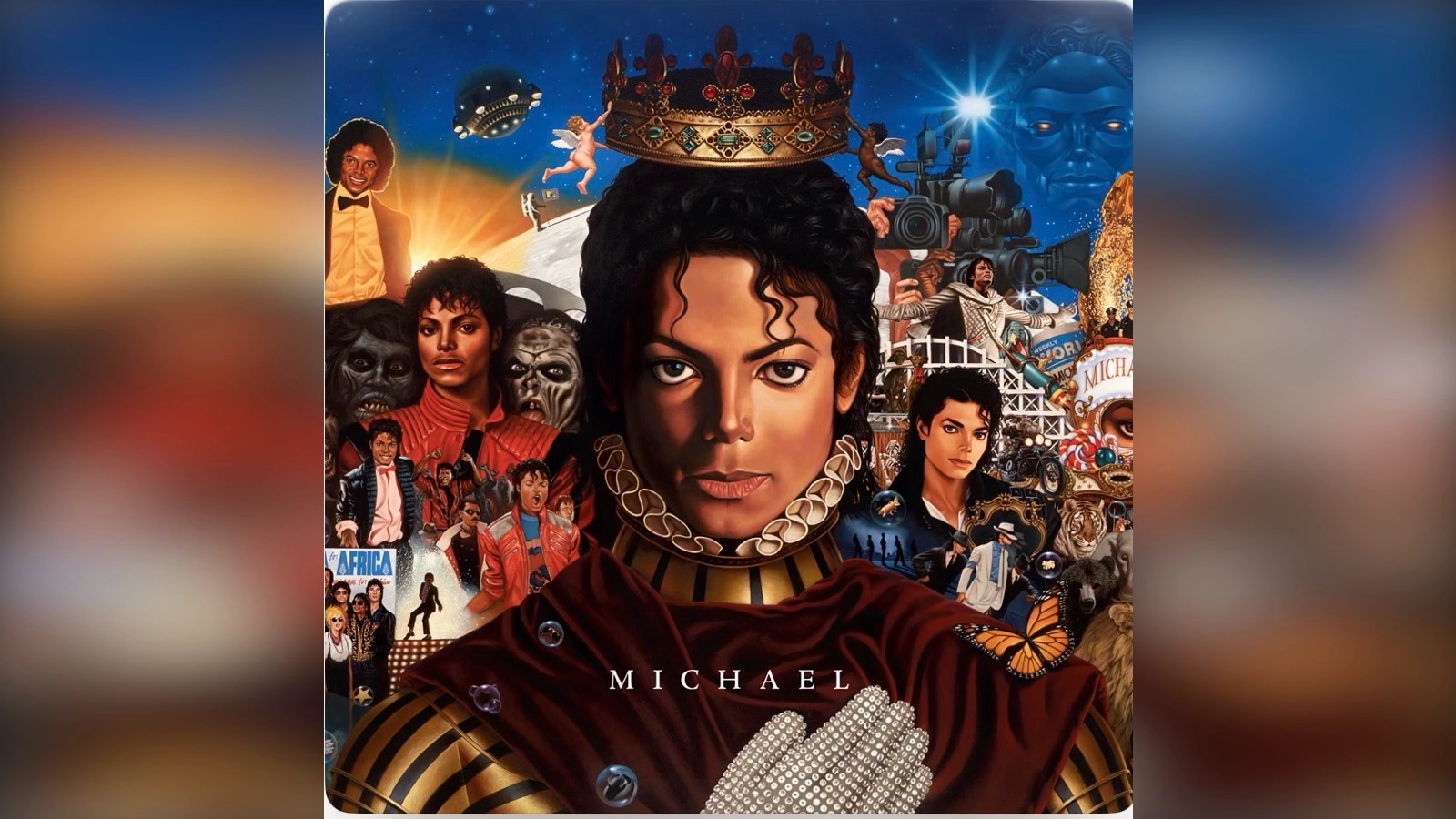
Photo Credit: Album cover of “Michael” (2010) by Michael Jackson. Released by Epic Records and the Estate of Michael Jackson. This image is used for editorial commentary only. All rights reserved by the copyright holder.
Immediately, fans and forensic audio experts cried foul. The voice wasn’t right. It didn’t move the way Michael moved, the distinctive vocal fingerprints, the breath control, the emotional timbre that made Jackson unmistakable were simply absent.
Australian journalist Damien Shields, then 22 years old, spent the next 14 years investigating what he calls “the biggest fraud in music history.”. His podcast, Faking Michael, makes a methodical case that Eddie Cascio and James Porte faked the vocals using an imposter singer named Jason Malachi and hoodwinked Jackson’s estate and longtime label Sony Music . The stakes were enormous: in 2010, the estate made a deal potentially worth $250 million with Sony for 10 albums, including new and unreleased material.
The evidence is damning. When superproducer Teddy Riley and Jackson’s nephew Taryll began postproduction on the tracks in August 2010, Taryll concluded his late uncle’s vocals weren’t on the songs and complained on social media . The estate asked producers for their expert opinions but allegedly ignored their feedback and released the tracks anyway in December 2010. Another one of Jackson’s nephews, Taj Jackson, even made a post to X (Formally and best known as Twitter) Recently calling out the fake songs:
The fallout was severe. Fans filed a class-action suit against the estate and Sony, which settled in an undisclosed agreement in 2022 . Sony later pulled the three disputed tracks from the album entirely, an extraordinary admission that something had gone terribly wrong.
Perhaps most telling is the story of two British fans, James Marks and James McCormick, so enraged by the fake tracks that they accessed Sony’s cloud server in 2011 to download all 12 Cascio-Porte songs and prove they were fraudulent. They were arrested by the National Crime Agency, their homes raided, facing trial for computer misuse, while, as they later claimed, the true fraudsters remained untouched. As one fan theory holds, the arrests may have been an effort to silence those exposing the truth about the Cascio tracks.
The Cascios pushed these tracks as authentic on Oprah. Eddie Cascio sat on national television and declared:
I can tell you that it is Michael’s voice. He recorded right there in my basement.
Jackson’s longtime producer Teddy Riley, appearing alongside him, agreed, though he would later be caught in the crossfire of the controversy.
While the family’s current suit paints them as victims of Jackson’s “grooming,” the historical data suggests a pattern: first fake vocals, now legal filings. The truth, as always, has a paper trail.
Part IV: The 2020 Agreement: A Reluctant Deal to Preserve a Legacy
Fast forward to 2019. HBO releases Leaving Neverland, reigniting public debate and subjecting Jackson’s legacy to another round of trial by media. The film was later totally discredited as hundreds of inaccuracies and falsehoods were uncovered and has since been removed from all of HBO Max’s platforms. According to the Estate’s petition to compel arbitration (filed July 8, 2025), the Cascios saw an opportunity.
The Estate’s legal team alleges that rather than continue defending their friend, the Cascios threatened to “repudiate their prior support” and concoct false allegations unless they were paid . According to court documents, a meeting was arranged at the Sunset Marquis Hotel, where the Cascio representatives insisted on meeting at the swimming pool wearing only bathing suits so that Estate representatives could not wear a wire to record the conversation . Only someone engaging in extortion or other unlawful conduct would be worried about their conversation being recorded. A truthful person asserting legitimate legal claims should have no objection to being documented.
The Estate, faced with protecting Michael’s children from further trauma and safeguarding a legacy worth billions, did what any fiduciary would do: they sought to make the problem go away. In 2020, they entered into a “Confidential Acquisition and Consulting Agreement.”
This was a business decision to purchase “life rights” and prevent a public spectacle, not an admission of guilt. The document, which Decked Out has analysed, includes comprehensive releases of any and all past claims, strict confidentiality, and a mandatory arbitration clause. Crucially, it includes a waiver of California Civil Code Section 1542, the provision that protects claimants from unknowingly releasing unknown claims. This means the Cascios explicitly waived the right to later sue for claims they didn’t know about at the time.
In exchange for these concessions, the Cascios were paid. And for five years, they stayed silent.
Part V: The $213 Million Demand and the Extortion Allegation
According to the Estate’s filings, the silence didn’t last. After receiving payments for five years, the Cascios, through their legal team, demanded an additional $213 million.
The timeline tells its own story. In July 2024, Frank Cascio’s then-attorney sent an ominous email: “We expect a substantive response by end of day tomorrow. Otherwise, we will be forced to expand the ‘circle of knowledge, so my team can prepare a complaint.” The email included a rhetorical inquiry about whether “the materiality of this claim has been revealed by the estate to the buyer of the catalogue,” a reference to the recent sale of a stake in Jackson’s music catalog.
When the $213 million demand didn’t materialize, the ask dropped to $44 million . Only when those demands were refused did the abuse allegations suddenly become a federal case in February 2026.
The Estate’s legal team, led by Martin D. Singer, has called this a “civil extortion scheme” . And the pattern is indeed troubling: decades of public defense, followed by a paid settlement, followed by a massive monetary demand, followed by a lawsuit. If the Estate can prove that the abuse claims were only leveraged after the monetary demand was made, and that the demand preceded the filing, the criminal nature of the allegations against the Cascios could unravel their entire case.
Frank Cascio, through his new attorney Mark Geragos, claims he felt “immense pressure” to sign the 2020 agreement and that his dyslexia prevented him from understanding its terms. But as the Estate points out, Geragos himself has a long history of defending Jackson, once declaring on Good Morning America that “there’s nothing sexual going on” and that Jackson was “absolutely 100 percent innocent”.
Part VI: The 2026 Lawsuit: A Breach of Contract and a Test of Facts
Now, we arrive at the present. On February 27, 2026, the Cascio siblings filed a complaint in the U.S. District Court alleging claims ranging from sex trafficking of children to negligence, fraud, and breach of contract. The filing names John Branca, John McClain, and multiple Jackson entities as defendants, alleging they enabled and covered up decades of abuse.
The complaint is detailed and graphic. It alleges that Jackson groomed the children with gifts and travel, plied them with drugs and alcohol, and isolated them from responsible adults. It claims that Jackson’s employees and advisors facilitated the abuse by booking hotel rooms near Jackson’s, procuring pornography, and installing security systems to prevent discovery.
But here is where the facts get murky for the plaintiffs.
The Estate’s legal team has already secured a tentative ruling from the judge indicating that the dispute will likely be forced into arbitration. Why? Because the 2020 contract explicitly states that any dispute “arising out of or relating to this Agreement… shall be determined by binding arbitration.”
By filing in a public court, the Cascios are arguably in breach of Paragraph 20 of their own agreement, which states that filing a public lawsuit “shall constitute a breach of this Agreement, and the confidentiality provisions thereof, and shall entitle the non-breaching Party to all damages, including attorneys’ fees expended in compelling arbitration.”
The contract goes further still, including this language: “Without limiting the foregoing, the question of arbitrability is itself a question to be resolved finally by the arbitrator and not by a court.” Even the question of whether the case belongs in court must be decided in arbitration.
During a January 2026 hearing, attorney Marty Singer told the court that the Cascios agreed to the 2020 deal and later renegotiated for “significantly more money upfront.” He argued that the family is now attempting to pursue a public lawsuit that would breach the confidentiality and arbitration clauses.
Mark Geragos, representing the Cascios, objected passionately, telling the court the tentative ruling was “wrong on the law and wrong on the trend in the legislature.” He argued that California law now favors allowing sexual abuse claims to proceed publicly, and that the 2020 agreement was signed under duress.
Outside the courthouse, one of the Cascio brothers appeared visibly emotional. Geragos told reporters: “They wanted to see for themselves the position that the estate has been taking, which is basically to call them liars.”
Howard King, another attorney for the Cascios, claimed to possess “10 hours of sworn testimony, on video and audio, of all five family members talking about the horrific abuse, in detail.” He alleged that the estate sought to suppress that material: “If they succeed in muzzling this, it’ll never come out.”
Part VII: Are They in Breach? A Legal Analysis
Based on the documents provided and the court’s tentative ruling, the Cascios face an uphill battle regarding the 2020 contract. Let’s break down the legal arguments.
First, the Release is Extremely Broad. Paragraph 4 of the Agreement releases the Estate from “any and all claims… known or unknown, suspected or unsuspected” from the beginning of time until the execution of the agreement. The Cascios also waived California Civil Code Section 1542, which ordinarily protects claimants from unknowingly releasing unknown claims. This waiver is specific, explicit, and likely enforceable.
Second, Arbitration is Mandatory and Self-Executing. The contract is ironclad on this point. Paragraph 20 requires arbitration for “any dispute, claim or controversy arising out of or relating to this Agreement or the breach, termination, enforcement, interpretation or validity thereof.” This language is deliberately broad—it covers not just contract disputes, but any claim “relating to” the agreement. The abuse allegations, whatever their merit, clearly “relate to” the agreement because the agreement was the vehicle for settling those very claims.
Third, the “Arbitrability” Clause. Perhaps most importantly, the contract states that “the question of arbitrability is itself a question to be resolved finally by the arbitrator and not by a court.” This means that even if the Cascios argue their claims aren’t covered by the arbitration clause, that argument must be heard by an arbitrator, not a judge. The California Court of Appeal has already ruled against the Cascios on this precise issue, upholding the arbitrator’s authority to decide arbitrability.
Fourth, the Extortion Counter-Claim. The Estate has filed for civil extortion based on the $213 million demand. If the Estate can prove that the abuse claims were only raised after the monetary demand was made, and that the demand preceded any public allegation, the criminal nature of the allegations against the Cascios could provide the Estate with significant leverage.
Fifth, the Public Policy Argument. Geragos has argued that California law now favors allowing sexual abuse claims to proceed publicly, and that NDAs designed to silence abuse survivors are unenforceable. This is a legitimate legal argument, and it may resonate with some judges. However, the Cascios face a significant hurdle: they accepted money, signed a release, and stayed silent for five years. Courts are generally reluctant to allow parties to unwind settled contracts years later, even in sensitive cases.
Part VIII: The Tragedy of the Truth
For Decked Out Magazine, this is both a legal story and a cultural one. The story of a system, and in this case, a family, trying to rewrite history.
Frank Cascio wrote that Michael “was being attacked by liars.” He has now become one of those attackers. The family that once told Oprah “Never” now tells the court “Always.” The book that was supposed to set the record straight now sits as Exhibit A in a case about whether the author can be believed.
The truth has a home at Decked Out. And the truth is that Michael Jackson, a man acquitted by the justice system and scrutinized by the world, cannot defend himself from the dead. But the paper trail can. The decades of interviews can. The book he inspired can.
The Estate is not the villain here. They are the guardians of a legacy, fighting off a $213 million shakedown dressed up as a trauma narrative. They are protecting Michael’s children from having to relive their father’s trials in public court. They are enforcing a contract that the Cascios willingly signed.
If the Cascios succeed in voiding the 2020 contract, they will have proven that in the modern era, loyalty is just a line item, and the truth is whatever the highest bidder pays for it.
But if the Estate prevails, if the case is forced into arbitration, if the extortion claim holds up, if the paper trail speaks louder than the press conference, then perhaps there is still room for justice. Perhaps Michael Jackson, even in death, can finally rest.
The Legal Scorecard: Where Things Stand
As of this writing, the judge has issued a tentative ruling indicating that the case will be forced into arbitration . A final hearing is scheduled for March 2026, with oral arguments expected to address whether the arbitration clause is enforceable.
The Cascio Arguments:
· The 2020 agreement was signed under duress and without independent counsel
· Frank Cascio’s dyslexia prevented him from understanding the terms
· California public policy favors allowing sexual abuse claims to proceed publicly
· The estate breached the confidentiality clause first by speaking to the press
The Estate Arguments:
· The 2020 agreement is a valid, enforceable contract with specific waivers
· The Cascios accepted money and stayed silent for five years
· The $213 million demand preceding the lawsuit constitutes extortion
· The contract explicitly requires arbitration for all disputes
The next hearing is set for March 5, 2026, regarding sealing of documents . Decked Out will continue to monitor this case as it develops.
Correction Clause: Decked Out is committed to accuracy. As new court documents and rulings emerge in this case, we will update our reporting accordingly. If you find a factual error, please email jaelrucker@deckedoutmagazine.com or andrewgreene@deckedoutmagazine.com for an immediate audit and correction.
Author Bio
This article was reported and written collectively by the Decked Out Editorial Team.
Jael Rucker is the founder of Decked Out Magazine. She has previously worked as the Associate Commerce Editor at PureWow, focusing on analytics and trends to pitch stories and optimize articles that build and engage their audience. Her work has also been seen in Footwear News and WWD. Prior to 2024, she was the style and pop culture editor at ONE37pm for over three years, contributing numerous product reviews, brand profiles and fashion trend reports, which included interviewing Steph Curry, Snoop Dogg and more.
Andrew Greene is a quality-obsessed, results-driven powerhouse with nearly two decades of experience transforming complexity into clear, actionable solutions. His secret weapon? A mix of analytical sharpness, problem-solving precision and a communication and leadership style that’s equal parts clarity and charisma. From Quality Assurance to political data analysis, you can think of him as the Swiss Army knife of operational excellence, minus the corkscrew (unless it’s a team celebration).
As a freelance journalist, Ryan Smith’s work is driven by a commitment to restoring what has long been absent from institutions meant to uphold truth and accountability: honesty and transparency. Alongside his analysis works on the life, career, trials and tribulations of Michael Jackson, whose unfair treatment over the years paved the way for the path he is on, Smith also dissects and examines popular culture, such as books, movies and video games, always aiming to shed light on what’s beneath the surface.
An das Autorenteam, herzlich Dank für Eure tolle Recherche. Bin sehr gespannt auf neue Infos
i’m definitely going to be following. I want to know what happens, but from my understanding it’d be very rare that a judge will change their mind after a tentative ruling.
I hope the estate lawyers point out the fact that they have previously entered into and signed contracts with Frank, his siblings, and in-laws (fake songs) without incident. Franks ‘dyslexia’ also didn’t impair his ability to read and understand the contracts he signed for his book deal or with the various auction houses he’s done business with since 2009. Isn’t it odd how pressure and intimidation weren’t ever factors for them until the estate finally said ‘no’?
An excellent article about a serious display of betrayal from a family who exploited Michael Jackson’s generosity and kindness and name when he was alive and even more so when he passed away. People should check out the podcast Faking Michael; it is a crucial piece of document on that subject and on the members of that family.