By Jael Rucker: Published: January 4, 2026
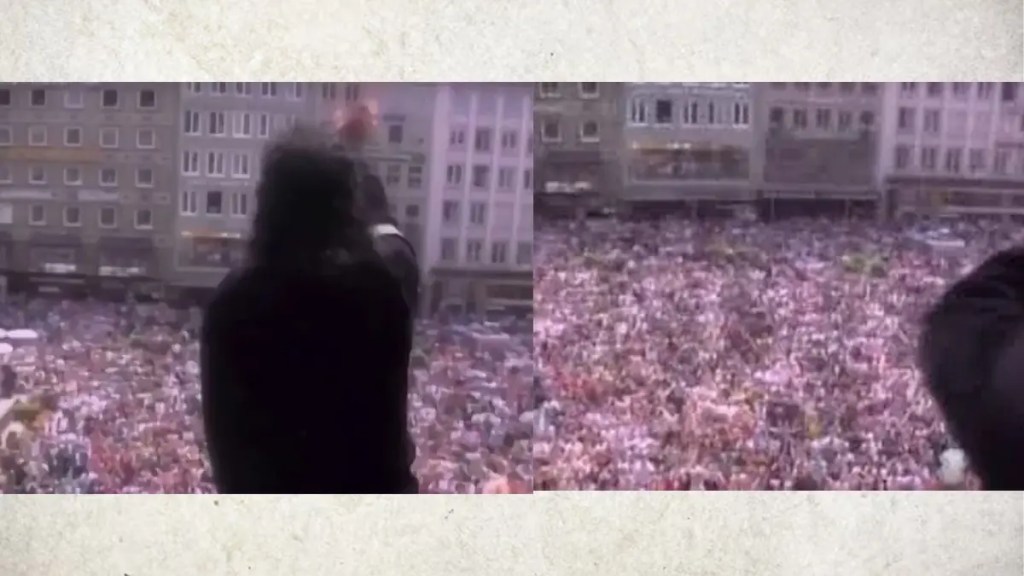
Photo: Freepik, Michael Jackson Personal Archives
FORENSIC UPDATE [Jan 2026]: As we approach the 2026 ‘Michael’ biopic, the conversation surrounding Jackson’s lifestyle is being viewed through a new, more empathetic lens. However, the forensic data remains absolute: Michael Jackson did not simply experience “fame”; he experienced a total loss of public autonomy. While modern celebrities navigate digital mobs, Jackson navigated physical ones that fundamentally altered his environment. It is imperative to understand that Neverland and his search for privacy weren’t “eccentricities”—they were forensic necessities for a man who could no longer walk a city street without being mobbed with crowds larger than some current artist’s concerts.
We’ve already covered the origin of the tabloid narrative, which means we’re now going to take a look at Michael Jackson’s transition into becoming the most famous man on Earth and the challenges that level of fame presented. The first half of this article will focus on Jackson’s pre-Thriller years, where he was famous but still able to have some degree of normality in terms of being able to go certain places without being heavily mobbed by the media and general public.
The second half of this article will hone in on Jackson’s ascension to achieving the title of the most famous person in the world from Thriller on. Over the decades, many people have held unfounded opinions about how Jackson chose to live certain aspects of his life (such as building Neverland). Aside from the fact that it was never the general public and media’s place to do so since they didn’t even know Jackson and hadn’t even come close to stepping in his shoes, let alone walking in them; what many have failed to understand is the true magnitude of Michael Jackson’s fame, and what it would be like to have to navigate that.
Because nobody had ever reached that level of fame before, there was no “blueprint” or prior example for Jackson to follow…he was quite literally the first and only in this regard. Not only that, but when your life experiences such a dramatic shift, you are simply left with no other choice than to try find what is going to be your new normal.
Let’s take a deeper look.
Pre-Thriller fame

Photo: Google News Archive
While most are aware of The Jackson 5’s instant success, what many don’t know is that their fame reached what the media defined as the second coming of “Beatlemania.” Dubbed “J5 mania,” this era was a glimpse into what Jackson would have to deal with fame-wise in the future. Take their May 1970 show at the Philadelphia Civic Center, for example—the group had to be escorted to and from their hotel by Philadelphia police as there was a crowd of nearly 4,000 people stationed outside. This October 1970 issue of the Schenectady Gazette (pictured above) details some more of what the J5 had to deal with. In it, the report stated that the brothers would have to wear dark sunglasses and big hats to avoid being recognized. That report also confirmed the Jacksons had already been forced into changing their number twice since moving, and that Mrs. Jackson was being frequently called by worrisome fans in regards to rumors they would hear about one of her sons being sick or harmed.
The following month, an article from The Morning Record newspaper reported that The Jackson 5 had been involved in multiple incidents in which they had been mobbed at airports, had their shirts ripped off by screaming fans and had been forced into ending shows early due to being bum rushed on stage.
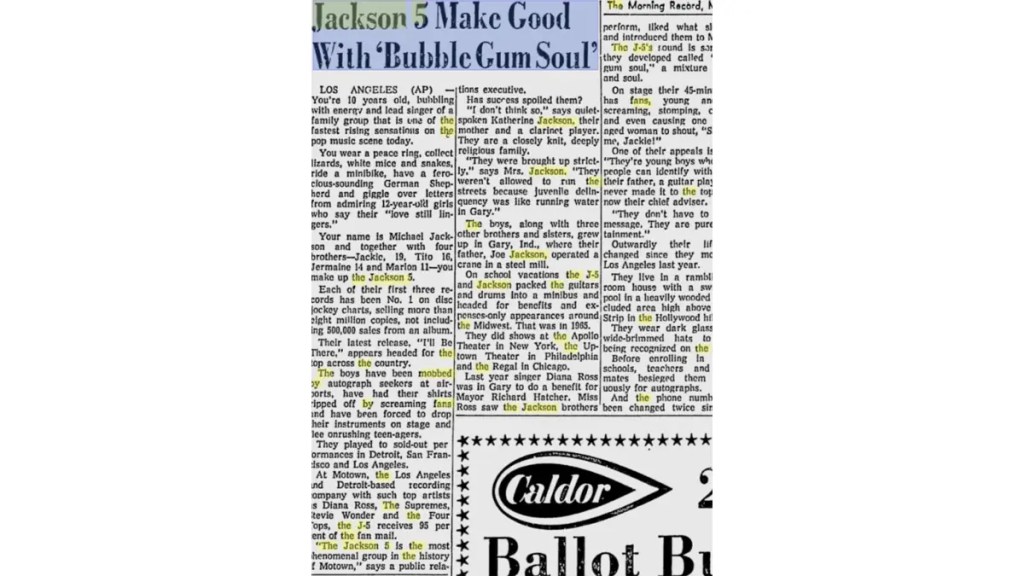
Photo: Google News Archive
In an interview with Gold Magazine in 2002, Jackson talked more about this period, stating:
“We didn’t have school, we had private school when we were touring. I didn’t go to a state school. We tried it for two weeks and it didn’t work. It was very difficult. It’s hard growing up a celebrity child. Very few make that transition from child star to adult star. It’s very difficult. I relate to Shirley Temple. I met her in San Francisco and I sat at her table and I cried so bad. She said, ‘What’s wrong Michael?’ I said, ‘I love you. I need to be around you more.’ She goes, ‘You’re one of us, aren’t you?’ and I said ‘Yes, I am.’ Somebody else said, ‘What do you mean?’ and she said, ‘Michael knows what I mean.’ And I know exactly what she meant — to have been there as a child star and to have graduated to have succeeded in making that transition to fame as an adult is very difficult.“
Mid-1970s and early 1980s
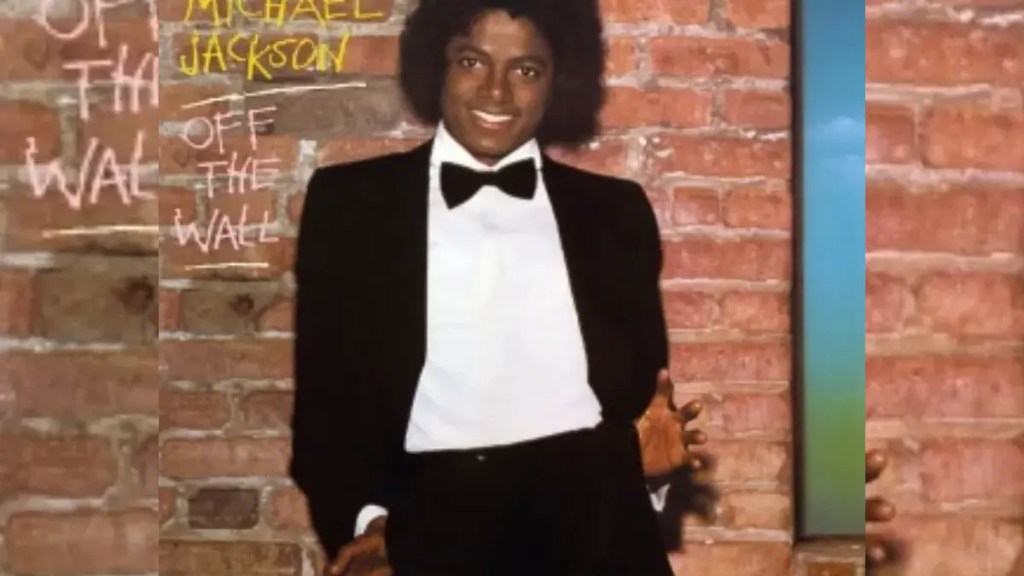
Photo: Epic Records
By the mid-to-late 1970s, Jackson was already growing frustrated with the restrictive elements of his fame. In her 1991 book My Family, The Jacksons, his mother, Mrs. Jackson, reflected:
“Michael, at 18, was upset by all the fame. He was temperamental. And when Michael had a crisis, you wouldn’t want to be around him. I’m tired of this. I’m so tired of all the crowd that touches me and my brothers! They have no respect for us!“
Of course, this level of fame would only increase upon Jackson releasing his first adult solo album, Off the Wall, in 1979. Sometime around 1981, editor David Hart chronicled the loneliness Jackson’s fame was causing him.

Photo: Google News Archive
The report stated:
“He talks about sitting in his room in the big Jackson family home in L.A. crying sometimes because he’s so lonely. He says that, if he gets too lonely, he’ll walk around his neighborhood looking for somebody to talk to. But he lives in a fancy residential area where people don’t walk around at night. He never runs into anybody when he’s out walking at night, but walking does make him feel better.“
Note that this was before Thriller, so if this is what he was dealing with prior, imagine the struggles that came once he eventually became the most famous man in the world…
Thriller and beyond
To say Jackson achieved an otherworldly level of fame starting from the Thriller era onward would be a massive understatement. While Jackson would speak about his fame on many occasions, a 1983 interview with Rolling Stone details that transitional point.
“Diana Ross marched bravely into a Manhattan shoe store with her three daughters and had them fitted for running shoes, despite the crowd of 200 that convened on the sidewalk. Michael, who’s been a boy in a bubble since the age of reason, would find that intolerable. He will go to only one L.A. restaurant, a health-food place where the owners know him. As for shopping, Michael avoids it by having a secretary or aide pick out clothes for him. ‘You don’t get peace in a shop. If they don’t know your name, they know your voice. And you can’t hide.‘”
“Being mobbed hurts. You feel like you’re spaghetti among thousands of hands. They’re just ripping you and pulling your hair. And you feel that any moment you’re gonna just break.“
The publication continued:
“Thus Michael must travel with the veiled secrecy of a pasha’s prized daughter. Any tourism is attempted from behind shades, tinted limo glass and a bodyguard’s somber serge. Even in a hotel room, he hears females squeal and scurry like so many mice in the walls.“
At this point, we can’t tell you without showing you, so allow us to give you something comparable to a visual presentation.
Disguises
Jackson would frequently try to wear disguises to avoid being recognized. However, most of the time they did not work (as indicated by the Righting History video above).
Hotel Mobs
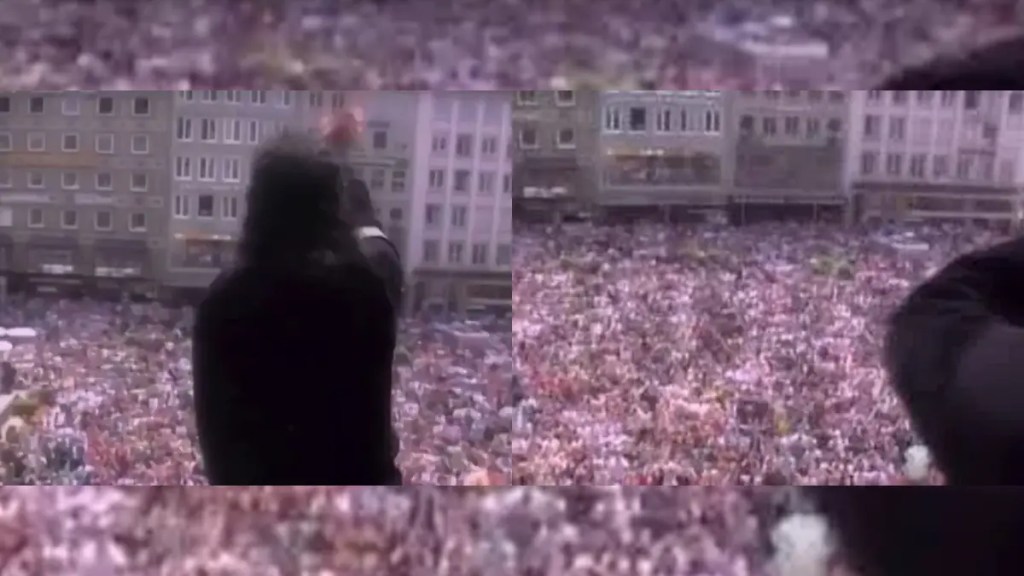
Photo: From Michael Jackson’s Personal Camera Archives
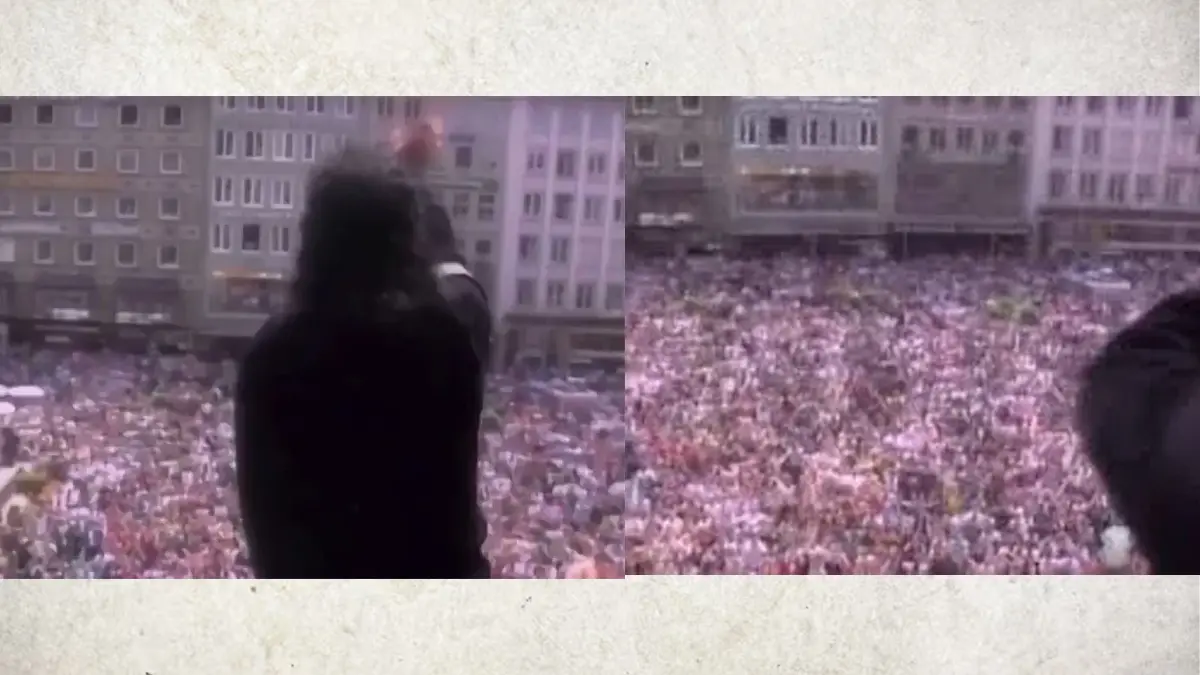
These were captured outside of Jackson’s hotel room. And this wasn’t a one-off event either, it happened with just about every hotel he stayed at, regardless of where he was in the world. There are plenty of videos documenting these hotel crowds through the decades, and during Jackson’s interview with Martin Bashir (don’t worry, we’ll be getting to him down the road), you can see multiple incidents of his hotels being swarmed and traffic literally being stopped because of him.
Traffic Backup
This is an example of what traffic would be like when Michael Jackson came to town.
Michael Jackson Trying to Do…Anything
The above video is an example of what it would be like when Jackson would try to do, well…anything “normal” such as going shopping, to the movies or an amusement park.
And that’s not even the beginning (seriously). Furthermore, Jackson would rarely ever get privacy as he was photographed the entire time he was out and about.
In the video above, you can see where the paparazzi taped him and his kids the whole time they were in the store. In the aftermath of his passing, several of Jackson’s bodyguards have detailed the amount of planning and work it would take just to get him from point A to point B. The only way this could be avoided was if Jackson had a place shut down or went before/after operating hours (and even then, that didn’t always work).
Knowing the above information, we’re now going to focus on two criticisms of Jackson that I think were completely ridiculous—the so-called complaints about his Neverland Ranch, and the decision for his children to wear masks when out in public with him.
I’m going to detail Neverland more in the future, but for now, let’s look at what the media has had to say about Jackson’s home—something the majority probably never got the chance to see in person or talk to Jackson about directly. This September 1993 article by the Lakeland Ledger is one of many that insinuated Neverland was “weird”:
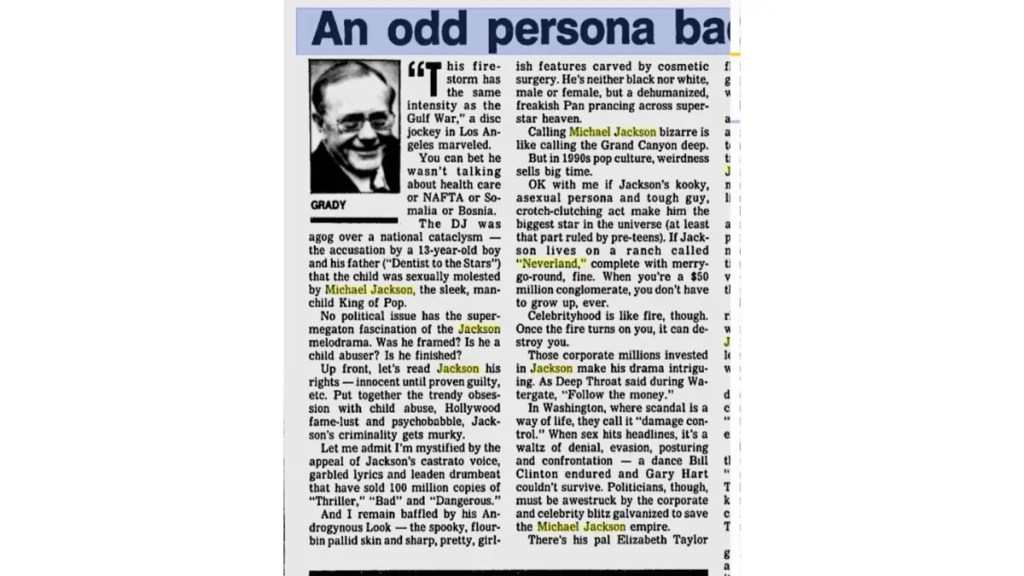
Photo: Google News Archives
As you can see, there were many disgusting things said in this article, but I’m focusing on the jab taken at Michael for having a merry-go-round. Well, Grady (and those that think like him), what exactly are you supposed to do when you can’t go to places like the amusement park, zoo and movie theaters without being mobbed and hounded every. single. time. Look at the many fully grown adults who visit Disney every year who don’t have children. Are they weird? I went to Magic Kingdom by myself while on a work trip in Orlando a few years ago because nobody else wanted to go with me. Am I weird? The only thing that separated Michael Jackson and the general public was that they could do these things freely, and he could not.
You, too, would probably find a way to bring the things you enjoy to you if they were stripped away completely because you had become so famous that you couldn’t do anything.
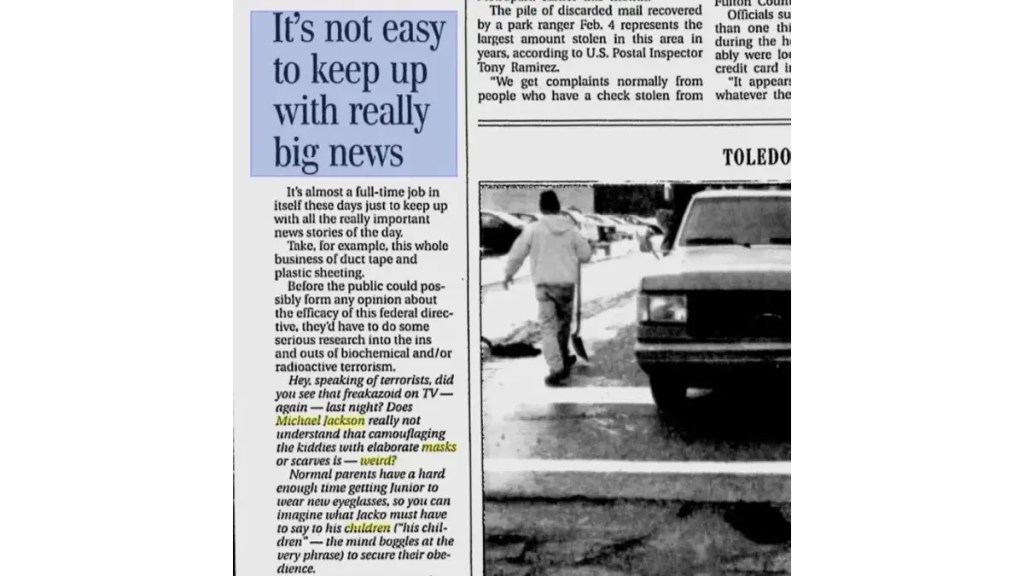
As for his children wearing masks, who was anybody to criticize a decision a parent chose to make in regards to their children’s safety (or any decision for that matter)? Here’s an example of said criticism coming from the Toledo Times in February 2003:
The Toledo Times
“Hey, speaking of terrorists, did you see that freakazoid on TV again last night? Does Michael Jackson really not understand that camouflaging the kiddies with elaborate masks or scarves is—weird?“
Those were the exact words of the editor, whom I might add, compared Jackson to a terrorist. To whoever wrote this (and whoever thinks like him), Michael Jackson didn’t owe you or anybody else a damn explanation over his parenting decisions. That said, Jackson explained why he chose to have his kids wear masks on multiple occasions—it was so that they wouldn’t be recognized whenever they weren’t with him, which in turn allowed them to enjoy hanging out with friends, going to the park, etc., without being hounded when he wasn’t there—things Jackson himself did not get to do as either a child or adult.
What was so hard to understand about that, and why hasn’t anybody apologized to Michael Jackson, as his children have since spoken about their difficulties in terms of dealing with the media and paparazzi, both as children and now adults? Looking at how well-rounded, polite and courteous his kids are, I’d say he did a darn good job of raising them during the time he had with them and that the “concerns” from strangers were unfounded.
Up Next
[The MJ Archive: The Pepsi Incident — The Forensic Origin of a Medical Crisis]
In our next deep dive, we move from the external prison of fame to the moment Michael Jackson’s physical reality changed forever. We’re performing a forensic analysis of the 1984 Pepsi burn—not just as an accident, but as the medical catalyst for the transformation the world would spend the next two decades misinterpreting.
Read the current analysis on the 2026 Biopic’s visual authenticity: 👉 Forensic Authenticity: How Jaafar Jackson is Reconstructing the MJ Blueprint
Author Bio
Jael Rucker is the founder of Decked Out Magazine. She has previously worked as the Associate Commerce Editor at PureWow, focusing on analytics and trends to pitch stories and optimize articles that build and engage their audience. Her work has also been seen in Footwear News and WWD. Prior to 2024, she was the style and pop culture editor at ONE37pm for over three years, contributing numerous product reviews, brand profiles and fashion trend reports, which included interviewing Steph Curry, Snoop Dogg and more.
![[THE FILES] 285 : Minority Report (2002)](https://deckedoutmagazine.com/wp-content/uploads/2026/06/tom_cruise_minority_report_history_hero.webp)

![[THE FILES] 284 : Ashley Tisdale – He Said She Said (2007)](https://deckedoutmagazine.com/wp-content/uploads/2026/06/ashley_tisdale_he_said_she_said_history_hero.webp)