Midnight Club II (2003)
Commercial & Technical Breakthrough Milestones
Commercial Performance
Multi-Million Unit Platinum Seller
Earned Sony PlayStation 2 “Greatest Hits” status and established Rockstar’s dominant street racing franchise.
Pioneering Online Multiplayer
8-Player Network Racing Telemetry
Pioneered early broadband online racing modes across open-world city grids.
Developer / Publisher
Rockstar San Diego / Rockstar Games
Locations
Los Angeles, Paris, Tokyo
Soundtrack Artists
Thomas Bangalter (Daft Punk), Felix Da Housecat, Underground Techno & Hip-Hop
Genre
Open World / Arcade Racing / Street Racing
**History & Overview**
Launching to sixth-generation consoles in April 2003, Midnight Club II stands as a hyper-kinetic milestone in open-world street racing media. Developed by Rockstar San Diego—the entity formed following Rockstar Games’ acquisition of Angel Studios—and published under the main Rockstar Games banner, the title aggressively commercialized the raw subculture of illicit midnight street racing across three sprawling metropolitan sandboxes: Los Angeles, Paris, and Tokyo. Bypassing licensed real-world vehicular constraints, the game engineered a physics-defying arcade handling blueprint emphasizing high-velocity weaving, vertical jumps, and zero-compromise speed.
**Gameplay & Design Mechanics**
- Motorcycle Integration Debut: Introduced high-speed motorcycles alongside street-tuned tuner cars and supercars, allowing players to weight-shift and slipstream through heavy city traffic.
- Unrestricted Checkpoint Navigation: Bypassed traditional circuit walls to give racers complete freedom across open city environments, rewarding shortcut discovery and spatial awareness.
- Elite Electronic Audio Payload: Featured an iconic soundtrack anchored by dark techno, progressive trance, and underground hip-hop featuring Thomas Bangalter (Daft Punk), Felix Da Housecat, and legendary electronic registries.
**Cultural & Gaming Legacy**
- Benchmark for Open-World Racing Design: Set the technical blueprint for open-city environment streaming and aggressive AI behavior that heavily influenced subsequent open-world racing franchises.
- Definitive Y2K Nightlife Time Capsule: Captures the late-night tuner culture and industrial electronic music aesthetic of the early 2000s.
**The Decked Out Review**
“Relentless, brutal, and brilliantly soundtracked, Midnight Club II remains an unmined masterpiece of sixth-generation arcade racing physics.”
Developer / Publisher Rockstar San Diego / Rockstar Games
Platforms PlayStation 2, Xbox, Microsoft Windows
Release Date April 9, 2003
Genre Arcade Racing / Open World
The Trailer
A Still from the Game
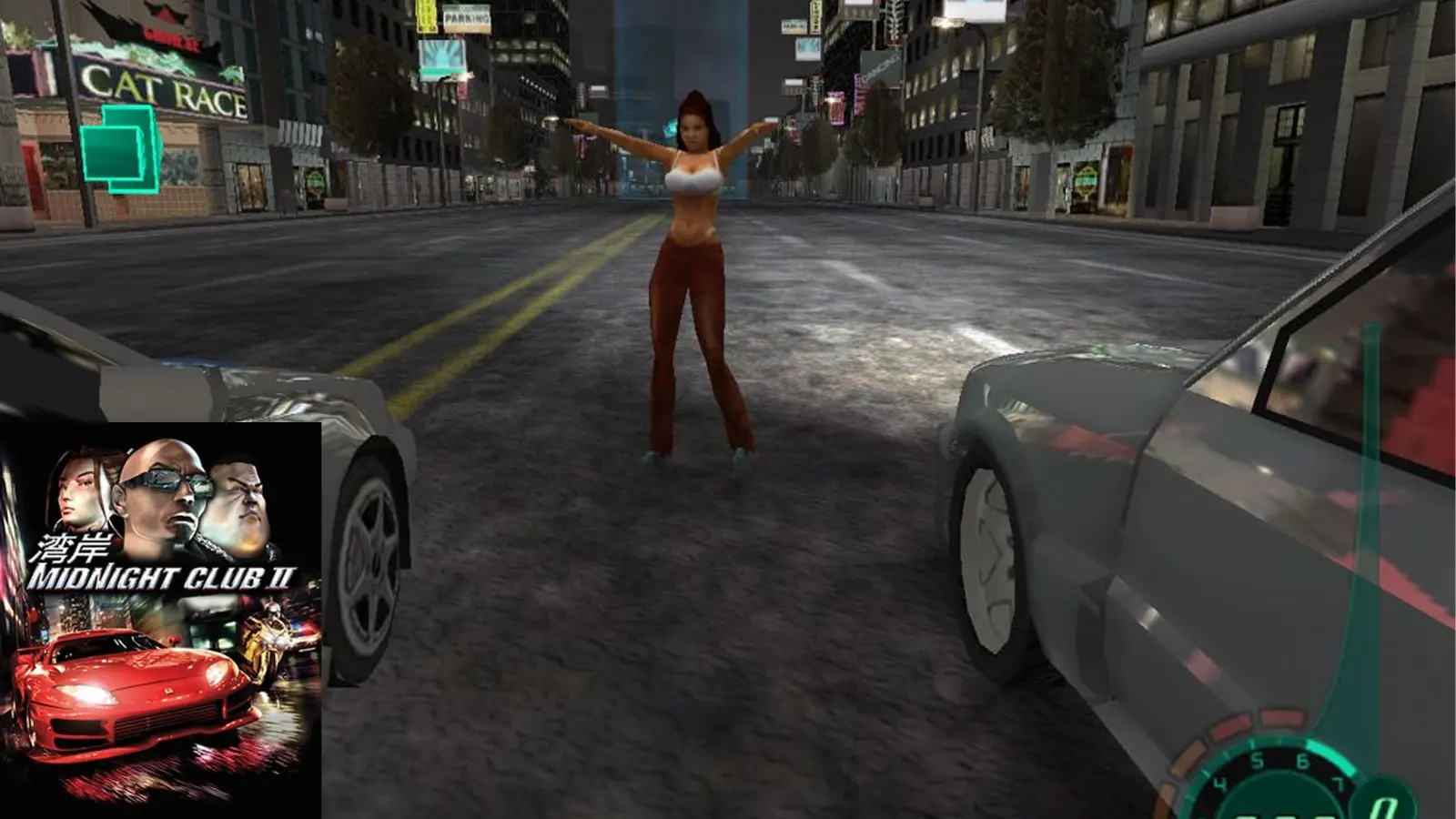
Photo: Rockstar Games