

SPOILER ALERT: We don’t pull punches in our audits. Full plot details for Scream 7 follow. To preserve the mystery, bookmark this page and return after you’ve seen the film.
In 1996, Wes Craven and Kevin Williamson looked at a genre choking on itself and turned the problem into the point. They made the audience complicit. They built a film that understood horror not as something that happens on screen but as something the viewer actively participates in, their own genre literacy weaponised against them. The original Scream was never really about Ghostface. It was about the psychology of consumption. About what watching violence does to the people who watch it.
Any assessment of Scream 7 takes place in a context that cannot be washed away. Melissa Barrera was fired from the franchise after sharing social media posts about Gaza, posts that Spyglass deemed antisemitic. The internet did what the internet does, of course. Sides were taken, campaigns were launched, and the film became a referendum before a frame had been seen. Those arguments have been relitigated elsewhere to the point of exhaustion. This is not the place to revisit them, though they will undoubtedly appear. What will be focused on is examining the $500,000 worth of emergency rewrites that followed, because that money, and the chaos it represents, did not stay outside the cinema door. It is in the film. It is in the seams.
RELATED: The Quotation Mark Adaptation: Why Fennell’s ‘Wuthering Heights’ is More Fan-Fic Than Brontë
Table of Contents
The Prescott Protocol: Neve Campbell’s Definitive Return
The franchise’s co-creator, Kevin Williamson, takes the director’s chair for the first time on a Scream film, inheriting thirty years of diminishing returns on his own idea. What he’s made reaches toward structural complicity in its own diagnosis, and the conversation around Scream 7 will probably prevent it from being properly reckoned with. On its own terms first. Neve Campbell’s return as Sidney Prescott is not nostalgia bait (or the last desperate act to keep the franchise afloat). Sidney has always been the franchise’s moral centre, the figure whose psychological reality grounds the carnage in consequence, and her absence from Scream VI left that film floating.
She plays a woman who has buried thirty years of horror beneath a facade of normal life. Campbell does not ask for your sympathy. She shows you the weight and lets you draw your own conclusions as the carnage catches up to her once again.
A Deep Dive
The kills are the most brutally committed in the franchise. Scream 7 has stopped apologising for what it is. It has also stopped being funny. The meta-humour that gave previous entries their warmth is largely gone, and with it a very specific deal between the film and its audience. They were in on the joke. Previous Screams made you complicit through wit. This one makes you complicit through coldness. You don’t laugh your way into the trap. You drift into it. What replaces the warmth is distance. A cold you can’t quite locate. Some of these kills stay with you even when the face doesn’t. The villain is the strangest Sidney has ever faced. No history between them. No reason for any of this beyond an obsession she never knew existed. And the film starts doing to its own characters what it argues the culture does to real people. They stop being people. They become things that happened.
Williamson is making a film about disconnection disguised as connection. The ingredients are all there: the parasocial obsession, the ideology that curdles in isolation, the AI that industrialises a pathology older than the technology itself. The AI is not a subplot that misfires, even if it doesn’t fully land. The ambition is correct even where the execution falters. The film uses deepfakes to resurrect Sidney’s dead, weaponising her grief against her with her own history. The idea that the people you’ve lost can be reconstructed and deployed by someone who never knew them is the franchise’s most disturbing escalation yet. The execution doesn’t always match the concept, but the concept is the right one. However, it’s worth noting that the film also uses those same familiar faces to lure back audiences who miss them: a hollow gesture if there ever was one — digital ghosts brought back to destroy the protagonist and to draw in cash, sitting oddly and detachedly well with everything else the film is doing.
How It Compares to Its Predecessors
The commentary beats are less sharp than in previous entries, not because Williamson has lost the thread, but because commentary is no longer the register in which the film operates. Williamson said as much himself: this one is about family. The meta has stepped back because Sidney’s relationship with her daughter Tatum is the emotional architecture, and the impersonal parading as personal surrounding it serves that purpose.
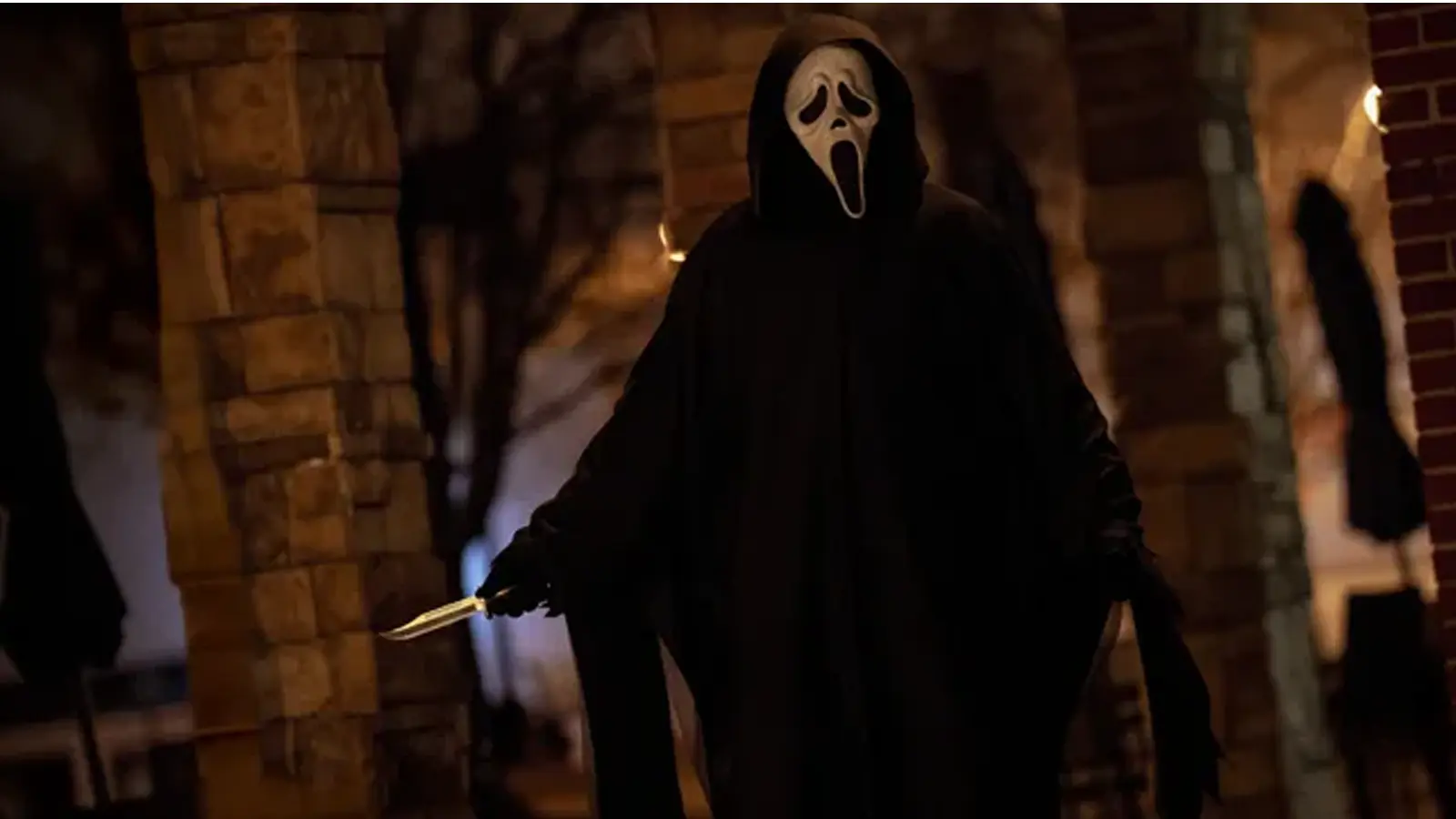
Photo: Paramount Pictures
The film’s central argument is that we live in an age where people who barely know you can construct devastatingly intimate weapons from the publicly available wreckage of your life. That your grief, your trauma, your history, the private architecture of everything that has ever hurt you, is now data. Accessible, processable, and deployable by anyone with sufficient obsession to gather it. What Williamson has constructed is a portrait of what happens when ideology consumes a human being in the absence of a genuine human connection. The killer begins from a place of authentic suffering. They conclude, consumed by media that would feel coherent to anyone who had no one left to tell them otherwise. They act on those conclusions with absolute conviction. Their logic is, in the most uncomfortable sense, comprehensible. They never knew the target: Sidney. They just knew enough. In 2026, that’s enough.
The revelation of who is behind the mask is the cherry on top of an icy-cold cake that hurts your teeth. A stranger with no claim on Sidney beyond obsession and data is exactly what you have been feeling throughout. The film doesn’t warm up to deliver its thesis. It stays cold because that is the thesis. The disorientation you feel after the unmasking is not a failure of recognition. It is the correct recognition: you never knew this person either. You were watching the way they were watching. Detached. Processing. A spectator to your own complicity.
The Re-Write
The film is genuinely a mess in places, and not always a productive one. A $500,000 rewrite was required after the film lost its entire protagonist structure when Barrera and Jenna Ortega departed. Some scenes lose the thread. Some beats don’t survive what the production went through. But that’s a different problem from the coldness, which the film has worked for. Underneath the mess is something genuinely ambitious. A film that knows it cannot move forward without the past, and cannot escape the past long enough to move forward. Williamson knows the franchise cannot survive without its mythology. He also knows that dependence on mythology is precisely the pathology his film is diagnosing.
The resulting tension between what the film needs to be commercially and what it argues intellectually gives Scream 7 a melancholy that no previous entry in the series has carried. It feels like a film in mourning for what the franchise has lost, for a cultural moment in which the audience’s capacity actually to receive a complex idea has been so comprehensively compromised by the very conditions the film is critiquing that engagement feels almost structurally impossible.
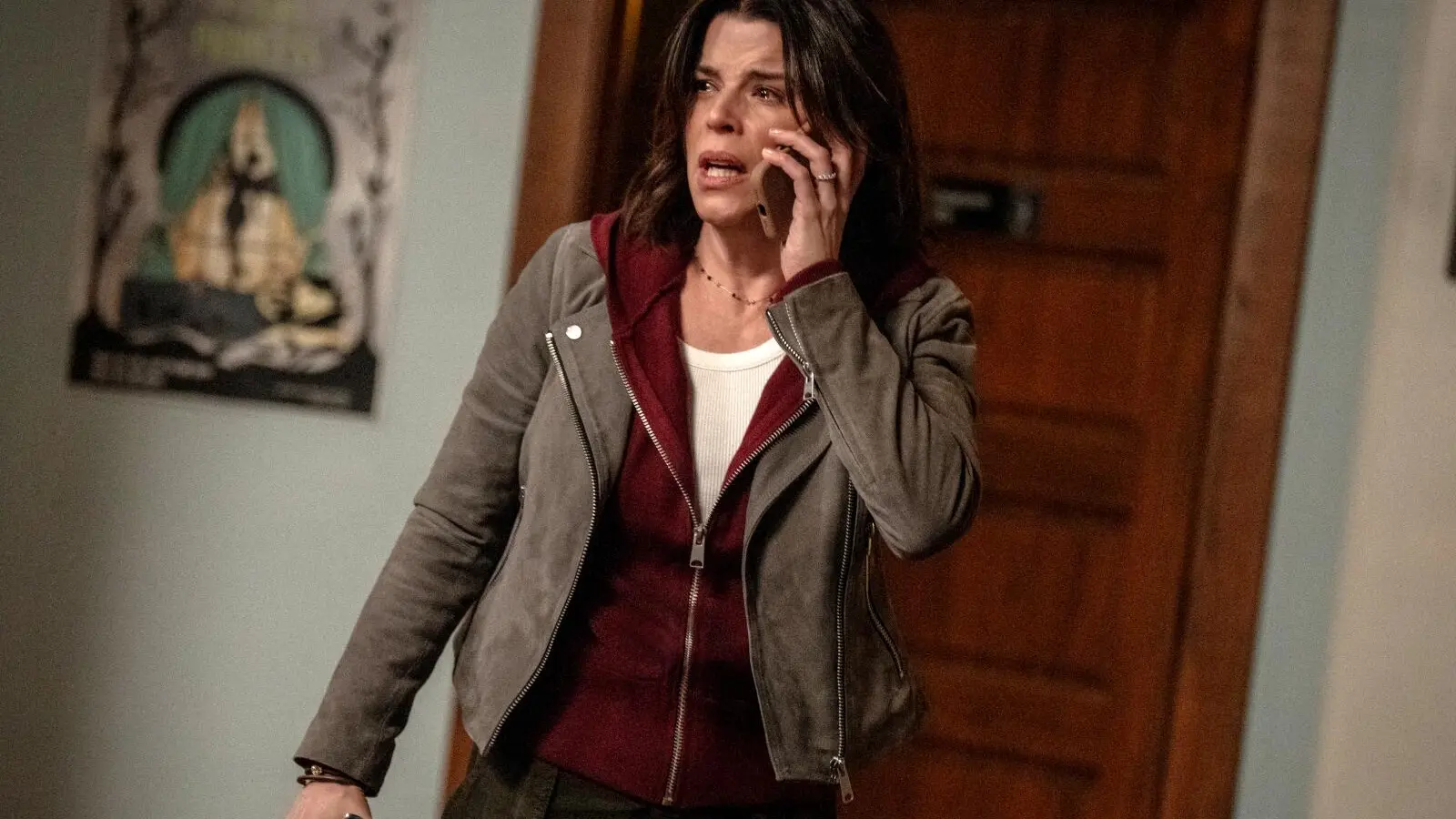
Featured Photo: Paramount Pictures
Scream was born from the idea that horror audiences had become too knowing, too literate, too comfortable with the grammar of their own fear. Williamson and Craven made that complicity the weapon. For thirty years, the franchise held a mirror up to whoever was watching and dared them to look. The mirror is still in the room. Some are peering into it, while others aren’t, turning their attention instead to the violence outside. Understandable.
Scream 8 is already in development. Williamson knows it. Campbell knows it. The film knows it. A story about impersonal forces consuming everything intimate and private will itself become a product, a continuation, a data point in a franchise’s commercial trajectory, regardless of what it says or means or achieves. It looked directly at the apparatus that would eventually swallow it whole and got swallowed anyway. Completely clear-eyed. Completely powerless to stop it. A franchise built on reinvention has now made its most emotionally distant entry at the precise moment the audience it needs most has already decided what it thinks. Scream 8 will happen. Whether the series has the goodwill left to survive another cycle is a different question.
Our Final Review
Randy Meeks laid it out in 1996. The past will come back to bite you in the ass. Whatever you think you know about the past, forget it. The past is not at rest. Any sins you think were committed in the past are about to break out and destroy you. He was talking about horror movies. Turns out he was talking about this one.
Flawed, detached, and more ambitious than it’s being given credit for. Even if the blade isn’t as sharp as it once was, it still cuts deep enough for your time.
3/5 stars.
Author Bio
As a freelance journalist, Ryan Smith’s work is driven by a commitment to restoring what has long been absent from institutions meant to uphold truth and accountability: honesty and transparency. Alongside his analysis works on the life, career, trials and tribulations of Michael Jackson, whose unfair treatment over the years paved the way for the path he is on, Smith also dissects and examines popular culture, such as books, movies and video games, always aiming to shed light on what’s beneath the surface.
![[THE FILES] 274 : The Road to El Dorado (2000)](https://deckedoutmagazine.com/wp-content/uploads/2026/06/road_to_el_dorado_history_hero_image.webp)


![[THE FILES] 273 : Toy Story x McDonald’s (1996)](https://deckedoutmagazine.com/wp-content/uploads/2026/06/mcdonalds_toy_story_mcdonalds_commercial_hero_image.webp)