
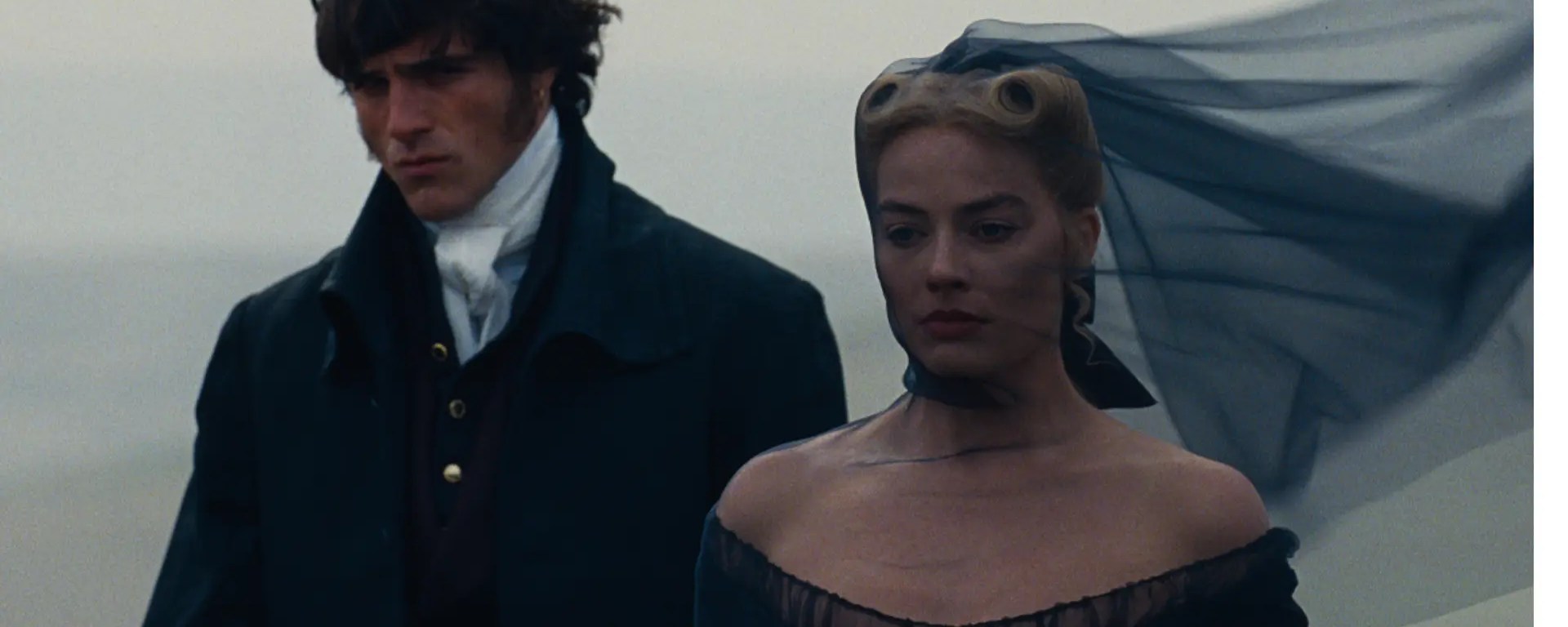
Emerald Fennell has made a film called “Wuthering Heights,” and she wants you to notice those quotation marks. They’re a pre-emptive defence, like putting up a sign that says “Not Actually Wuthering Heights” before anyone can complain. When Emily Brontë devotees storm out of the cinema, wondering where half the novel went, Fennell’s already got her excuse ready. It is, by her own admission, not an adaptation of but a version of how she felt reading it at fourteen.
Which raises an uncomfortable question: why use the name at all?
RELATED: We’re Already Living in The Matrix. We Just Call It Culture.
Table of Contents
The Quotation Mark Strategy: A Willful Departure from Brontë
Fennell’s left out the elements that matter most, of course. Previous adaptations of the novel have done the same. Brontë’s novel spans decades, two full generations. Heathcliff doesn’t just ruin his own life and Cathy’s. He destroys two families, the Earnshaws and the Lintons, and he does it on purpose. He’s patient about it, methodical. He spends years destroying everyone connected to Catherine because he couldn’t have her. Revenge is the entire architecture of his character. He turns Hareton into an illiterate brute. He forces young Cathy, Catherine’s daughter, to marry his sickly son just to torture her. The man is dedicated to inflicting misery. And then—this is what actually makes the book more than just Gothic misery—the second generation breaks the cycle. Young Cathy and Hareton find each other and refuse to let Heathcliff’s poison define them. They’re the redemption and the entire reason the first generation’s tragedy has weight. Without that, the hollowness only rings louder in Fennell’s version.
The supernatural elements have been removed entirely. Catherine’s spirit does not appear at the window. For a novel whose entire metaphysical framework depends on the idea that love this consuming doesn’t end at death, that it bleeds into the landscape and torments the living, this is not a minor omission. Kate Bush built an entire career-defining song around Cathy’s ghost begging to be let in. Bit harder to do when the ghosts don’t exist.
In place of Brontë’s savage psychological architecture, Fennell has installed a swooning romance. Catherine and Heathcliff are in perpetual physical contact. In the novel, physical intimacy appears only in Catherine’s death scene: a desperate embrace as she’s dying. That tells you everything about what Fennell’s done here, stripping away everything monstrous and dressing them up as beautiful people suffering beautifully.
Except the film can’t even deliver on that promise. Robbie and Elordi are two objectively charismatic, attractive actors who should be able to generate heat in their sleep, yet here they barely register together. For a film selling itself on obsessive, all-consuming desire that transcends death and sanity, ‘adequate’ is a disaster.
Losing the Heights: Why Cutting Hindley and the Second Generation Collapses the Narrative
The novel is about what happens when obsessive passion meets social impossibility. Catherine and Heathcliff’s love functions as psychotic identification. Catherine’s “I am Heathcliff” is her diagnosis: “he’s always, always in my mind—not as a pleasure, any more than I am always a pleasure to myself—but, as my own being.” When Catherine marries Edgar for social survival, Heathcliff experiences it as literal self-murder. His response is multigenerational revenge. The moors versus the Grange. Wildness versus domestication. Catherine literally dies trying to live in the civilised world at Thrushcross Grange. Brontë wrote a revenge tragedy spanning generations to demonstrate that this kind of fusion operates as pathology, not romance.
Fennell’s repackaged all of this as brooding intensity and consensual kink.
The film makes the sadomasochistic subtext into actual text. Isabella—who in the novel is Heathcliff’s abuse victim and eventually escapes him—gets rewritten entirely in ways that transform the novel’s critique of destructive obsession into validation of it. And it’s a bold move. Daring. Utterly abhorrent.

Photo: Warner Bros.
Because of that, in parts, it borders Ken Russell territory—The Devils energy injected onto the Yorkshire Moors. The sexualised violence, the bodies as sites of ecstasy and degradation, the romanticisation of absolute toxicity—she’s channelling the spirit of Russell’s transgressive vision. The problem is she’s making it beautiful. The whole film has the quality of a demented dollhouse: someone playing with very expensive toys. Those costumes—stunning as they are—have a plasticky sheen that belongs in a photoshoot, not on people who sweat and bleed on the Yorkshire Moors. Russell understood that real transgression has to make you uncomfortable, has to sit with the sickness until it curdles in your stomach. Fennell uses it as visual shock value and moves on.
Brontë couldn’t write explicit sexuality, so she encoded it. The violence is displacement. The horror comes from watching people destroy themselves whilst the narrative maintains formal propriety—the gap between what’s happening and how it’s described creates suffocating tension, the sense that the obsession is too large and too sick for language to contain. Fennell strips away the Victorian-coded language and shows you the mechanics, but in doing so, loses both the tension and the actual depravity that the novel is famous for.
Barbie and the Gentle Giant: When Star Power Smothers Character
Then there’s the casting. Heathcliff is described in the novel as racially other: “a dirty, ragged, black-haired child” who Mr Earnshaw finds on the streets of Liverpool, a port city central to the slave trade. He’s called a “dark-skinned gipsy” in the novel. His racial ambiguity is central to how the other characters treat him, how they dehumanise him, and how his revenge gets its fuel. Fennell cast Jacob Elordi, a white Australian, and defended it by saying he looked like the illustration in the first book she read.
That’s the defence. Not “we’re exploring the text’s themes of otherness differently,” not “we’re making a deliberate choice about how race functions in period drama.” Just: he looked like a picture I saw once.
Online defenders say: forget the book exists, and you might enjoy it. Purists say this is a misreading of the text. Both camps agree on one thing: nobody disputes that Fennell can construct provocative images. The cinematography is beautiful. The costumes are extraordinary. Maybe if Fennell had called this something else, written her own Gothic romance from scratch, we’d be having a completely different conversation. The film might even be better, freed from the weight of comparison. But “original Gothic romance” doesn’t get you $80 million from Warner Bros. “Wuthering Heights” does. It’s basically IP exploitation in a corset.
Other adaptations have gutted their source material just as thoroughly without committing the same betrayal. Wolfgang Petersen’s The Neverending Story strips out the entire second half of Michael Ende’s novel—due to budget constraints—but doesn’t deliberately transform it into something the book was arguing against. Petersen captured the spirit despite simplifying the structure. Fennell’s done the opposite: she’s kept the names and the moors and called it Wuthering Heights whilst systematically dismantling everything that made Brontë’s novel the text that it is.
And the film’s stuck in no-man’s-land; it’s too tame for Fennell’s usual crowd who turned up to Saltburn wanting to be shocked beyond measure, and too unfaithful for anyone who gives a toss about Brontë. What she’s made is a very expensive mood board, targeting the BookTok and Bridgerton audience who’ve heard of the novel but never actually read it. For them, this will probably work. For anyone who understands what Brontë was actually doing, this is smutty fan fiction with a studio budget.
Fennell has said she can’t adapt Wuthering Heights. On the evidence of this film, she’s right. The quotation marks were a warning.
Author Bio
As a freelance journalist, Ryan Smith’s work is driven by a commitment to restoring what has long been absent from institutions meant to uphold truth and accountability: honesty and transparency. Alongside his analysis works on the life, career, trials and tribulations of Michael Jackson, whose unfair treatment over the years paved the way for the path he is on, Smith also dissects and examines popular culture, such as books, movies and video games, always aiming to shed light on what’s beneath the surface.

![[THE FILES] 183: Mary-Kate and Ashley “Switching Goals” (1999)](https://deckedoutmagazine.com/wp-content/uploads/2026/05/mary_kate_and_ashley_switching_goals-2000x1121.webp)
One thought on “The Quotation Mark Adaptation: Why Fennell’s ‘Wuthering Heights’ is More Fan-Fic Than Brontë”