
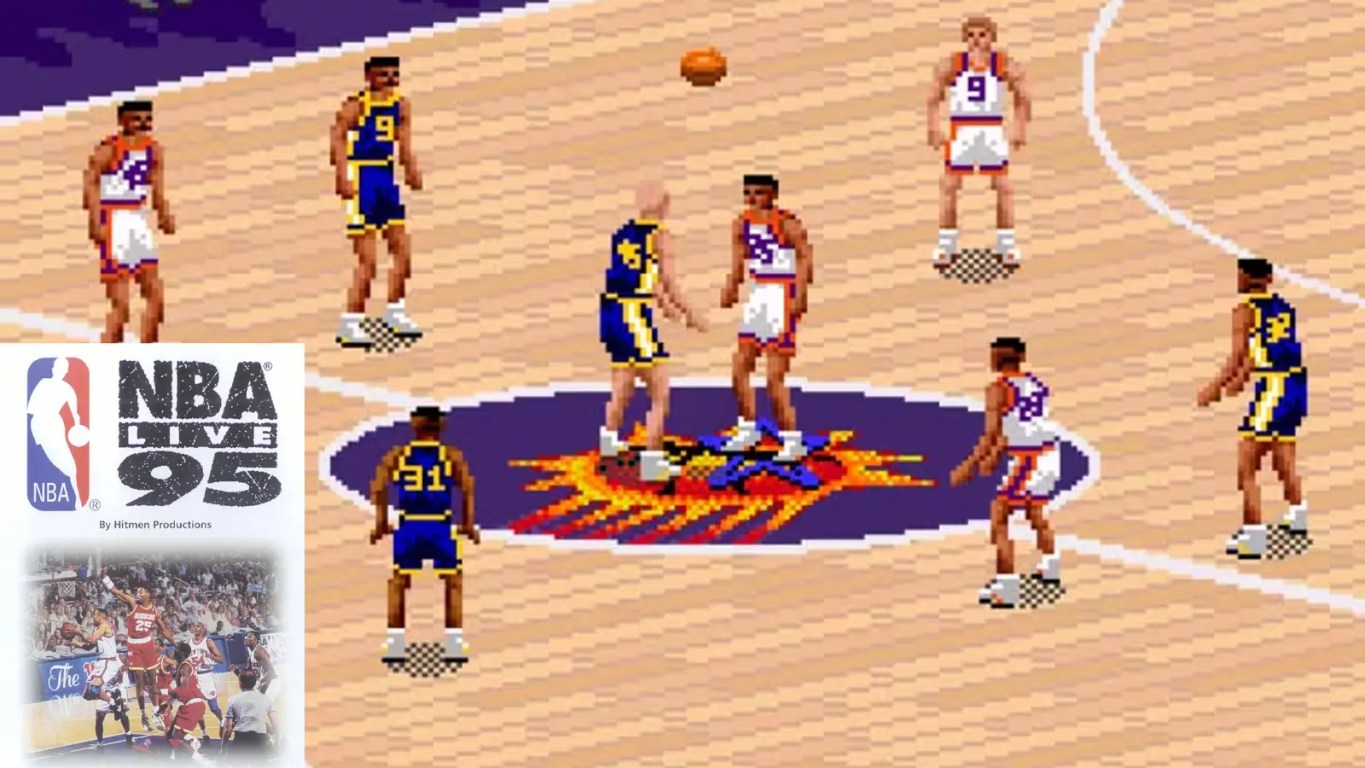
- The Subject: NBA Live 95
- Release Date: October 1994 (SNES/Genesis), 1995 (PC)
- The Lead: Developed by Hitmen Productions / EA Canada
- The Logic: EA Sports rebrands their “Showdown” series into “Live,” introducing the isometric perspective that would define sports sims for the next decade
If you grew up in the 16-bit era, the sound of the EA Sports “It’s in the Game” intro, followed by the squeak of sneakers on a digital hardwood floor, is a core memory. NBA Live 95 was the first title to drop the clunky “Bulls vs. Lakers” naming convention in favor of a yearly branding that made every copy feel like a must-have hardware update.
That’s right, NBA Live 95 is the next file to be added to our library.
RELATED: [THE FILES] 015: Freestyle Revolution: The “Superstar” Era of NBA Live 06
Table of Contents
The Hardware: The Isometric Shift
Before Live 95, basketball games usually used a flat, side-scrolling view. Live 95 changed the game’s “OS” by introducing the Isometric Perspective.
- The Depth: By tilting the court at an angle, EA created a sense of 3D depth on a 2D console. It allowed for better spacing, easier passing lanes, and made fast breaks feel genuinely fast.
- The Turbo Button: This was the game that perfected the “Turbo” mechanic in a simulation setting. Managing your burst of speed without tiring out your star player became a strategic layer that separated the casuals from the pros.
- T-Meter Free Throws: Live 95 introduced the “T-Meter” for free throws—a horizontal and vertical bar that required precise timing. It was so effective that variants of this “Hardware” are still used in 2K and EA games today.
The Software: The ‘Missing’ Legends
The “Software” (the roster) was elite, but it had two massive, “Darth Vader” sized holes:
- The Jordan/Barkley Sitch: Due to licensing deals, Michael Jordan and Charles Barkley were notoriously absent from the game. Jordan was replaced by a generic “Roster Guard” (or simply left off), while Barkley’s absence made the Phoenix Suns a shadow of their real-life selves.
- Roster Management: NBA Live 95 was also the first console basketball game to allow trades. You could finally move players between teams and save your custom rosters to the cartridge battery, making it the first “Management Sim” for many young fans.
The 2026 Context: The ‘Live’ Legacy
In the present day, the NBA Live franchise is a ghost of its former self, having been overtaken by the NBA 2K juggernaut. However, Live 95 remains the “Hardware” ancestor of every modern basketball sim. Its influence on presentation—using real player photos and “TV-style” stat overlays—paved the way for the hyper-realistic broadcasts we play today.
The ‘Decked Out’ Verdict
NBA Live 95 wasn’t just a game; it was a vibe shift, taking the NBA from a pixelated hobby to a polished, professional simulation. And for many (especially nostalgia heads), the “Isometric Era” remains the gold standard of 16-bit sports.
The Archival Staple
*As an Amazon partner, we earn a commission on qualifying purchases, which allows us to expand our digital library*
Featured Photo: EA Sports
RELATED: [THE FILES] 019: NBA 2K (1999) – The Visual Disruption
Author Bio
Jael Rucker is the founder of Decked Out Magazine. She has previously worked as the Associate Commerce Editor at PureWow, focusing on analytics and trends to pitch stories and optimize articles that build and engage their audience. Her work has also been seen in Footwear News and WWD. Prior to 2024, she was the style and pop culture editor at ONE37pm for over three years, contributing numerous product reviews, brand profiles and fashion trend reports, which included interviewing Steph Curry, Snoop Dogg and more.



![[THE FILES] 070 | Mulan (1998): The Technical Blueprint of a Dynasty](https://deckedoutmagazine.com/wp-content/uploads/2026/04/mulan_disney_screenshot_dvd.webp)