
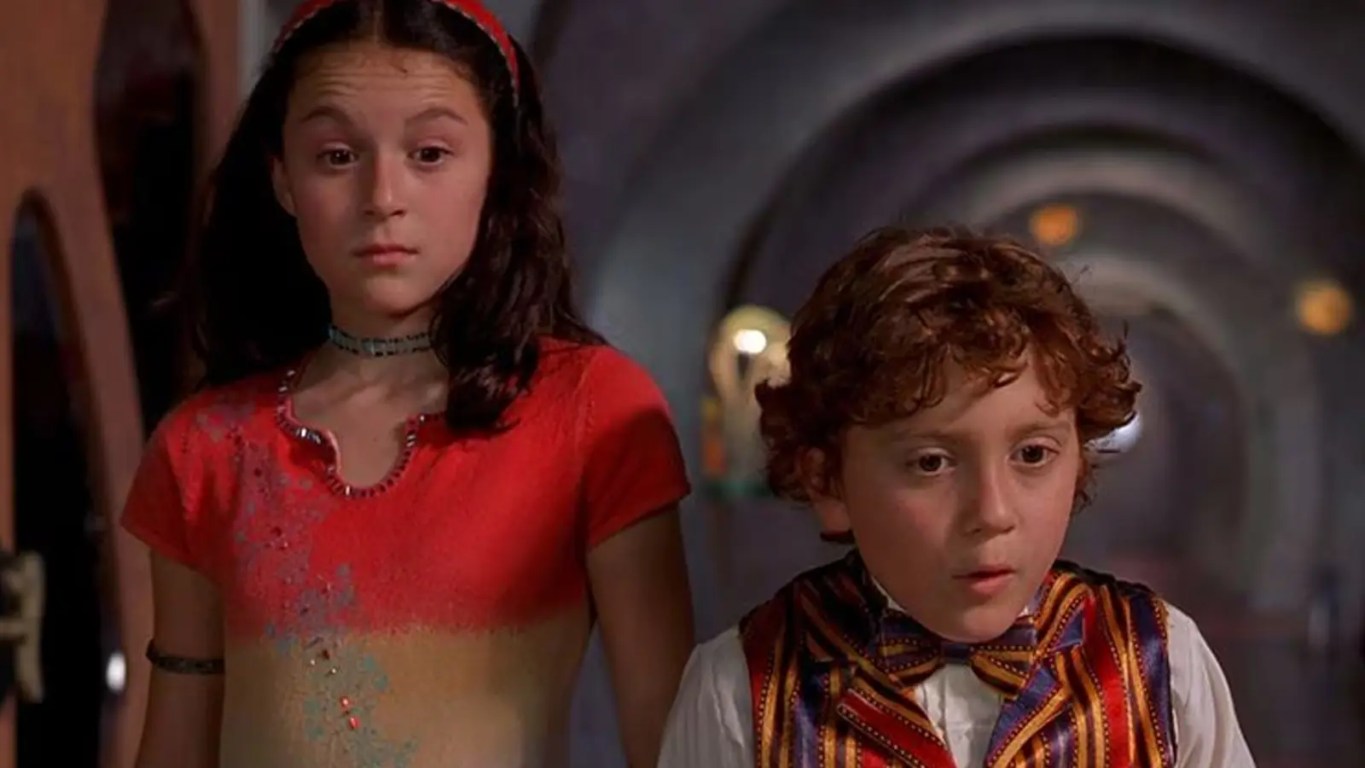
- File Status: Open
- Recording Hub: Troublemaker Studios (The Garage), Austin, TX
- Mastering Signature: Robert Rodriguez (The “Rebel Without a Crew” Blueprint)
- Primary Hardware: Arriflex 435 / Sony HDW-F900 (Digital Pivot)
- Sonic Profile: Orchestral-industrial fusion featuring heavy brass and acoustic “Spy” guitar textures.
- The Visual Chain: 35mm Gate / Early-stage High-Definition Digital Rendering
In the early months of 2001, the industry was focused on the massive pre-summer blockbusters. When Robert Rodriguez delivered Spy Kids on March 30, it wasn’t just another entry in the “James Bond for kids” subgenre—it was a high-performance disruption of the Hollywood family model. While the Weinsteins reportedly pushed for the Cortez family to be “Americanized” (a coded request to strip the film of its Latino heritage), Rodriguez held the line, betting that the universal appeal of a strong family unit, combined with DIY digital ingenuity, would resonate globally.
The result? A box office phenomenon that didn’t just win its opening weekend; it held the No. 1 spot for three consecutive weeks, out-maneuvering high-budget competition and proving that an Austin-based independent spirit could produce a $147M global asset on a “lean” $35M build.
Ladies and gents—our final installment of the first Spy Kids film.
RELATED: Spy Kids Legacy & Tech: [THE FILES] 009 OSS Architecture
Table of Contents
The Audit: High-Performance ROI
Robert Rodriguez’s “one-man crew” philosophy isn’t just a stylistic choice; it’s a financial strategy. The architecture of Spy Kids proved that by bringing post-production in-house and utilizing digital prototypes, you could maximize “Screen Value” without bloating the ledger.
- Production Budget:$35,000,000
- Competitive Context: In the 2001 market, this was an incredibly disciplined spend. Inspector Gadget (1999) cost $90M and 102 Dalmatians (2000) cost $85M. Rodriguez produced a more visually inventive, gadget-heavy world at 40% of the cost.
- Domestic Opening:$26,546,881
- The film captured nearly 24% of its total domestic gross in its first 72 hours, ranking #1 and toppling the Morgan Freeman-led Along Came a Spider.
- The “Legs” Factor: The film’s 4.25x multiplier (Total Domestic Gross / Opening Weekend) is the gold standard for “Word of Mouth” success. It wasn’t just a flash in the pan; it was a sustained cultural moment.
Final Global P&L Statement:
- Domestic (US & Canada): $112,692,062 (76.2% of total)
- International: $35,242,118 (23.8% of total)
- Worldwide Total: $147,934,180
- Net ROI: 4.2x Production Budget
The Strategy: The “Austin Blueprint”
The financial success of Spy Kids wasn’t just a payday; it was the capital injection that built the modern Troublemaker Studios infrastructure.
- Infrastructure Funding: The $147M haul gave Rodriguez the leverage to bypass the Hollywood VFX machine. He used the profits to build a permanent digital pipeline in Austin, Texas, allowing him to shoot, edit, and score his future films in a private, high-spec ecosystem.
- The Digital Transition: While the 2001 film was shot on 35mm, its box office success funded the Sony HDW-F900 hardware transition for the sequels. Spy Kids was the last “Analog” piece of the franchise, paying for the “Digital” future.
- Cultural Equity: By refusing to “whitewash” the Cortez family, Rodriguez created the first mass-market Latino-led blockbuster franchise. This “Cultural Hardware” proved to be recession-proof, spawning three immediate sequels and a 2023 reboot.
RELATED: [THE FILES] 009.1: The Gadget System: Spy Kids x McDonald’s (2001)
RELATED: [THE FILES] 023: Romeo Must Die (2000) – The X-Ray Logic
Featured Photo: Troublemaker Studios
Author Bio
Jael Rucker is the founder of Decked Out Magazine. She has previously worked as the Associate Commerce Editor at PureWow, focusing on analytics and trends to pitch stories and optimize articles that build and engage their audience. Her work has also been seen in Footwear News and WWD. Prior to 2024, she was the style and pop culture editor at ONE37pm for over three years, contributing numerous product reviews, brand profiles and fashion trend reports, which included interviewing Steph Curry, Snoop Dogg and more.


![[THE FILES] 160 | The Hummer H2 (2002): The Absolute Peak of Early 2000s Excess](https://deckedoutmagazine.com/wp-content/uploads/2026/05/hummer_h2_history_hero_image.webp)