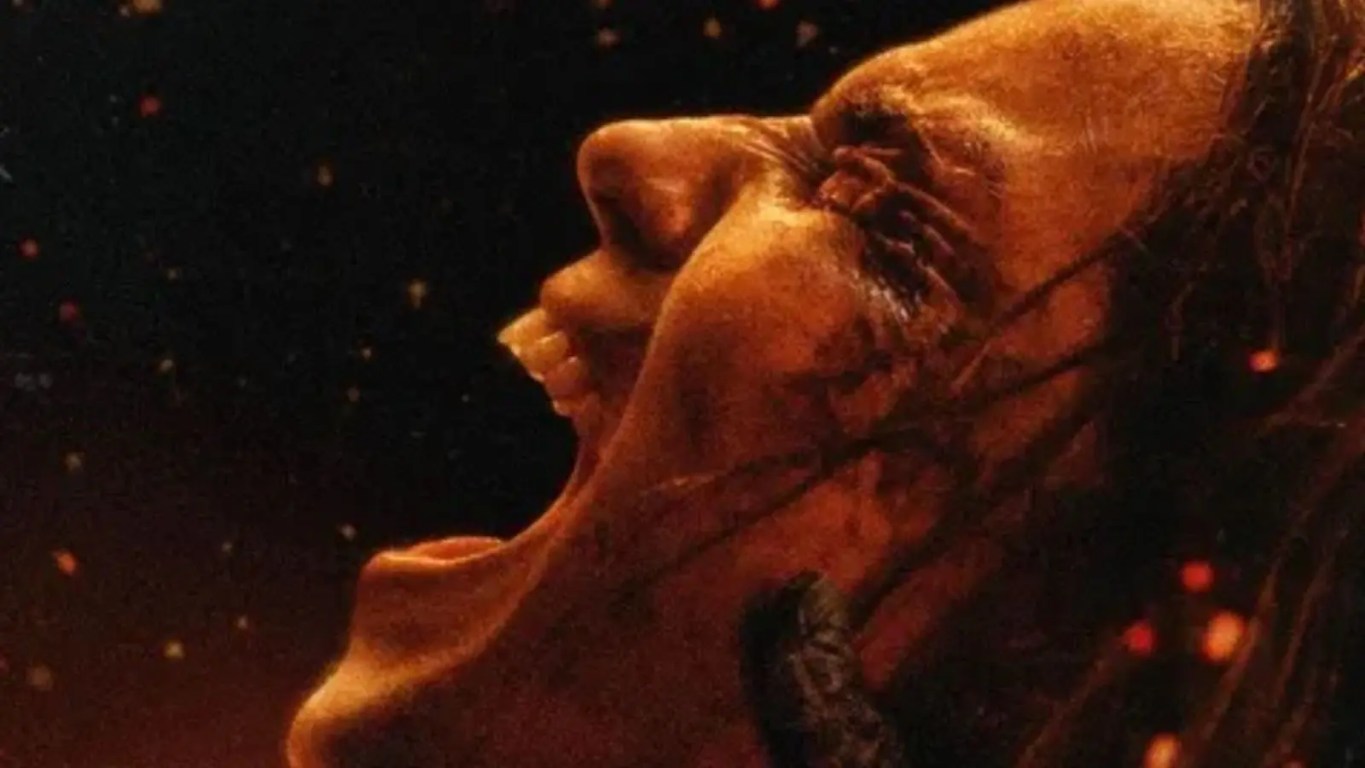
Full disclosure before we start: I went into Evil Dead Burn nursing a second-degree burn on my thumb, after accidentally scalding it. So when the film opened with something I can relate to, which I won’t spoil, I felt it hit somewhere quite specific.
And Burn is about what burns leave behind. Not the Deadites, not the Necronomicon, not the MacGuffin everyone spends the back half rummaging around for, but a widow named Alice (Souheila Yacoub), what her marriage cost her, and a family gathering that goes the way family gatherings tend to go in this franchise. Sébastien Vaniček’s twist on the formula is that the household was rotten before anything supernatural touched it.
RELATED: TOHO Drops First Teaser for Godzilla Minus Zero: A New Threat Rises in Post-War Japan
Table of Contents
The family is sketched rather than painted, which is franchise tradition (the original gave its five students about two personality traits between them). However, it creaks here, because these characters are asked to carry far heavier baggage than a tape recorder. Still, the sketches do their work, and the two that matter most are the women closest to the man whose funeral they’re all there for. Alice flinches at the memory of her husband. Susan (Tandi Wright), his mother, flinches at nothing, a woman gone cold in a way the film wisely never explains outright. The longer you sit with the pair of them, the more you suspect you’re watching one woman at two points in time: one who can still feel it, and one who stayed until the feeling died. Their eventual collision, which Vaniček has said he deliberately refused to referee, is the most restrained thing in the film, and the restraint is why it works.
Then there’s Joseph (Hunter Doohan), the gentle younger brother, an aspiring writer and the family’s designated safe pair of hands. Long-time fans will assume he’s walking in a certain 1981 archetype’s footsteps. He’s walking in a different pair, and the film knows exactly whose, and they don’t belong to the much-loved chainsaw-wielding maniac of old.
When the film works, it works the old way, the 1981 way. Its best comedy hides inside the horror rather than mugging at you (the signposted gags, mostly involving Polly (Maude Davey), are another matter). It refuses the cheap jump scare almost entirely, and thank goodness, because decades of horror have inoculated us all against the quiet-quiet-LOUD ambush. Instead, it shows you the mundane object early and leaves you alone with it. You can brace for a loud noise. You cannot brace your way out of dread, and if you haven’t been paying attention, the shock finds you anyway. Vaniček has named Green Room as his model, the slow assembly of violence you can see coming and can’t stop, and it shows. The finest example is the most mundane item, a callback to the original if you’re paying attention, and when its moment comes you’ll feel it arriving seconds before the film hammers it, and you’re likely to find your nails digging in your seat for every one of them. Its accompanying audio flourish, which I’ll keep vague, had me concerned for myself for a few seconds. That’s the film reaching out of the screen and putting an injury inside you: the single best piece of craft in the picture.
But the film keeps blinking at the moments it shouldn’t. The dagger the Deadites hunt is a leash on the wrong animals. These are the franchise’s great taunters, the things that know the secret shames of the living and say them out loud in borrowed voices, and Burn hands them the richest psychological hunting ground the series has ever crafted: Alice with her hidden scars, Susan frozen solid by her own history, Joseph and his gentleness that curdles into cowardice, a family whose whole culture is built on not seeing the obvious. Then it points them at a letter opener. There’s a grim irony the film never notices: the dagger is a family heirloom, handed down the same bloodline as everything else in this house. Even the plot device is generational. You feel the cost in the film’s best scene of pure violence: Edgar (Erroll Shand) rampaging through his own house after his wife and son while Alice crawls away like a frightened child. Nobody watching mistakes what that image is; the film is spelling out its theme in furniture and screaming. But the rampage is in service of the search, the vilest taunts are jabs tossed off between shelves, and you sit there doing the arithmetic: if these things weren’t hunting a relic, what else might they have spent ninety minutes interrogating? Alice’s heaviest moment arrives at the very end, quietly, said to a stranger, and the film treats it as a wrap-up beat rather than the destination it spent two hours building. Either be braver or don’t bother. And I’m not alone in the more basic complaints: the Deadites are frequently unintelligible, their lines gargled into distortion by the same sound department capable of surgical precision, and the whole picture is so murkily grey I desperately wanted a magic remote with a brightness setting.
Nor is abuse the only theme fighting for air. Vaniček’s debut, Infested, was a film about xenophobia, about who France notices and who it polices, and that thread survives here in Alice’s Frenchness: the outsider wife her in-laws never quite let in, her foreignness one more thing quietly held against her. It surfaces and stings, then gets swept up in the whirlwind like everything else. That’s the film’s pattern in miniature. It never lingers on any of its themes until necessary, and by the time it’s necessary, the violence has arrived to carry them off.
Some critics have gone further and called the film itself an act of cruelty toward its heroine, punishment dressed as allegory. I don’t think that’s quite right. My complaint isn’t that Burn shows too much of what Alice endures. It interrogates too little of it. The abuse story is underfed, and that’s the opposite of gratuitous.
I said I wouldn’t spoil, and I’m going to bend that once, shape only, not scene, because it’s the reason this review exists. Remember the necklace that saves Ash in the original, and what it meant: forty-five years ago this franchise ended its first film on the idea that love was real and love was enough. Burn stages the same offer and refuses it. At the worst possible moment, love gets said out loud to Alice by the person with the least right to say it, and she answers the way forty-five years of understanding houses like this one has taught us to answer. It isn’t enough. And for about thirty seconds, this is the bravest film in the franchise.
The Verdict
Verdict: Nasty, occasionally brilliant, with a genuine thesis about love and violence. But the dagger plot isn’t a flaw in an otherwise strong film; it’s the reason the stronger film never gets to exist. The theme deserved the film’s full attention. It got its spare time. 3.5/5
RELATED: Project Hail Mary (2026) | Cast, Where to Stream, Box Office & Reviews
Author Bio
As a freelance journalist, Ryan Smith’s work is driven by a commitment to restoring what has long been absent from institutions meant to uphold truth and accountability: honesty and transparency. Alongside his analysis works on the life, career, trials and tribulations of Michael Jackson, whose unfair treatment over the years paved the way for the path he is on, Smith also dissects and examines popular culture, such as books, movies and video games, always aiming to shed light on what’s beneath the surface.