
- Date of Record: November 4, 2002
- Platforms: PlayStation (PS1), Game Boy Advance (GBA)
- Operational Status: Archival / Legacy
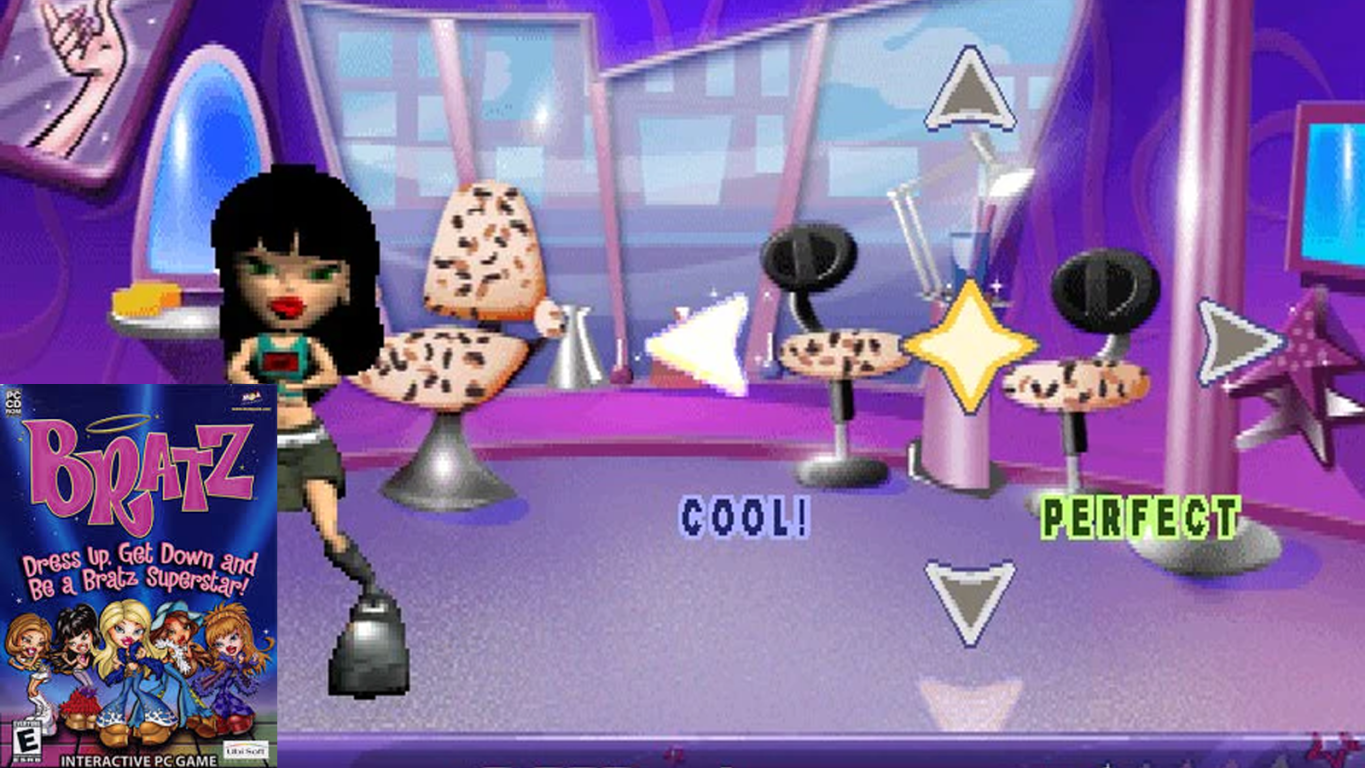
By late 2002, the “Girls with a Passion for Fashion” had already disrupted the global toy market, but their leap into the digital realm with Bratz for the PlayStation and Game Boy Advance was a tactical masterclass in aesthetic branding. Developed by DC Studios and published by Ubisoft, this wasn’t just a licensed tie-in; it was the first time the Bratz “Hardware”—the signature heavy-lidded eyes, glossy lips, and platform boots—was translated into a polygonal world.
While the industry was preoccupied with the high-polygon realism of the 128-bit era, Bratz carved out a niche in lifestyle and dance simulation.
This makes Bratz the next file entry in our library.
RELATED: [THE FILES] 059 | Bratz: Starrin’ & Stylin’ (2004) — The 2D Fashion Manifesto
Technical Architecture: The Low-Poly Glow-Up
- The Sprite-to-Polygon Ratio: On the PS1, the game utilized a “2.5D” approach. While the characters were 3D polygonal models, the backgrounds were often pre-rendered 2D plates to save on VRAM, allowing for more detail on the clothes and makeup.
- The “Style” Engine: The core “hardware” of the game wasn’t the combat or the physics—it was the Customization Engine. The game allowed for real-time swapping of textures (fabrics) and color palettes on the character models, a precursor to the “Character Creator” depth seen in modern titles.
- GBA Portability: The Game Boy Advance version was a technical “Audit in Miniature,” utilizing isometric 2D art to mimic the fashion-magazine layouts of the era.
Virtual Hardware: The Stilesville Toolkit
The gameplay of Bratz (2002) functioned as a specialized rhythm-logic engine designed to test “Vibe Accuracy” rather than traditional combat or platforming skills. Operating as a 3D dancing simulator, the primary loop required players to hit scrolling icons and button combinations to sync with a bubblegum-techno soundtrack, pushing the PlayStation’s audio chip and latency limits.
Cultural Impact: The Y2K Time Capsule
The release of Bratz (2002) coincided with the peak of “Bubblegum Futurism.” The game’s soundtrack—a blend of early 2000s R&B, pop, and dance-beats—pushed the audio capabilities of the PS1 to their limit. It wasn’t just a game; it was a vibe check for the era.
- The Inclusion Factor: From a technical standpoint, the game was ahead of its time by offering a diverse lead cast with no “main” protagonist. The “Hardware” of the squad was built on multi-ethnic representation, which remains a cornerstone of the brand’s 2026 revival.
- The Legacy: Today, the 2002 game is cited by digital archivists as the definitive source for “Bratz-core.” The low-poly aesthetic, once a technical limitation, is now a highly-coveted “Y2K filter” used by creators to capture the nostalgia of the Stilesville era.
Performance Data
![[THE FILES] 086 | Bratz (2002) — The Y2K Digital Makeover -](https://deckedoutmagazine.com/wp-content/uploads/2026/04/bratz_2002_video_game_still_jade.png)
Photo: DC Studios
- Release Date: December 12, 2002
- Developer: DC Studios
- Publisher: Ubisoft
- Platforms: PlayStation, PC, Game Boy Advance
- Status: Ranked as a “Cult Classic” amongst Bratz fans.
Author Bio
Jael Rucker is the founder of Decked Out Magazine. She has previously worked as the Associate Commerce Editor at PureWow, focusing on analytics and trends to pitch stories and optimize articles that build and engage their audience. Her work has also been seen in Footwear News and WWD. Prior to 2024, she was the style and pop culture editor at ONE37pm for over three years, contributing numerous product reviews, brand profiles and fashion trend reports, which included interviewing Steph Curry, Snoop Dogg and more.
![[THE FILES] 193: Lupe Fiasco — Kick, Push (2006)](https://deckedoutmagazine.com/wp-content/uploads/2026/05/Lupe_fiasco_kick_pushy_hero_image-2000x1116.webp)

![[THE FILES] 192: The SpongeBob Game Boy Advance SP (2000s)](https://deckedoutmagazine.com/wp-content/uploads/2026/05/Screenshot-2026-05-25-at-8.30.13-PM.webp)