
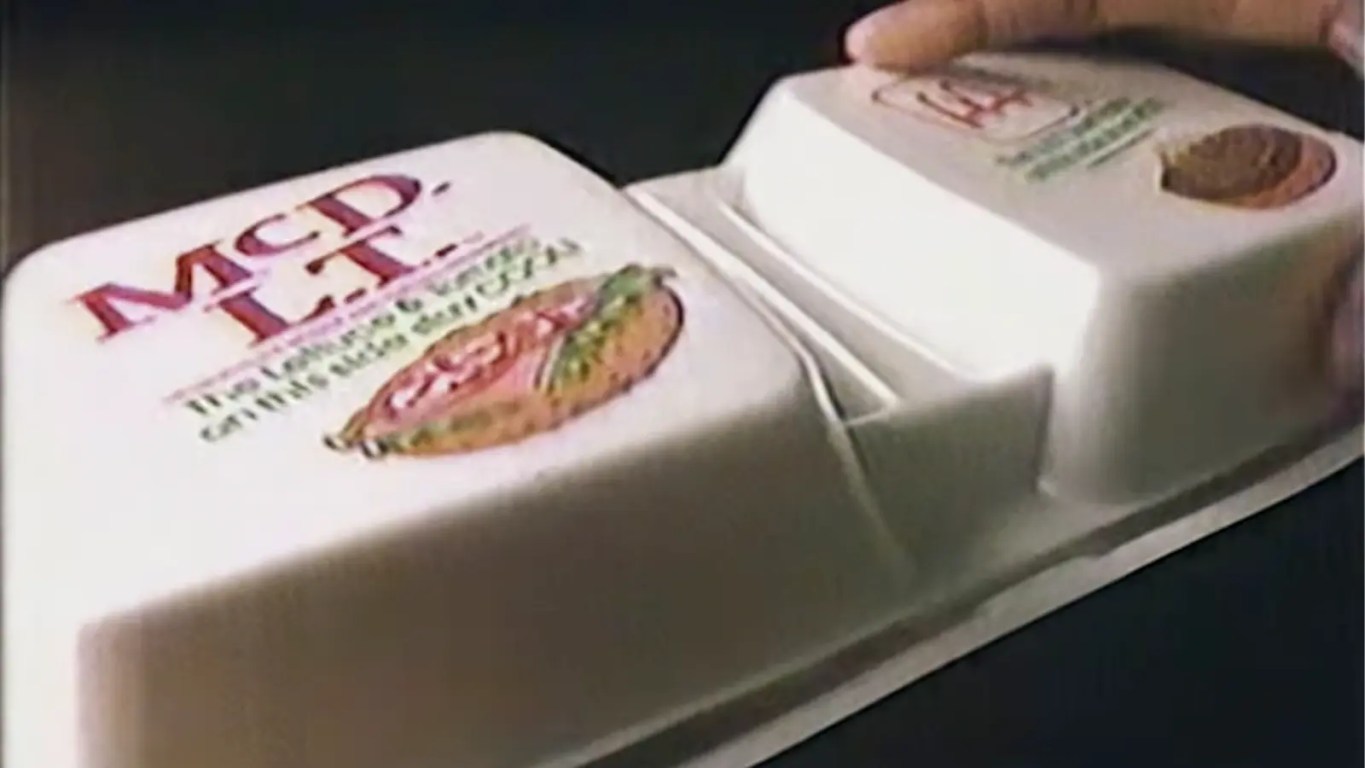
In 1984, McDonald’s faced a technical crisis: “The Soggy Lettuce Syndrome.” When you put cold vegetables on a hot burger and wrap it in paper, physics dictates that the steam will wilt the greens and turn the bun into a sponge. The solution, you ask? The McDLT—a burger that required the customer to act as the final assembly technician. (Yes, seriously).
The McDLT is the next file being added to our library.
RELATED: [THE FILES] 009.1: The Gadget System: Spy Kids x McDonald’s (2001)
Table of Contents
The Engineering: A Dual-Chamber Design
The McDLT’s most iconic feature wasn’t the food; it was the specialized polystyrene (styrofoam) container. It consisted of the following.
- The Design: A specialized, oversized “clamshell” with two distinct chambers.
- Chamber A: Housed the bottom bun and the beef patty (The Hot Side).
- Chamber B: Housed the top bun, lettuce, tomato, cheese, and pickles (The Cool Side).
- The User Experience: The customer had to flip Chamber B onto Chamber A at the moment of consumption. It was a deconstructed dining experience marketed with a high-energy Jason Alexander (pre-Seinfeld) musical campaign.
The Failure: The Environmental Wall
So…why did it fail? The McDLT didn’t fail because people hated the taste—it was actually one of their best-reviewed burgers. It failed because of its physical footprint.
- The Bulk: The dual-chamber container took up twice the space of a Big Mac, making drive-thru storage a logistical nightmare.
- The Toxic Asset: By the late 80s, the environmental movement targeted polystyrene for its ozone-depleting CFCs. McDonald’s, facing a massive PR disaster, was forced to “Retire the Styrofoam” in 1991. Without the specialized container, the McDLT couldn’t exist—it was a product entirely dependent on its packaging.
The End of the Styrofoam Era
The McDLT remains a fascinating chapter in the history of fast food because it prioritized a technical solution over environmental reality. While it successfully solved the “Soggy Lettuce Syndrome,” the cost of that solution—a massive, non-biodegradable footprint—became too heavy for the brand to carry into the 1990s. It serves as a reminder that in the world of product design, the packaging is often just as important as the product itself.
Today, the McDLT lives on in the memories of those who remember the thrill of the “flip,” standing as a monument to a time when fast food was as much about the experience of assembly as it was about the meal.
RELATED: [THE FILES] 001.1 The Lord of the Rings 2001 Burger King Promotional Campaign
Featured Photo: McDonalds
Author Bio
Jael Rucker is the founder of Decked Out Magazine. She has previously worked as the Associate Commerce Editor at PureWow, focusing on analytics and trends to pitch stories and optimize articles that build and engage their audience. Her work has also been seen in Footwear News and WWD. Prior to 2024, she was the style and pop culture editor at ONE37pm for over three years, contributing numerous product reviews, brand profiles and fashion trend reports, which included interviewing Steph Curry, Snoop Dogg and more.
![[THE FILES] : Dead Presidents (1995)](https://deckedoutmagazine.com/wp-content/uploads/2026/07/dead_presidents_1995_history_hero_image.webp)

![[THE FILES] : Stay (2005)](https://deckedoutmagazine.com/wp-content/uploads/2026/07/stay_movie_history_hero_image.webp)
![[THE FILES] : Rugrats in Paris: The Movie (2000 Video Game)](https://deckedoutmagazine.com/wp-content/uploads/2026/07/rugrats_in_paris_history_hero.webp)