By Jael Rucker: Published: January 10, 2026
A Note on the MJ Archive
As part of the launch of Decked Out, I am officially migrating the definitive “MJ Archive” series from Medium to its permanent home on this domain. This article has been updated with new high-resolution infrastructure and serves as the foundation for our ongoing look into the legacies that shaped culture. If you followed this series on Medium, welcome to the upgraded experience.
LOS ANGELES, CA — Since we’ve covered the 1984 Pepsi Burn and the lifelong painful effects Michael Jackson endured as a result, we’ll next dive into another topic people have frequently misunderstood and have ignorantly made fun of—Jackson’s vitiligo and lesser-known lupus conditions. To this day, there are certain individuals who make statements along the lines of “Michael Jackson bleached his skin,” “Michael Jackson didn’t want to be Black,” and so on and so forth. Today, we’re going to dispel those false sentiments by going in-depth about the facts and effects both of Jackson’s conditions brought forth and how it impacted him separately and together.
We’ll start with the vitiligo.
Michael Jackson’s Vitiligo Diagnosis

Featured Photo: Michael Jackson/Spike Lee
Before we get into Jackson’s dealing with vitiligo, let’s first take a look at what the condition actually is. According to the National Institutes of Health (NIH), vitiligo is a chronic (long-lasting) autoimmune disorder that causes patches of skin to lose pigment or color. There is no cure for the condition, and symptoms can include the following: milky-white patches often on the hands, feet, arms, face, hair, eyebrows, eyelashes, beard, and body. Additionally, you can even experience inflammation or swelling in your eyes, along with inflammation in the ear.
Furthermore, according to the Mayo Clinic, while it is difficult to predict how the disease will progress, most of the time the pigment loss spreads and eventually involves the entirety of the skin.
While the reported year of Jackson’s diagnosis was 1986, apparently his doctor, Arnold Klein, first began noticing the vitiligo sometime around 1983. We’re going to pull some excerpts from Klein’s interview with Larry King discussing Jackson’s vitiligo, courtesy of our friends over at True Michael Jackson:
“King: Did Michael have it?
Klein: Absolutely. We biopsied.
King: Do black people have it more than white people?
Klein: No. But it’s just more visible on black people, because they have a dark skin. The other thing is, it certainly occurs within a family history. And I believe one of Michael’s relatives did, in fact, have vitiligo.
King: How bad was his?
Klein: Oh, his was bad because he began to get a totally speckled look over his body. And he could…
King: All over his body?
Klein: All over his body, but on his face significantly; on his hands, which were very difficult to treat.”
Now, as we mentioned earlier, the natural progression of vitiligo is such that it eventually overtakes your whole body, but I want you to pay very close attention to another factor Mayo Clinic lists as reasons for the disease starting or progressing faster: A trigger event such as stress, severe sunburn or skin trauma.
Remember, Jackson’s scalp was burned by way of fire in early 1984—not only does that directly qualify as a skin trauma, but something like that would also give you enough psychological distress/stress to either activate an autoimmune disease that’s been lying dormant, or worsen one that’s already there.
Clinical Connections: Michael Jackson’s Vitiligo
I would next like to pull some great insight that was recently written by our friend, Cats Cave, about Jackson’s vitiligo. Here are some valuable excerpts:
“Oprah Winfrey did not provide Michael Jackson with the space to express what his diagnosis truly meant to him. Instead, her confrontational tone pressured him to reveal details about his treatment. In healthcare, professionals are taught a crucial principle: patients are the most reliable historians of their own bodies. Providers are encouraged not to interrupt, to give patients room to share their experiences, and to ask clarifying questions only when necessary — allowing individuals to speak their truth clearly. Ideally, journalism should follow the same standards, offering interviewees the respect and freedom to share their perspectives without interruption and clarifying points respectfully when needed. Unfortunately, tabloid media have never shown Michael the same kindness. Oprah, with her influential platform, chose to advance her own agenda at his expense, ultimately causing harm rather than fostering understanding.”
“There’s no cure for Vitiligo.
Let that thought sink in.
Imagine Michael learning he had this condition, there really wasn’t a safe zone for processing and understanding, particularly when autoimmune diseases were so poorly understood, particularly for a black man with a medical concern, where believability and support were (and still are) virtually nonexistent, and psychosocial support was trivialized.”
“Treatment is customized to meet each individual’s needs. One common approach is using cosmetic camouflage, such as makeup, which Michael relied on for many years. However, as the depigmented patches became more extensive, covering them with makeup was not always feasible, necessitating evening out his overall skin tone with medications specifically designed to target depigmentation in vitiligo patients.”
Now we head to what treatments are available, even though the condition isn’t curable.
The Treatment
According to Jackson’s longtime makeup artist, Karen Faye, during a 2003 interview, the original course of action was to use makeup matching Jackson’s skin color all over his body for his first few years of having the condition. That process worked initially, but due to the fast progression of the vitiligo, the approach was short-lived, so an alternate option was going to have to be considered. It makes total sense when you think about it—actors literally spend hours in hair and makeup day in and day out when they’ve got to have full body makeup applied for a role, and it’s not long before they’re annoyed with the process.
Now imagine having to do something like that every day because you are trying to hide a skin condition from the world. It’s not a feasible long-term solution, which is ultimately what ended up being told to Jackson by Dr. Klein. We’re now going to reference Klein’s interview with Larry King once more, courtesy of True Michael Jackson:
“King: So, how do you treat vitiligo?
Klein: Well, I mean there’s certain treatments. You have one choice where you can use certain drugs called (INAUDIBLE) and ultraviolet light treatments to try to make the white spots turn dark or — his became so severe, that the easier way is to use certain creams that will make the dark spots turn turn light so you can even out the pigments totally.
King: So your decision there was that he would go light?
Klein: Well, yes, that’s ultimately what the decision had to be, because there was too much vitiligo to deal with and…
King: Otherwise, he would have looked ridiculous?
Klein: Well, you can’t — he would have to wear heavy, heavy makeup on stage, which would be ridiculous. And he couldn’t really go out in public without looking terribly peculiar.
King: How did you treat the vitiligo?
Klein: Well, we basically used creams that would even out the same color and we destroyed the remaining pigment cells.
King: And did his color change a lot over the years?
Klein: No, because once we got — we got it more uniform, it remained stable. But you still had to treat it because once in a while, and he had to also be extraordinarily careful with sun exposure because of a lot of things. And that’s why he had the umbrellas all the time (INAUDIBLE) skin now.”
Okay, now we’re going to pause on the vitiligo for a second and talk about Jackson’s other condition—lupus.
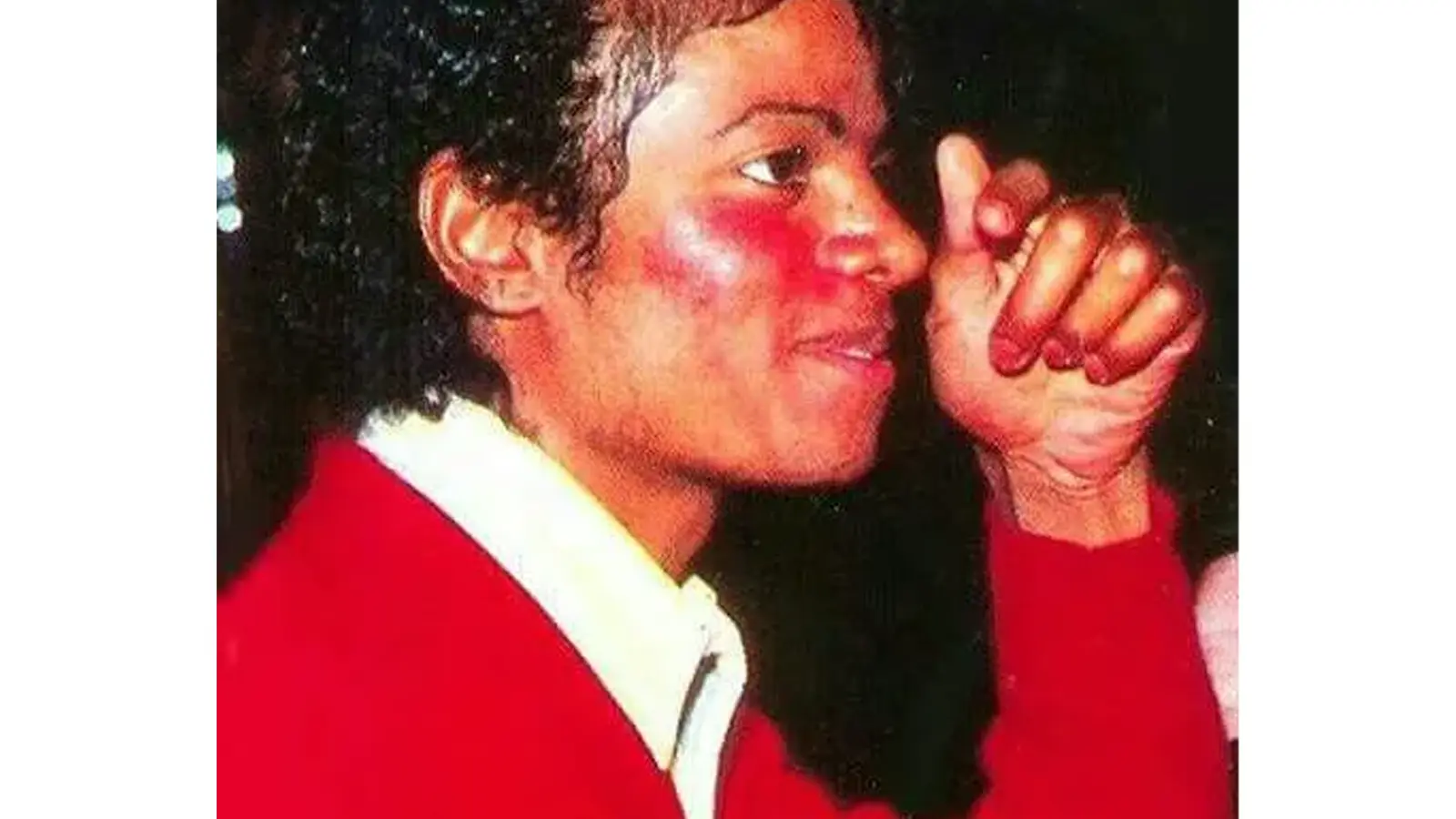
Photo: Unknown, MJ Archives
In 1983, the same year his vitiligo spots began appearing, Jackson was also diagnosed with lupus. Now, what exactly is lupus, and how does it impact your body and skin specifically? As per Mayo Clinic, lupus is an autoimmune disease that occurs when your body’s immune system attacks your own tissues and organs. The inflammation caused by lupus can affect many different body systems — including your joints, skin, kidneys, blood cells, brain, heart, and lungs.
According to Mayo Clinic, the most distinctive sign of lupus is a facial rash (which you can see in the photo above) that resembles the wings of a butterfly unfolding across both cheeks. Similar to vitiligo, sunlight can cause the condition to flare up/worsen, and it can also present skin lesions that appear out of nowhere. Additionally, lupus sufferers can have their fingers and toes turn white/blue when exposed to cold or when under stress. Oh, and that’s not counting the potential effects it can have on your brain, lungs, heart, and central nervous system.
What’s more, the Rheumatology Center of Jersey confirms that inflammation from lupus can cause your hair to fall out in clumps, and that discoid lesions can form on your scalp and scar your follicles so you never grow hair in those areas again. Lupus can also cause you to lose your eyebrow and eyelash hair.
While Jackson wasn’t officially diagnosed until 1983, he had a health scare in 1977 that might have been an early sign of his lupus in hindsight:

Photo: Google News Archives
Just prior to filming The Wiz in 1977, one of Jackson’s lungs collapsed out of nowhere, which he later said was a result of pleurisy. Here’s how Jackson described the scary situation in his autobiography Moonwalker:

Photo: Michael Jackson’s Moonwalker
According to the Lupus Foundation of America, the most frequent lung problem that affects people with lupus is pleuritis, aka pleurisy, with the site further reporting that this condition essentially occurs because the pleura, which is a membrane that covers the exterior of the lungs and the interior of the chest cavity, becomes inflamed due to excessive build up. That fluid between the lungs and chest wall then basically leaks out, which can cause a lot of pain and additional side effects. For Jackson, that side effect was a collapsed lung, and, again, a potential early indicator of his lupus condition.
Ready to tie it all together?
Vitiligo, Lupus and the 1984 Pepsi Burn
The irony of 1983 and 1984 being possibly the two most transformative years of Jackson’s career is that it was also quite possibly the most transformative when it came to his health issues—the best and the worst at the same time, so to speak. Many have criticized Jackson’s decision not to speak about his vitiligo until his 1993 interview with Oprah, but I want to encourage you to think about it from a different perspective. First of all, everybody is entitled to privacy when it comes to their health. That said, getting vitiligo, lupus, and having your scalp catch on fire from a freak accident resulting in permanent damage all in one year is, frankly, very bad luck.
In addition to the physical effects that come with that, it’s only natural that your mental and emotional health would be affected as well. Remember from our earlier article discussing Jackson’s battle with acne as a teen, he had a very hard time dealing with his acne issues, as it pretty much depressed him so bad he isolated himself and couldn’t even look at people directly when they spoke to him.
Now imagine this—out of nowhere, you start noticing uneven white patches all over your body. You hope that they eventually go away, but as it turns out, they aren’t ever going to. In fact, the spots are only going to get larger, more disruptive, and eventually take away all of the pigmentation from your skin. The same year that starts, you also get diagnosed with lupus, and now, in addition to the worsening white spots that are eventually going to remove all of your pigment, you’ve now got bright red rashes appearing across your face and body. And if that isn’t enough, several months later, you are now the unlucky individual whose scalp catches on fire leading you not just to an immense amount of pain, but a big permanent bald spot right smack dab in the middle of your head that you have to hide by wearing hair pieces and hats.
All before even turning 30…
This would affect anybody at any age, but it’s especially going to have an effect on a young person in their twenties. Furthermore, due to Jackson’s lupus, as time progressed, he also could have been experiencing even more hair loss on his scalp, along with his eyebrows and eyelashes. Want to know what people made fun of (and still do) when Jackson was alive? All of the things we’ve listed above.

Photo: Google News Archives

Photo: Google News Archives

Photo: Google News Archives
Michelle Malkin seems like a lovely human being, doesn’t she?
Over the years, there’s been a part of me that wonders if life would have been easier for Michael from a media/tabloid perspective if he had spoken about his health conditions earlier. Honestly, with the way he was treated…I don’t know if it would have. Knowing the vendetta the media had against him, I believe they still would have said he was lying, trying to “prepare” everyone for the “changes that were to come,” so to speak.
In either case, common sense should have told people that it is physically impossible to go from Jackson’s original medium brown hue to his final color without something actively being present that’s depleting your melanin. If it were possible, you would see a lot more people doing it. It’s simply not physically, medically, or scientifically achievable. So Jackson’s 1993 interview with Oprah should have been the end of it.
As it turns out, it was not the end of it.
People accused Michael of lying about his vitiligo for years afterwards, and have still continued to perpetuate this myth since his death. So here we go…

Right there, in the fine print, on his autopsy report.
And by the way, June 25th is World Vitiligo Day in honor of Michael Jackson.
Read the current analysis on the 2026 Biopic’s visual authenticity:
Forensic Authenticity: How Jaafar Jackson is Reconstructing the MJ Blueprint
Author Bio
Jael Rucker is the founder of Decked Out Magazine. She has previously worked as the Associate Commerce Editor at PureWow, focusing on analytics and trends to pitch stories and optimize articles that build and engage their audience. Her work has also been seen in Footwear News and WWD. Prior to 2024, she was the style and pop culture editor at ONE37pm for over three years, contributing numerous product reviews, brand profiles and fashion trend reports, which included interviewing Steph Curry, Snoop Dogg and more.


![[THE FILES] : How High (2001)](https://deckedoutmagazine.com/wp-content/uploads/2026/07/how_high_movie_hero_image.webp)