
08/08/2026
Clocking It: The Political Rundown — The Verdict
Earlier this week, Halfway Clocked exposed the cracked facade of authoritarian power. China’s demographic collapse. Russia’s resource dependency. Iran’s legitimacy crisis. Three autocracies projecting strength while their foundations crumble beneath them. Three regimes that cannot afford to show weakness because weakness reveals the lie at the heart of their legitimacy.
That was the Halfway Clocked picture: autocracies are brittle, not inevitable. Their strength is a facade. Their weaknesses are structural. And the cracks are widening in real time.
Now comes the question that the diagnosis alone cannot answer. If autocracies are so weak, why do they keep winning tactical battles? Why has democratic backsliding accelerated? Why do liberal alliances appear to be in retreat while authoritarian regimes expand their influence?
The answer is not that autocracies are strong. The answer is that democracies have been sleeping, and that liberal alliances, designed for a different era, have failed to adapt to the challenges of this one.
The verdict is not that the liberal international order is dead. The verdict is that it must be reborn. The 21st century belongs not to the strongest state, but to the most trusted one. Trust is democracy’s asymmetric advantage. And it is time to wield it.
Table of Contents
The Alliance That Would Not Die
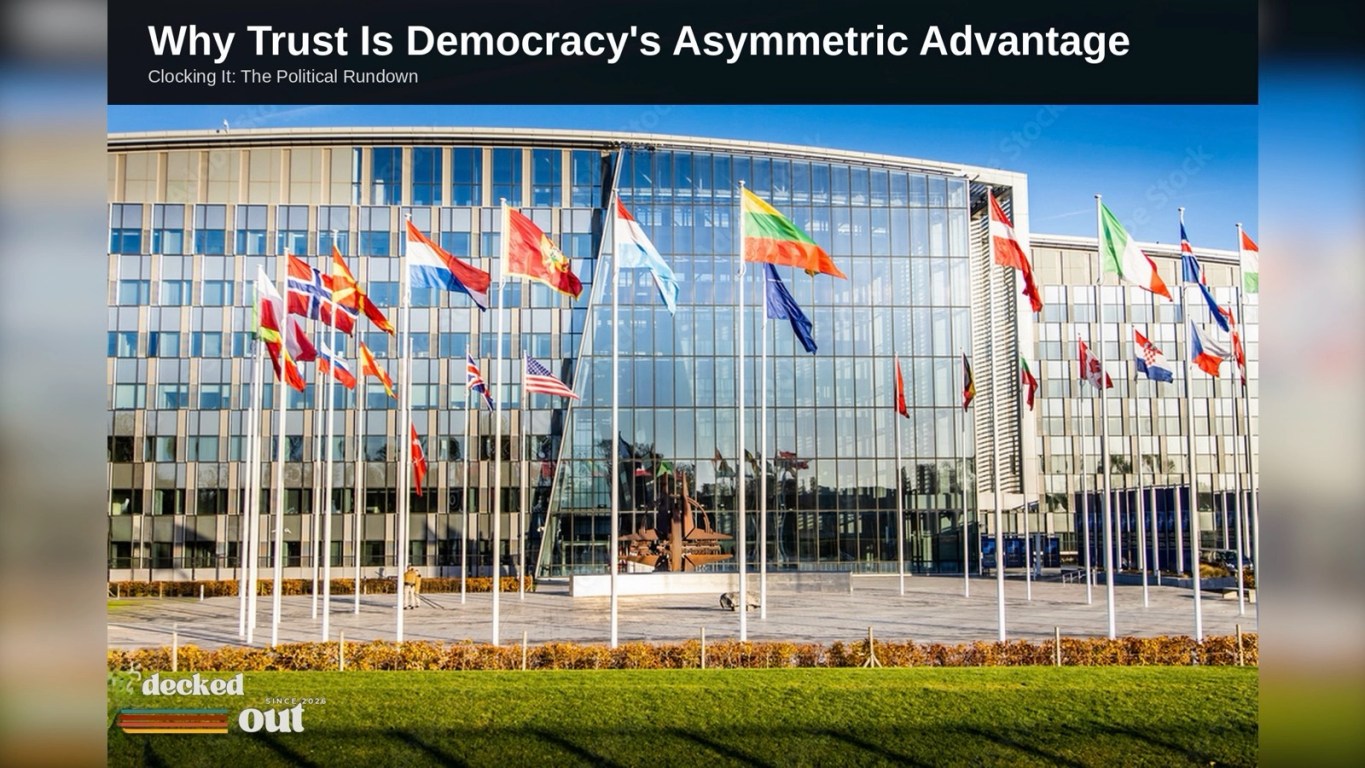
Let us begin with the institution that has been pronounced dead more times than any other: NATO.
The obituaries for trans-Atlanticism are being written too soon. Yes, the Trump administration has profoundly shaken the U.S.-European relationship. Yes, trust is draining away fast. Yes, the alliance faces perhaps the biggest challenge in its history, a potential future without the United States or U.S. security guarantees.
But the evidence points not to the end of the trans-Atlantic alliance but to the emergence of a more demanding and ultimately more durable partnership. NATO is not dying. It is being renegotiated.
The concept of “NATO 3.0” has emerged as the framework for this transformation. Under this model, Europe would be capable of providing for its own security, shifting from dependence on the U.S. to a fairer sharing of responsibilities. The NATO Summit held in Türkiye in early July 2026 was widely viewed as a new milestone in this adaptation.
The numbers tell the story of an alliance that is finally stepping up. Defense spending by European members and Canada has expanded substantially, projected to rise by 11% in 2026 compared to 2025. All 32 allies signed a landmark pledge to allocate 5% of their gross domestic product to defense. European allies and Canada have boosted their collective defense investments from 1.4% of GDP in 2014 to 2.3% in 2025. German Chancellor Friedrich Merz has said that Berlin aims to reach NATO’s 3.5 percent defense spending target by 2029, years ahead of the agreed timeline.
This is not collapse. This is maturation. Europe is finally emerging as a geopolitically mature entity, accepting the strategic autonomy that has been optional for too long. As one analysis put it: “A burden shifting from the U.S. toward Europe is ongoing … Europeans are taking action on their own initiative because of Trump’s hostility, not as a result of U.S. instigation.”
The transition is not without risks. Europe still lacks several vital operational capabilities, including intelligence, surveillance, reconnaissance, and space-based data collection. As of 2023, the U.S. alone operated 246 military satellites, while the combined number owned by all European NATO members amounted to merely one-fifth of that figure. Reducing dependence on the U.S. requires resolute political will and consensus on common European security issues.
But the direction is clear. NATO is no longer viewed as a pillar of the liberal international order. Increasingly, it is seen as a narrower military arrangement. But that does not mean it is worthless. It means it is being remade for a new era, an era in which Europe takes the lead in its own conventional defense while the United States focuses on strategic competition with China.
The alliance that was built to contain the Soviet Union is adapting to contain a multipolar world. That is not failure. That is survival.
AUKUS: The Alliance of the Future
If NATO represents the adaptation of an old alliance, AUKUS represents the creation of a new one.
The trilateral security partnership between Australia, the United Kingdom, and the United States is the most significant defense alliance created in the 21st century. And its most important work is happening under Pillar II, the advanced capabilities pillar that pools the talents of each nation’s defense sector to develop transformational military technologies.
The list of Pillar II technologies reads like a blueprint for 21st-century warfare: undersea capabilities, quantum technologies, artificial intelligence, autonomy, advanced cyber, hypersonic and counter-hypersonic systems, and electronic warfare.
The achievements are already visible. During Exercise Talisman Sabre 2025, AUKUS partners deployed subsea autonomous and remotely-operated uncrewed vehicles to conduct intelligence, surveillance, and reconnaissance missions. They deployed advanced artificial intelligence algorithms on an Australian P-8A Maritime Patrol aircraft for the first time, allowing military forces to locate and identify adversary submarines faster than human operators could alone.
In June and July 2025, AUKUS partners tested and benchmarked their leading quantum optical atomic clocks at the Naval Research Lab in Washington D.C.. In November 2024, they signed the Hypersonic Flight Test and Experimentation (HyFliTE) Project Arrangement. In May 2026, they announced the joint development of transformational underwater technologies, the first signature project under Pillar II, with the first capabilities expected in service by 2027.
What makes AUKUS different from the alliances of the past is not just its technology. It is its flexibility. It is designed to be adaptable, to bring in partners as needed, Japan has already participated in Maritime Big Play exercises, and to focus on capabilities rather than geography.
AUKUS is not a relic of the Cold War. It is a model for the alliances of the future: agile, technology-focused, and built around shared interests rather than shared ideology alone.
The European Democracy Shield: Defending Democracy From Within
If NATO and AUKUS represent the military dimension of the democratic arsenal, the European Democracy Shield represents the political one.
As of November 2025, the European Union’s policies to defend democracy against authoritarian contestation have crystallised into a new policy framework: the Democracy Shield. The Shield defines the principal threats to Europe’s political order as predominantly external and systemic—including authoritarian regimes that utilise hybrid tactics to exploit social divisions, manipulate elections, undermine trust, and distort history.
The Shield is not perfect. The European Democracy Shield contained unaddressed weaknesses. The EU deepened cooperation with many autocratic regimes and declined to respond in any critical manner to many clear attacks on democratic norms. But it represents a recognition that democracy cannot be taken for granted, and that defending it requires more than military power.
What a “Democracy Shield” for the broader liberal alliance might look like includes several elements:
Coordinated export controls. The democracies of the world should coordinate to deny authoritarian regimes access to the technologies they need to build surveillance states, repress dissent, and wage war. Not just semiconductors and AI, but the entire ecosystem of dual-use technologies that enable authoritarian control.
Sovereign tech funds. Democratic nations should invest in building their own technological capabilities, reducing dependence on authoritarian supply chains and ensuring that the technologies of the future are built by free societies, not controlled by autocratic ones.
A Marshall Plan for civil society. The original Marshall Plan rebuilt Europe after World War II. A 21st-century version would rebuild civil society in struggling democracies. Independent media. Civil society organizations. Rule of law institutions. The infrastructure of democracy itself.
Trust-building mechanisms. The most important asset democracies have is trust. Trust between allies. Trust between citizens and institutions. Trust in the rules-based order. That trust has been eroded, by disinformation, by polarization, by the deliberate weaponization of information by authoritarian regimes. Rebuilding it requires sustained investment in media literacy, fact-checking, and democratic education.
The Asymmetric Advantage: Why Trust Wins
Here is the cultural reality that matters most.
Autocracies project strength through coercion. They control their populations through surveillance, repression, and propaganda. They project power through military force and economic pressure. They win tactical battles because they are willing to pay costs that democracies are not.
But coercion has limits. Surveillance does not create loyalty. Repression does not generate innovation. Propaganda does not build trust. And without trust, no system can endure.
Democracies are different. Democracies are built on trust. Trust between citizens and institutions. Trust between allies. Trust in the rules-based order. That trust is messy. It is inefficient. It is often frustrating. But it is also self-correcting.
When a democracy fails, the people can vote the failures out. When a democracy makes a mistake, it can admit it and change course. When a democracy faces a crisis, it can mobilize the collective energy of a free people.
Autocracies cannot do any of these things. When an autocracy fails, it must hide the failure. When an autocracy makes a mistake, it must double down. When an autocracy faces a crisis, it must rely on coercion, which only deepens the crisis.
This is the asymmetric advantage that democracies possess. Not military power. Not economic might. Trust.
The 21st century belongs not to the strongest state, but to the most trusted one. The state that can build alliances based on mutual interest, not coercion. The state that can attract talent and investment because people believe in its future. The state that can weather crises because its citizens trust its institutions.
That state is not China. It is not Russia. It is not Iran. It is the democratic alliance, if it can wake up and wield its advantage.
The Verdict — Democracy’s Arsenal Is Ready. Will We Use It?
Halfway Clocked showed us the cracks in the authoritarian facade. China’s demographic collapse. Russia’s resource dependency. Iran’s legitimacy crisis. Three autocracies that project strength because they cannot afford to show weakness.
This week’s Verdict shows us the alternative. NATO 3.0: an alliance adapting to a new era of shared responsibility. AUKUS: a partnership built for the technologies of the future. The European Democracy Shield: a framework for defending democracy from within.
The tools are available. The alliances exist. The technologies are being developed. The strategies are being written.
The question is whether we have the will to use them.
The liberal international order is not dead. It is being renegotiated. The trans-Atlantic alliance is not collapsing. It is becoming more demanding and ultimately more durable. The democratic arsenal is not empty. It is being restocked.
But none of this matters if democracies continue to sleep. None of this matters if we continue to believe that autocracies are inevitable. None of this matters if we continue to treat authoritarianism as the future rather than the pathology it is.
The verdict is not that victory is assured. The verdict is that victory is possible, if we choose to fight for it.
The 21st century belongs not to the strongest state, but to the most trusted one. Trust is democracy’s asymmetric advantage. And it is time to wield it.
Clocked. That’s the tea.
Sources
· “NATO 3.0” model: A test of strategic autonomy, Nhan Dan, July 26, 2026
· Ankara summit to test NATO unity amid transatlantic strains, People’s Daily, July 6, 2026
· US and Europe move to adjust relationship toward shared responsibility, Nhan Dan, August 7, 2026
· “Trans-Atlanticism Isn’t Dead—It’s Being Renegotiated,” German Marshall Fund / Foreign Policy, July 1, 2026
· “NATO would survive a US withdrawal. But what kind of alliance would it become?” The Conversation, May 18, 2026
· AUKUS capability achievements, Australian Department of Defence, July 17, 2026
· AUKUS underwater tech partnership, UK Government, May 30, 2026
· AUKUS EW systems testing, Janes, March 18, 2026
· European Democracy Shield framework, EU Awareness, December 2025
· Carnegie Endowment, “Can the EU Overcome Divisions on Defense?” April 22, 2025
· Elcano Royal Institute, “Rebuilding European defence?” September 18, 2025
About the Author
Andrew Greene is a quality-obsessed, results-driven powerhouse with nearly two decades of experience transforming complexity into clear, actionable solutions. His secret weapon? A mix of analytical sharpness, problem-solving precision and a communication and leadership style that’s equal parts clarity and charisma. From Quality Assurance to political data analysis, you can think of him as the Swiss Army knife of operational excellence, minus the corkscrew (unless it’s a team celebration).