

09/12/2026
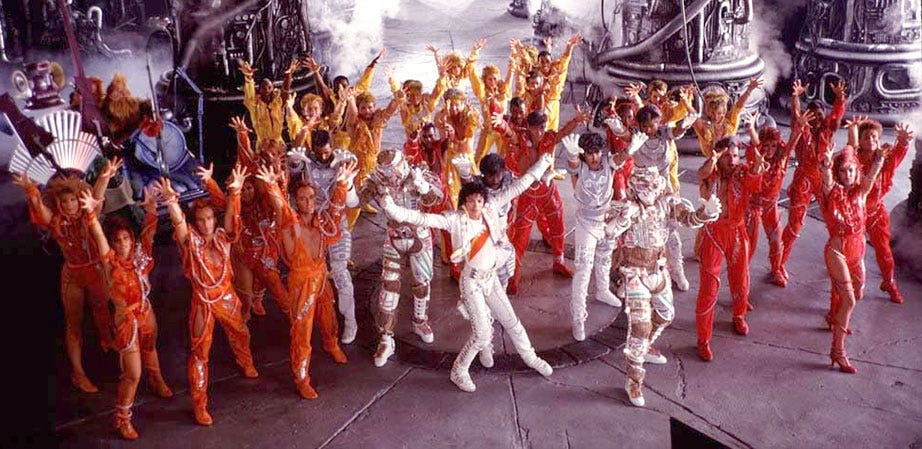
Michael Jackson as Captain EO stands at the front of a large group of dancers inside a foggy, futuristic industrial lair. Jackson wears his signature white sci-fi captain suit with silver armor pieces, striking a dynamic dance pose with both arms outstretched. Surrounding him, dancers in brightly colored futuristic jumpsuits, bright orange, yellow, red, and silver, pose in unison with their arms raised in the air. The dark gray metallic background is filled with heavy cables, machinery, and swirling white fog.
Captain. What springs to mind? Captain America? Captain Boomerang? Captain Kirk? Hell, even Captain Caveman? Well, unless you blindly clicked on this article, not bothering to even glance at the headline, I doubt Captain EO would’ve been on your list at all. And for good reason. He’s not a household name, not on the Marvel Comics roster, not even a classic character in the vein of Flash Gordon. But he is Michael Jackson, and unless you’ve been living on the planet Mongo for nearly 60 years, you’ll know exactly who he is.
Forty years ago, Disney opened a seventeen-minute film starring that man, built at a cost that would have funded a proper feature, directed by Francis Ford Coppola, executive-produced by George Lucas, and watchable nowhere on Earth except inside a Disney theme park. It played four parks across three continents, closed one by one through the nineties, returned as a tribute after Michael died, and closed again. It has never had an authorised release on video, on disc or on any streaming service. One of popular music’s most cinematic performers made a film with no legitimate way to see it.
To understand why it happened at all, and why its absence still aches, you have to go back much further than 1986. In Moonwalk, Michael’s 1988 memoir, he recalls being a child on the Motown soundstages. His brothers would groan through the hours, saying they’d be glad when the shoot was over, and little Michael could not fathom why they weren’t enjoying it. He watched instead. He studied what the director was after, tracked what the light man was doing, wanted to know why a scene needed so many takes. He called it his ongoing education in films. “I love the movies and have since I was real little,” he wrote. “Films can take you anywhere.” He described sitting down in a cinema and demanding to be carried somewhere wonderful, away from the pressures and the schedule.
Table of Contents
The boy and the Mouse
The corporate version of Captain EO‘s origin story involves Michael Eisner’s new regime, phone calls from Michael’s adviser David Geffen, and an Imagineering brief scrawled at speed: George Lucas, Michael Jackson, 3-D, ideas in days. All true. But Michael’s own account, given in Moonwalk, deserves to lead, because it reveals what he thought he was doing. Disney, he wrote, wanted a new ride and told him they didn’t care what he did as long as it was creative. So he sat in a meeting and spent the afternoon telling Disney executives that Walt was a hero of his, that he had read book after book on the man’s creative empire, and that he wanted to make something “Mr. Disney himself would have approved.”
He had every scrap of leverage in the room. Thriller had made him the biggest star alive, Disney had come to him, and the brief was whatever he wanted it to be. He spent it auditioning for a dead man’s approval. When Imagineer Rick Rothschild’s team pitched three concepts, the one Michael and Lucas seized on instantly was The Intergalactic Music Man: a stranger arrives in a cold, dead world and restores warmth and colour through music. Michael described the finished idea in one line that no studio synopsis has ever bettered: “Captain EO is about transformation and the way music can help to change the world.”
He flew up to visit Lucas at Skywalker Ranch, and together they shaped a short film built to swallow every recent advance in 3-D technology, one where the audience would feel they were in the spaceship, “along for the ride.” Spielberg was his other dream collaborator but was busy, so Lucas brought in Francis Ford Coppola, and that, as Michael put it with a shrug you can hear through the page, was the Captain EO team. (One footnote for the pedants: Michael remembered George coining the name from the Greek for dawn, while Harrison Ellenshaw, the visual effects supervisor who had worked on Star Wars and The Empire Strikes Back and whose father Peter painted Disney’s legendary matte backgrounds, remembered Coppola reaching for Eos in a San Anselmo story meeting. Memory is like that. Either way, the character who brings light to a dark planet was named for the sunrise.)
The kid in charge
Coppola’s descriptions of his star have sometimes been read as relatively warm. He remembered Michael as “genuinely sweet and kind of a boy in perpetual childhood”, and in the same breath called him highly intelligent and immovable on anything musical. His imagination had never been sanded down by adulthood, and on his own territory his instincts outranked the man who made The Godfather. Coppola wanted the climactic dance woven through the narrative, but Jackson resisted, keeping the songs apart from the story until late in the process. Coppola summed up the whole directing job in three weary words, “you constantly negotiate”, and lost the argument anyway. Forty years on, ask yourself which of them understood what a Michael Jackson performance was for.
Rusty Lemorande, who produced the film and co-developed its screenplay, recalled Michael pushing hard for a genuinely frightening Queen because he believed children enjoy being scared, and his stated reference points were a double bill only a child raised on wonder and terror in equal measure could assemble: he “loved Alien, he loved Snow White.” The Supreme Leader was the result, strung in a web of cables and biomechanical dread. She was played by Anjelica Huston, who collected an Oscar for Prizzi’s Honor in the year EO opened. A 1987 Starlog publication clocked her at once as a “Gigeresque” version of the Wicked Witch of the West, which is a fair description of a creature built from the collision of Giger’s biomechanical nightmare and Disney’s storybook wickedness. The makeup team called the resemblance unintentional. Whatever influences shaped the design in 1985, the finished creature puts Michael’s two favourite nightmares in the same room: the xenomorph and the wicked stepmother.
He adored Fuzzball, the little winged sidekick built by Rick Baker, the creature-effects master who had won the first competitive makeup Oscar ever awarded for An American Werewolf in London. Baker grudgingly repainted Fuzzball red at the late request of Vittorio Storaro, Coppola’s Apocalypse Now cinematographer, who decided the creatures should form a rainbow. Michael, for his part, lobbied for Fuzzball to get more screen time.
And Huston supplied the recollection that explains the whole gamble. Michael asked her to remain in her full prosthetics, three hours in the chair each morning, even for the shots where she was off camera entirely. She was irritated at first, then playback began and he started to sing, and she later recalled being overwhelmed by the electricity surrounding him: “I’d never seen a transformation like that.” Choreographer Jeff Hornaday, who had come off Flashdance, found he had to invert his entire working method for the same reason. Rather than handing Michael steps, he let him improvise to the music, then expanded whatever emerged into something forty dancers could perform, describing him as a collaborator at every level of the production. Then the shy boy starts to dance, and the world changes colour.
The dream deferred
Here is where the story turns, because Michael told us plainly what Captain EO meant to him. Working on it, he wrote, reinforced every positive feeling he had about film and convinced him more than ever that movies were his future. He loved being in front of the camera. He was itching to pioneer, and he had sharp words for a movie industry he saw drowning in formula, comparing the big studios to Motown during the disagreements of his youth: executives wanting easy answers and sure bets while the public quietly got bored. Lucas and Spielberg, he noted, were the exceptions. This from a man writing in his 1988 memoir, describing Hollywood’s franchise-clogged arteries with thirty years’ advance notice.
The sustained feature-film career he wanted never materialised. There was The Wiz behind him and Moonwalker ahead, and then decades of rumoured projects that never escaped development. A man who studied light and coverage from the age of ten ended up with seventeen minutes in a theme park as the truest record of what he might have been on screen. The critics of 1986 who dismissed EO as an overlong pop video had it exactly backwards. It was a feature-film career compressed under unimaginable pressure into a single reel.
Building that reel was another story. The production swelled from around forty planned effects shots to a number Lucas reportedly put at three hundred and fifty, past the original Star Wars, while Disney studio chief Jeffrey Katzenberg fought the spending and Ellenshaw’s post-production slid into nine months of chaos. The final bill has been folklore ever since, with retellings ranging from $17 million to $30 million, though Disney historian Jim Korkis has reported that WDI’s internal final billing, a figure never released publicly, came to $23.7 million against an original estimate of $10 million. The theatre itself became part of the film: synchronised lighting, lasers, smoke, effects pushing out into the auditorium. Rothschild has said flatly that the form we now call 4D “really came from Captain EO.” Michael would have treasured one detail. The engineer Disney credits with building EO’s 3-D projection and in-theatre effects was Don Iwerks, son of Ub Iwerks, the animator who sat beside Walt Disney at the very beginning and helped draw Mickey Mouse into existence. The boy who wanted Mr. Disney’s approval got his film projected by the bloodline of Walt’s first collaborator. Iwerks went on to build the projection rig for Star Tours, and D23 lists Captain EO as Lucas’s first Disney project, the start of a relationship that eventually led to Disney’s purchase of Lucasfilm in 2012. As opening day arrived, Rothschild asked Lucas what it had all been like, and the answer was perfect: “We had no idea what we were getting into.”
Be careful with the attendance mythology, though, because the honest version makes a better argument. Disneyland was thriving before Michael arrived, with visitor numbers soaring through fiscal 1985 on the back of a lavish 30th anniversary campaign, and EO opened barely a fortnight before the 1986 fiscal year closed, too short a window to read much into that year’s figures. The record attendance of 1987 belongs partly to EO, partly to Star Tours and partly to a strong tourism climate. What Michael actually gave Disney was demographic and cultural. Eisner’s company was openly chasing teenagers, had built the Videopolis dance club as bait, and then reached for the nuclear option: the biggest pop star on Earth, installed in Tomorrowland. Disneyland in the mid-eighties risked becoming culturally inherited, a place parents took children because their own parents had taken them. Michael made Disney a participant in 1986 rather than a museum of everyone’s childhood. Disney hired him as an engine of its rejuvenation, and the strategy EO helped prove, importing living pop culture into the parks, is one the company has been running on ever since.
The premiere week supplies the saddest chapter of the whole story, and the one that belongs at the centre of any account told through Michael’s eyes. In the days before the Disneyland opening, the National Enquirer ran the infamous photograph of Michael lying in a hyperbaric chamber. Korkis’s account has it that Michael leaked the picture himself, a piece of self-mythology timed to stoke the science-fiction mood around his space film, and that the ridicule which followed is why he stayed away from his own premiere. Whatever the reason for his absence, Eisner was left to joke to the crowd that Michael was present in disguise as an old lady, an usher or an Audio-Animatronic. In Korkis’s telling, the dreamer’s imagination, the very thing the film was built to celebrate, had turned on him at the door. He did come to the test screenings, though, slipping in behind his surgical mask, and when guests kept recognising him he retreated to the projection booth, where he watched his film, and watched the audience watching it, from a small dark room above their heads. Sit with that image for a moment. The most famous man alive, hidden in the one place in the theatre where the magic he made could not reach him.
And the audience below him was rapturous. Early screenings broke into applause mid-film, and Korkis cites an internal Disney survey from those first months in which 93 per cent of respondents named seeing Captain EO as their primary reason for visiting the park. The film played at EPCOT until 1994, Disneyland until 1997, Tokyo until 1996, and Paris until 1998. After Michael died in 2009, Disney brought it back across its parks, and audiences queued for a seventeen-minute film from 1986 until the tribute engagements closed in 2014 and 2015. Since then, the vault.
Someday
Which brings us to 2026 and the anniversary Disney chose to have. As of 10 September, Disney had announced the anniversary plush, but I couldn’t find any Captain EO screening or retrospective, and Lucas or Coppola had made no public comment tied to the fortieth. Instead, the company released an interactive Fuzzball plush at D23 in August, with chirping sounds and all, marketed explicitly around Captain EO‘s fortieth. The creature Baker repainted under protest. The sidekick Michael fought to keep on screen.
It went into scarcity. The plush went on sale through Disney Store in August at $54.99, and the listing later showed it out of stock. That is the state of play for an orange puppet from an attraction that closed a decade ago, from a film with no legitimate way to see it.
And on that point, a detail worth knowing. One reported reason Captain EO has never appeared on home video or streaming is buried in the original contracts, which required additional compensation for the performers if the film screened outside a Disney theme park. If those accounts are accurate, the obstacle that has kept EO off your television for forty years is one that a park exhibition would not necessarily trigger at all. I have not seen the contracts, and they are not publicly available, so I will not pretend a 2026 revival would need zero new clearances.
The chirp is part of a much louder noise. By late summer, the Michael biopic had become the highest-grossing music biopic ever made, surpassing Bohemian Rhapsody. The movie stardom he wrote about wanting in 1988 arrived in the only form he could no longer participate in, with his name at the centre of a blockbuster and the man himself seventeen years gone. Audiences queued for a 1986 short film in 2010 and filled cinemas for the biopic this year. Then they emptied the shelves of a chirping orange puppet.
Disney has the negative, which Rothschild described in 2010 as protected and good enough to strike a fresh print from, and Korkis reports that the company made a 4K scan and sound restoration in 2013 when the ageing materials deteriorated. If that reporting holds, a modern master is already sitting in a Disney vault. Disney has also warmed to this idea before: shortly after Michael’s death, Bob Iger said there were no plans to bring Captain EO back then, while confirming the company was considering it; within a year, it was playing in four parks. The stage is largely dressed, too. The 4D form Rothschild traces back to Captain EO now runs at five Disney parks under the banner of Mickey’s PhilharMagic, air bursts, scents and water sprays included. EO’s original Epcot home, the Magic Eye Theater, is open today, currently showing the Disney and Pixar Short Film Festival, eighteen minutes of shorts with in-theatre effects. A return would mean assessing the theatre and adapting its effects package, as the 2010 revival did, so nobody should pretend this is free. But the film and an existing effects theatre give Disney a starting point. The company would be returning Captain EO to the auditorium that Kodak paid to remodel around it in 1986, in a format it helped popularise, for an anniversary sitting in September like an open goal.
In Moonwalk, reflecting on the industry that kept artists boxed into formula, Michael made himself a quiet promise: “I’m going to try to make some changes. I’m going to try to change things around someday.” He was writing about the movies. Someday has been a long time coming, and he is not here to see it, but the boy who wanted to make something Mr. Disney would have approved of already did, forty years ago, and it is sitting in a vault. Bring back the magical musical spaceman. Put Captain EO where he belongs: up on that screen, dancing the colour back into the world, taking us anywhere.
About the Author
As a freelance journalist, Ryan Smith’s work is driven by a commitment to restoring what has long been absent from institutions meant to uphold truth and accountability: honesty and transparency. Alongside his analysis works on the life, career, trials and tribulations of Michael Jackson, whose unfair treatment over the years paved the way for the path he is on, Smith also dissects and examines popular culture, such as books, movies and video games, always aiming to shed light on what’s beneath the surface.
One thought on “Captain EO at 40: Bring Back Michael Jackson’s Disney Film”