

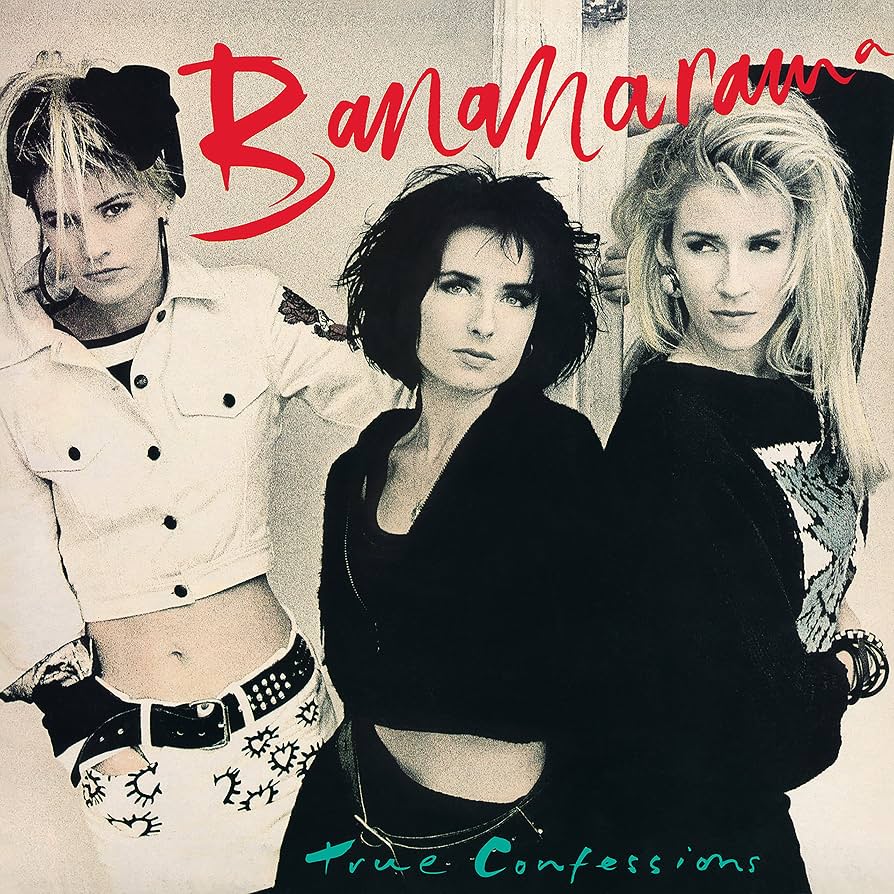
True Confessions, Bananarama’s third album and the one that gave them “Venus”, entered the Official UK Albums Chart at number forty-six in 1986 and never climbed higher. The 40th anniversary edition went in at number six this week. London Records, Bananarama’s record label, spotted the symmetry in their announcement and it’s a lovely bit of arithmetic: forty years on, forty places up.
It’s the highest a Bananarama studio album has ever charted in Britain, ahead of Deep Sea Skiving, which reached the Top 10 in 1983. Their Greatest Hits Collection still sits above the lot, having entered on 22 October 1988 and peaked at number three on 7 January 1989, so the record being broken is specifically the studio-album one. Sara, Keren and Siobhan have earned the champagne either way.
True Confessions didn’t change, though. Eleven songs in the order they were sequenced in 1986, sung by the same three women. What changed with True Confessions was everything around it: who buys records, how they buy them, and what a chart counts when it adds up the week. Point two different systems at one album and you can get answers forty places apart.
True Confessions 1986
True Confessions entered the UK albums chart at number forty-six on 19 July 1986. “Venus”, the single from it, spent that exact week at number eight, the second of two weeks at what would remain its joint peak. It had climbed slowly, entering at fifty-five at the end of May and taking six weeks to crack the Top 10, so “Venus” stood no higher in Britain at any other point in its chart life than in the week its parent album crawled in at forty-six.
This wasn’t a fading hit dragging a late album behind it. True Confessions then managed five weeks in the Top 100 and was gone by mid-August. “More Than Physical” followed in August, by which point the record it was promoting was already sliding off the chart.
The same album, three different verdicts
Now put the international columns alongside it. True Confessions reached number fifteen on the Billboard 200, spending a fortnight there in September 1986, which remains the highest an album by Bananarama has ever placed in America, and it went gold. It reached number six in Switzerland and stayed on the chart there for ten weeks.
One record. One historical moment. One set of songs. American Top 20 and gold, Swiss Top 10, and five British weeks without once climbing higher than forty-six.
That comparison isn’t a controlled experiment, since promotion, radio, distribution and release timing all differed by territory. It doesn’t have to be. It’s enough to establish the thing the rest of the argument rests on: forty-six was never a universal market verdict on this album. Something specific to Britain produced that number.
The likeliest explanation is that Britain’s singles and album markets rewarded different buying behaviour. A single was an impulse purchase for a couple of quid. An album was a considered one, made by people who had opinions about themselves and what their shelf said about them. Bananarama could dominate the first market without reliably converting that audience into comparable studio-album sales, and True Confessions is the sharpest instance of the gap in their catalogue.
Whether the music press helped keep it that way is where the band’s own testimony belongs. Sara Dallin has described how blokey the papers were and how Bananarama were never held in the esteem given to male bands; Keren Woodward remembers the volume of nasty articles. That evidence explains why Britain might have been the anomaly. It doesn’t have to carry the impossible burden of proving that a review caused a chart position, and it shouldn’t be asked to.
What can be stated flatly is the credibility gap. Dallin, Fahey and Woodward hold writing credits on eight of the album’s eleven tracks, and by 1986 they had already written songs touching on date rape, the Troubles and drug addiction. They were still routinely filed as lightweight product. Dallin has described arriving at interviews to be asked whether they had ever thought about writing their own material, a question that kept coming for so long that Woodward eventually dead-legged the singer of D:Ream on a staircase for asking it.
The gap between how they were read at home and abroad was almost comic. That summer, while “Venus” was climbing towards number one in America, Dallin recalls the NME asking Andy Warhol what the biggest thing happening in New York was. His answer was Bananarama.
Dallin and Woodward’s memoir, Really Saying Something, provides a more concrete example of the working conditions during the imperial phase. Woodward was pregnant throughout the True Confessions campaign, doing the American promotional tour at roughly six months and ill for most of it, and she recalls people at the label treating the timing as an inconvenience, with a suggestion that she might wait for a better moment to have the baby. Weeks before her son was born, Woodward recalls the record company having them film the “A Trick of the Night” video as part of a BBC programme, *In at the Deep End*. She was heavily pregnant; the shoot ran overnight and, by her account, no allowances were made.
They also entered the Guinness Book of World Records for the sheer number of chart entries they racked up as an all-female group, a distinction recent accounts still credit them with holding. If nothing else, that ought to have killed the idea that they were some passing novelty. It didn’t. They kept producing evidence and the category survived the evidence every time.
Two producers, two philosophies, one collision
True Confessions is stranger and better than its reputation allows, and the strangeness is in how it was built.
Nine of the eleven tracks were produced by Steve Jolley and Tony Swain, the pair who had shaped the first two albums into something moodier than the public image suggested. The Jolley and Swain material is serious-minded and rock-leaning: relationships going wrong on “Ready or Not” and “Promised Land”, an anti-drug lyric on “Hooked on Love”, and “A Trick of the Night”, which is the best song here and I will take that to arbitration.
Stock Aitken Waterman produced two tracks, “Venus” and “More Than Physical”, and those two carry the album’s entire dance-pop reputation. “Venus”, a Shocking Blue single from 1969, had been in Bananarama’s repertoire since their earliest days, and by Fahey’s account the three of them were stuck on what she calls “our difficult third album” with no lead single to build it around. Then they heard “You Spin Me Round” on the radio, and it settled the matter for all of them at once. They tracked the producers responsible to a studio in Borough, where Stock Aitken Waterman were still a fledgling operation next to the hit factory they were about to become, and proposed a hi-NRG “Venus”.
Nobody wanted it. Jolley and Swain had already rejected the dance treatment. SAW said it wouldn’t work either. And according to Dallin’s account in the memoir, their own record company, London Records, was not keen on the idea. The three of them were adamant, they kept pushing, and the record got made. The album was close to finished by then.
Two SAW tracks out of eleven, and the running order puts one of them at the top of side two. “Venus” is track six, so a Jolley and Swain album about bad romance and creeping unease has a Hi-NRG grenade going off the moment you flip the record. That collision is why it still rewards a proper listen, and it’s a fair guess at why it confused a 1986 buyer who had only heard the single.
The agency point matters more than the credits. Nobody handed three passive singers their big hit. Three women pushed an idea past everyone who knew better. The single went to number one in America.
What they won reshaped them. Stock Aitken Waterman produced the entire next album, and the increasingly production-line relationship is one of the reasons Fahey gave for leaving in 1988. True Confessions is the hinge: the record where Bananarama fought their way into the SAW system, just before that system became the centre of their sound.
2026: read the format charts
The main position is the headline. The format charts underneath it are more interesting.
True Confessions went in at number one on the CD chart and number four on cassette. On vinyl, it managed a respectable twelve.
Those three positions are worth reading carefully, and reading for exactly what they are. They can’t tell us which format sold the most copies, because each chart ranks a release against different competition in a different market. What they show is that the album competed unusually strongly in the CD and cassette fields rather than simply riding the modern vinyl-reissue market. They also can’t tell us the ages of the people buying, whether any of them owned the album in 1986, or how many are twenty-four-year-olds who worship Siobhan Fahey. Chart data doesn’t hand over demographics. But CD and cassette are the formats this album originally sold on, and a 1986 London/PolyGram trade advert pushed exactly that trio of record, cassette and compact disc. On the available evidence it looks less like a rediscovery than a reunion.
The reissue of True Confessions gave that audience plenty of reasons to turn up. A 3CD set, an expanded double vinyl, a picture disc, transparent red vinyl, a cassette, and three member-specific editions signed by Sara, Keren and Siobhan respectively, each carrying that member’s own recollections and a secret bonus track. Four new 2026 mixes across four remixers: Richard X, The Alias, Luke Mornay and AMYL. It’s an unusually lavish catalogue package, and the people it was made for went and bought it.
Getting the forty-year-old True Confessions into the Top 10 alongside the week’s new releases takes an audience willing to act in numbers. You can manufacture ten variants of a reissue and still need human beings interested enough to hand over money for them, and collectible editions don’t buy themselves.
The measuring instrument itself has also been rebuilt. Today’s Official Albums Chart combines physical formats, downloads, audio streams and video streams. Audio streaming entered the albums chart in 2015 and video streaming in 2023. The 1986 chart was based on physical retail sales, compiled by Gallup from a panel of retailers. These are not two readings from the same instrument.
What the gap actually shows
Both numbers are accurate. Neither is a referendum on the album.
Bananarama have spent four decades being summed up by figures that were counting different things and read as though they were counting the same one.
The record underneath them holds up. “A Cut Above the Rest” sounds like a threat. “More Than Physical” is better than its chart run. “Venus” remains an act of collective stubbornness by three women who pushed through three rounds of resistance.
London Records signed off their announcement by calling them girl group royalty. Absolutely. But just remember that they were royalty in 1986 as well, and the chart had them at forty-six.
Sometimes it takes 40 years to right a wrong.