Spoilers throughout, including the identity of the villain and the ending.
The film should’ve been called Spider-Man and His Amazing Friends because that’s essentially what it wants you to know. It wants you to understand the importance of connection, and what it costs you when you decide you can carry the lot on your own. And it’s a lesson that is very much welcome in an era of social isolation. Watch who actually saves Peter Parker in this thing, because it’s never Spider-Man.
For anyone coming to it cold, Peter’s identity was leaked to the world at the end of Far From Home, and No Way Home was the fallout. It got bad enough that he asked Doctor Strange for a spell that removed Peter Parker from every memory on earth, his friends’ included. Brand New Day picks him up four years on. MJ and Ned went to MIT without him. He stayed in New York and gave his whole self to the job, living in a small flat with the police scanner going, protecting a city that has no idea there’s a person underneath the mask.
RELATED: Spider-Man: Brand New Day (2026) Film Profile: Cast, Synopsis & Release Date
The film does something interesting with its central conflict. It arises from a familiar face we associate with heroics: Jean Grey, despite the dark side we’ve seen in the comics and onscreen in the past. She’s the thing terrorising the city for most of the runtime, an unseen force that can take hold of anybody’s body and mind, and the Department of Damage Control, the government outfit that polices anyone with powers, points Spider-Man at her and tells him to end it.
She and Peter are the same wound with two outcomes. Jean’s sister was snatched by the DODC for being different, experimented on and handed back dead. Peter works that out somewhere in the middle of hunting her, at which point he knows he’s been aiming at the wrong target. Peter chose his own erasure and has been living inside it for four years. The only real difference between the two of them is who they had left to talk to.
When the Hulk and Punisher were first shown to be involved, I believed this was Marvel throwing random character names into a hat and drawing them blindly. But they fit the theme of isolation, inner darkness and loss of control perfectly. Bruce Banner, now lecturing in quantum mechanics at Empire State University and holding himself together with an inhibitor device, is who Peter goes to for help when his own body starts turning on him. And like Peter, Banner can be standing in a room full of people and still feel disconnected due to what he’s carrying. Jean gets into his head, the inhibitor loses, and the anxiety the two men have been discussing in a lecture office becomes an actual Hulk fight. Frank Castle, who most of the audience walks in expecting to be the villain of the piece, is isolated by exactly the same thing. And again because of Jean, Castle’s loss of control comes out the way it always does, justified or not: a bullet that injures whoever is caught in the middle of the mess.
Plenty of ink has been spilt about whether a PG-13 Punisher can work, and the answer here is that he does, for a reason built into the story rather than the rating. Peter is the thing standing between Frank Castle and an 18 certificate. Every time Castle reaches for the version of himself we know from the Netflix run, there’s a lad in red and blue in the way, webbing his mouth shut or pulling the shot off target. Bernthal isn’t playing a diluted Frank. He’s playing a Frank who keeps being interrupted, and the interruption is the whole point of Spider-Man.
All of this stems from somewhere, and it isn’t Jean. The DODC identifies people by what they are rather than anything they’ve done. For the purpose of this story, that’s ICE with a Marvel logo on the paperwork, at least in who it decides to come for, and the film isn’t especially fussed about hiding it. What happens to them afterwards is the escalation only a comic can get away with. The X-Men allegory has always stretched to fit whichever decade it landed in, and this decade has picked its subject. What keeps it from being decoration is that the DODC is also the reason Peter spends half the film aiming at the wrong person.
There’s a second anxiety running underneath, and it’s quieter. Peter has no Stark money left, so he builds his own gear in that sad little flat, including an A.I. called E.V. that he talks to. Even Raimi’s Parker, at his lowest, got a knock on the door and a slice of chocolate cake and a glass of milk from Ursula, his landlord’s daughter, who barely knew him. This Peter has become a man erased from every life he loved, fabricating himself someone to speak to out of spare parts, which is roughly where we are: information and companionship arriving out of the same box, drawing us further into our worlds where the only inhabitant is speaking to itself whilst believing otherwise.
The E.V. material never announces itself, which is the harder trick to pull off. Peter gets no scene where he realises the thing isn’t a friend, and nobody delivers the speech about what all this is doing to us. It’s a bloke in a flat talking to a device that answers, and the film is content to let you notice how ordinary that looks.
That John Hughes influence they leaned on for the first three films has never felt more realised than it does here. If the “Home” trilogy drew its tone from Ferris Bueller’s Day Off and National Lampoon’s Vacation, then this is The Breakfast Club and Planes, Trains and Automobiles, where what’s said can hurt, where what’s said isn’t what you want to hear, and you still reach out and accept it regardless and make the best of it.
When the film pivots to Peter and his need to reconnect with Ned and MJ, who have forgotten him since the events of No Way Home, it goes old school in terms of filmmaking and takes its time. You could argue the breathing room for these scenes slows the film down, and that’s the beauty of it. It’s an art that is sorely missed, because most films today either believe the ordinary isn’t extraordinary enough to arrest attention, or don’t know how to make you care about the relationships on screen. Granted, Brand New Day has the luxury of three previous films of magnetic chemistry between Peter, MJ and Ned. But the film understands that these relationships are the story, and rebuilding them takes the time it takes.
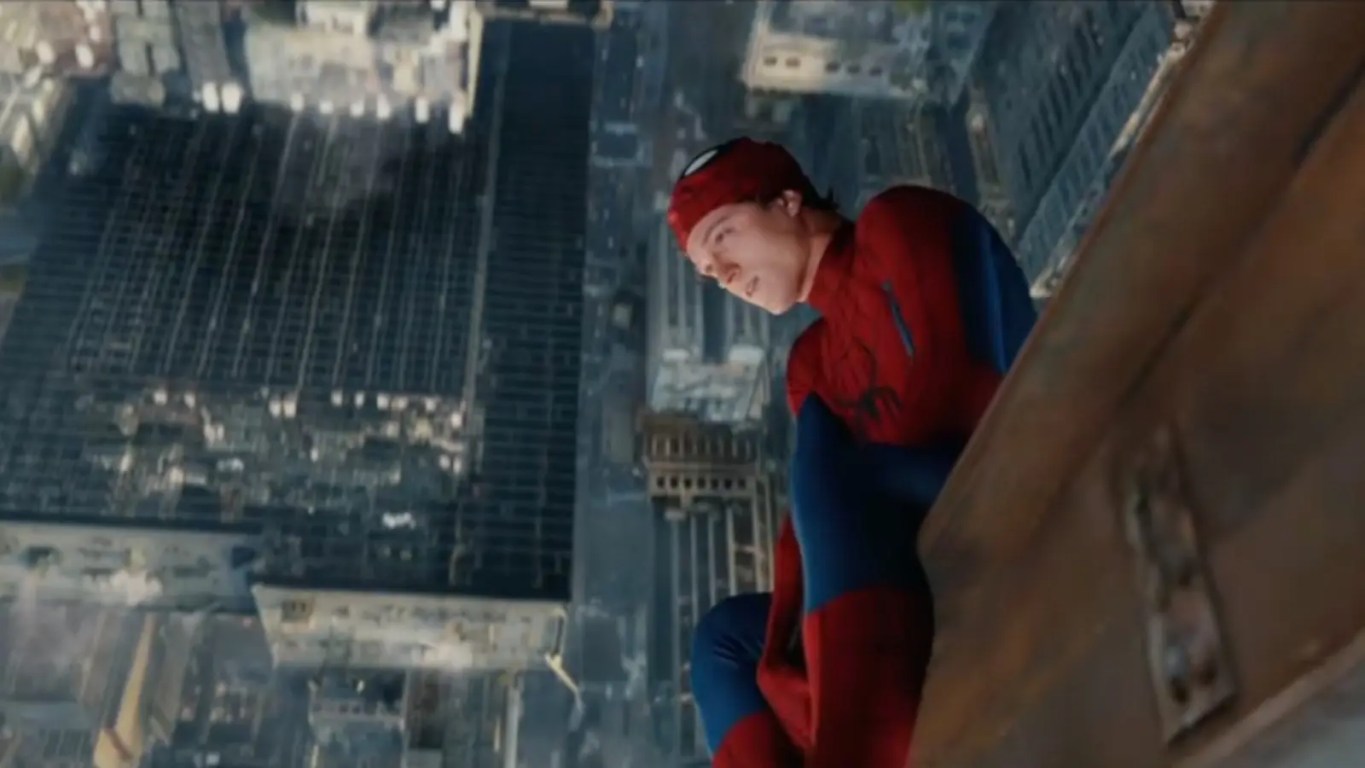
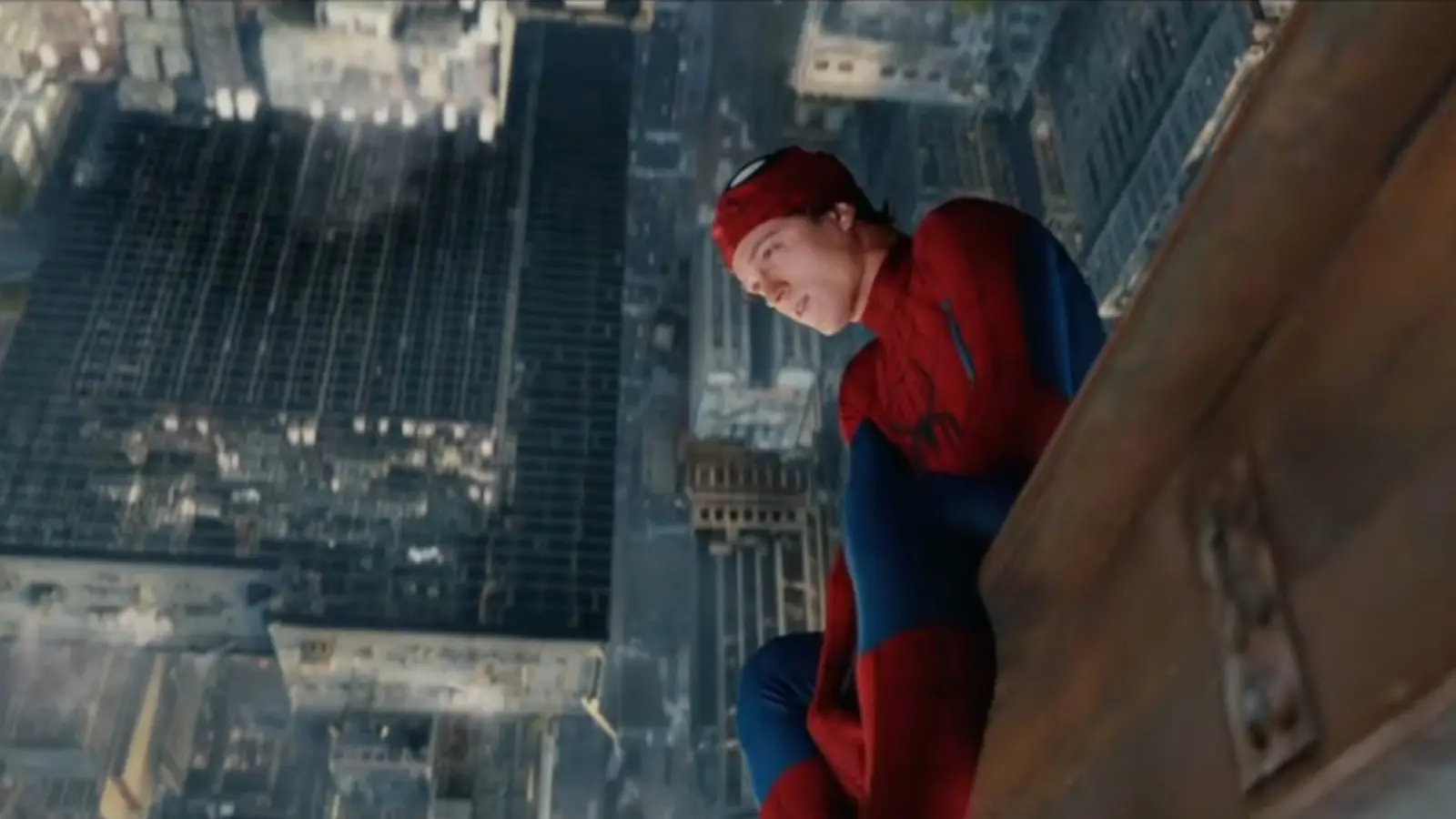
The same patience shows up in how it’s shot. Destin Daniel Cretton and cinematographer Brett Pawlak favour practical work wherever they can get away with it, and the swinging has weight to it because there’s usually something real in frame for Peter to swing past. The fight choreography comes from the Jackie Chan Stunt Team, who Cretton brought over from Shang-Chi, and it shows in the geography: you can follow every exchange, including the scrap with the Hand, which is more than most of this genre manages. Giacchino’s theme is still the best piece of music the MCU has produced for any character, and he knows exactly when to withhold it. Best of all is a handful of shots that recreate comic covers outright, filmed at 420 frames per second so that Holland can hold the pose. Amazing Fantasy #15 is in there. So is Amazing Spider-Man #129, which is where Frank Castle turned up in the first place.
Holland is the reason the emotional side holds. He plays Peter as a man in worse shape than the script actually writes him, and the gap between those two things is where the performance sits. It’s the best work he’s done in the suit, and the first time the damage has been the whole performance rather than the bits between the jokes. Sadie Sink is the standout of the whole film, and she’s carrying the hardest part of it. She’s playing grief rather than menace. There’s a version of this character that’s all glowing eyes and portent, and she never once reaches for it. Zendaya has less to do than in any of the previous three, and does something quite difficult with it: MJ has to be warm towards a man she’s meeting for the first time, and you can see the whole history she isn’t having.
And the best piece of writing in the whole film isn’t a line. It’s Ned’s wall and his tracker. He’s kept pictures of himself being rescued by Spider-Man during the events of Far From Home, and he’s built an app to hunt the wall-crawler down, all so he can find the man who saved him and his classmates and say thank you. That’s the entire film in props. It also answers, without ever announcing that it’s answering, the question No Way Home set up about whether Strange’s spell erased the digital footprint of Peter’s time with MJ and Ned: some of it, but not all. The spell took the person and left the hero, which is precisely the trade Peter has been making willingly for four years.
Where it lost the tightness is the climax, and it’s a Batman Forever parallel of all things. Peter is asked who he is: Spider-Man or Peter Parker? And he replies to a possessed member of the Hand, the ninja outfit last seen skulking through the Daredevil corner of this universe, that he’s both. It’s a decent answer to a question the film never asked. There is no real identity crisis in Brand New Day. There’s a mutation, which is a body problem, and there’s a grief problem, which is about who’s left in the room. Neither of those is “who am I”, and dressing the finale in that costume reaches for a resolution the previous two hours haven’t laid a brick for.
The mutation itself is lifted from Raimi and then only half committed to. In Spider-Man 2, Peter’s powers shut off because of the emotional turmoil he’s facing as his powers and superhero life collide with his ordinary life. Brand New Day‘s conflict for Peter is similar, but the isolation and despair that come with it are mutating his DNA, threatening to turn him more beast than man. It’s a strong idea, and it serves the theme rather than the plot, because it never costs anything. There’s never a point where you’re actually worried for anybody when Peter’s inner arachnid emerges, because you know it appears in short bursts and then vanishes without consequences. And you’re already primed to believe the worst won’t occur when the other half of the anxiety is played for laughs: his mutation causes him to develop organic shooters that spray his web like a fire hydrant. The film never finds a register where the body horror and the gag can share a scene, and doing both leaves it holding neither. What should have been the spine of Peter’s arc ends up as groundwork for future drama instead.
It pays the thesis off where it counts. Peter takes a bullet in the back for Jean, and Jean, who has spent the entire film climbing into people’s heads to hurt them, climbs into his to keep him alive until help can reach him. The girl he was sent to put down is the reason he’s still breathing. The film doesn’t hand her a recovery for it. She leaves on a bus, carrying everything the DODC did to her sister, with no one around her who has the first idea what that weighs. Everybody in the cinema can see which team is waiting at the far end of that road, and that’s the honest limit of what this story can offer her. It can give her the reprieve. The family has to come from her own kind, and that’s a different film.
Peter walks up to Ned in a shop and introduces himself as a stranger, and the handshake happens anyway, all on its own, because Ned’s hands know something Strange took out of his head. Whether that’s the spell cracking or muscle doing what muscle does, the film declines to say, and it’s right not to. MJ offers no such comfort. She reads the letter, and she tells him plainly that she doesn’t remember him and doesn’t love him. Nothing is restored here. It has to be built again from nothing, awkwardly, which is exactly the film this is.
At the end of Spider-Man 2, MJ asks Peter whether it isn’t about time somebody saved his life. It took twenty-two years and a spell that wiped him off the face of the earth, but somebody finally did. Several somebodies, in fact. Amazing friends, the lot of them. And if the film teaches you anything by the end, it’s to get out there and shake someone’s hand in the most awkward way you can.
4.5/5
Featured Photo: Marvel Studios
RELATED: Spider-Man (1977) Film Profile: History, Production & Marvel Live-Action Legacy
![[THE FILES] : Treasure Planet (2002)](https://deckedoutmagazine.com/wp-content/uploads/2026/06/treasure_planet_history_hero_image.webp)