
06/26/2026
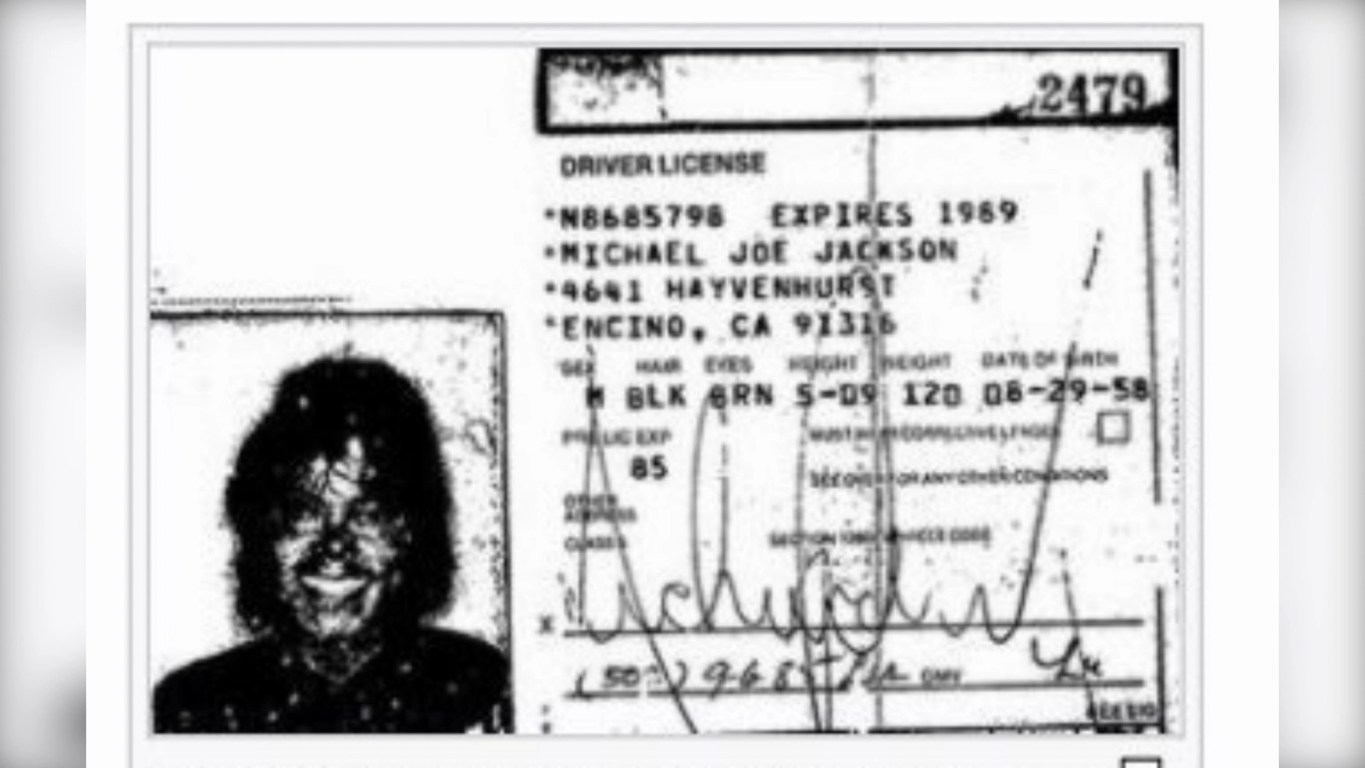
When the Federal Bureau of Investigation released its extensive records on Michael Jackson on December 22, 2009, the document dump offered an unprecedented glimpse into how America’s premier law enforcement agency viewed the iconic entertainer. Spanning more than 600 pages total, with eight parts being publicly released, these files paint a complex picture of federal interest in Jackson that stretched from 1992 to 2005.
The records, released under the Freedom of Information Act, demonstrate that FBI involvement with Jackson primarily centered around two areas: responding to threats against the singer and providing investigative technical assistance to California law enforcement during investigations into child abuse allegations. Despite the intensity of these inquiries, federal investigators ultimately found no evidence supporting criminal charges against Jackson.
Between 1993-1994 and again in 2004-2005, California authorities probed abuse accusations against the pop star. The FBI lent its technical expertise and investigative resources to these state-level cases. Furthermore, the bureau investigated genuine threats against Jackson, most notably from Frank Paul Jones, who was later imprisoned for his actions. Additionally, unbeknownst to Jackson himself, the FBI opened an investigation in 1995 and later closed the case in 2007.
Here are the FBI’s Michael Jackson Files.
Table of Contents
The Tabloid Trail: Part One
The initial installment of the released documents comprises ten pages dominated by legal paperwork and newspaper clippings. These materials reference an alleged improper 1979 phone conversation between Jackson and British disc jockey Terance George, 13 years old at the time. Jackson was twenty. The tabloid coverage reveals that George initiated contact with Jackson, not the other way around. When Jackson returned to London four years later, George attempted to revive their connection, meeting his idol and even posing for photographs together before being politely dismissed by Jackson’s management.
A decade after making his allegations, George appeared in Louis Theroux’s documentary Louis, Martin & Michael in 2003. When questioned about his accusations, he claimed they “came out really without my authority,” explaining that “it developed from somebody who had a big mouth, basically, one of my close friends who knew about the story.” While George maintained that “the majority is true,” he acknowledged that newspapers “get their bit and they twist it and they make things a bit sensationalized really.” With no corroborating evidence, recorded conversations, or formal legal complaints, neither Legat London nor the FBI pursued the matter further.
The Digital Deep Dive: Part Two
The second file section spans forty-four pages documenting forensic analysis of Jackson’s computer equipment. Following raids on Jackson’s properties in 2003, investigators seized sixteen hard drives. The FBI’s Computer Analysis Response Team (CART) meticulously examined each drive, compiling their findings in an April 5, 2004 report addressed to Sheriff Jim Anderson.
Their exhaustive investigation revealed no incriminating materials whatsoever. The hard drives contained no illegal content, and the computer histories showed no evidence of accessing or searching for such materials. On March 29, 2004, CART forwarded four DVDs to the Forensic Audio Video Image Analysis Unit (FAVIAU) solely for file formatting conversion. After completing this technical task, investigators noted definitively that “there are no outstanding leads or evidence items.”
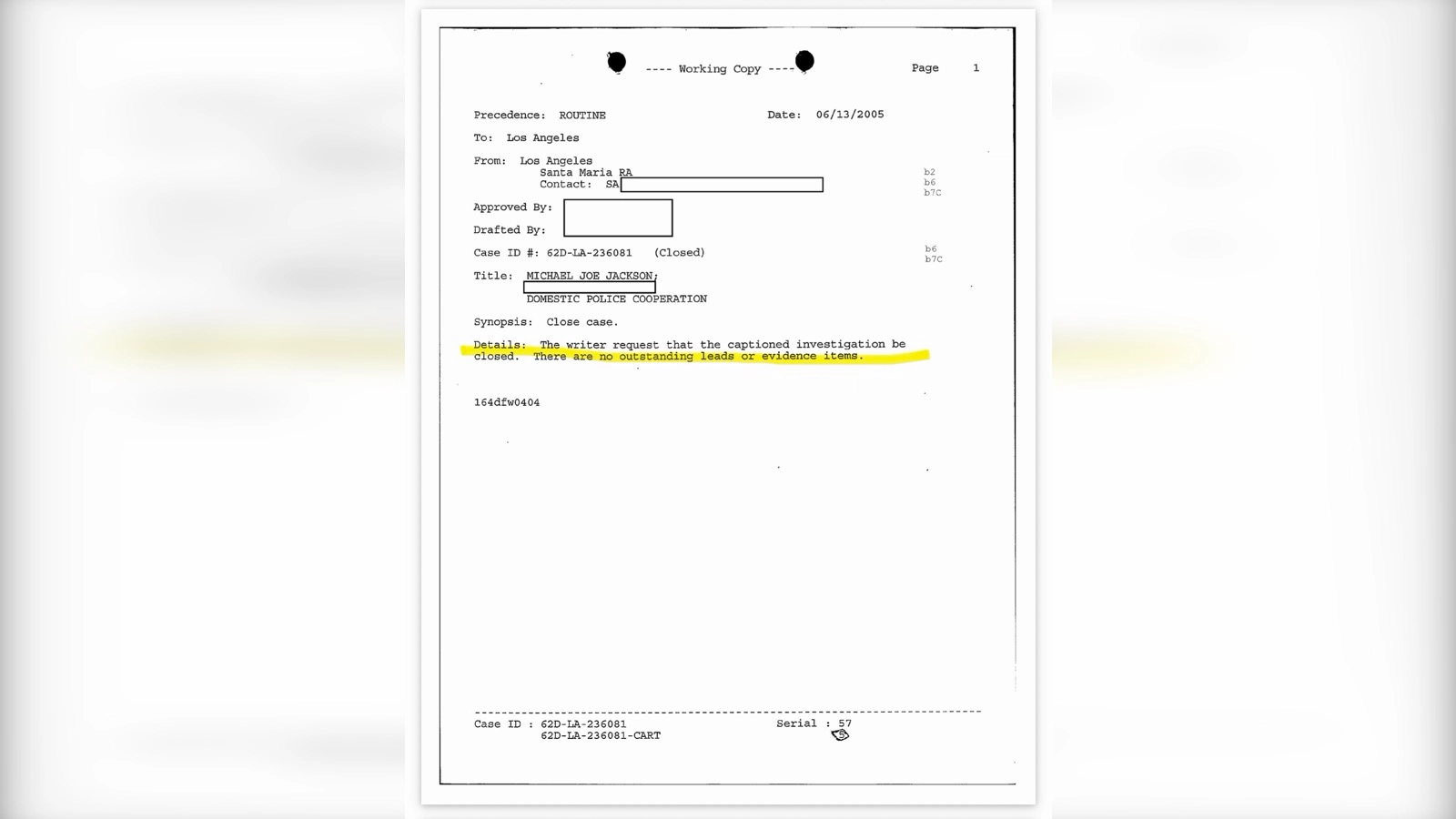
Part 2, Page 39 of the FBI’s Michael Jackson Files
The Mann Act Maneuver: Part Three
The fifty-nine pages comprising the third section illuminate the early stages of the 1993 allegations against Jackson. These documents reveal that on September 8, 1993, the Los Angeles Police Department requested FBI assistance in potentially prosecuting Jackson under the Mann Act—formally known as the White-Slave Traffic Act, a law originally weaponized against boxing champion Jack Johnson.
This request proved remarkably short-lived. On the very same day, the United States Attorney declined to pursue a Mann Act prosecution against Jackson.
The remaining pages catalog various allegations that surfaced throughout 1993, with many documents duplicated from the first section. Investigators traveled to the Philippines to interview a former Jackson employee and his wife, but dismissed their claims due to credibility concerns stemming from a dispute over back pay.
Another accusation came from a writer who alleged Jackson molested two Mexican boys in 1985 or 1986. However, the writer simultaneously claimed the FBI had helped cover up the matter because Jackson was slated to receive a White House honor from the President in 1984, a claim the FBI thoroughly debunked after finding no such reference in their archives. The writer was later revealed to be Victor Gutierrez, whom Jackson successfully sued in 1998 for falsifying stories in the media that Diane Dimond reported as real.
The Mysterious Videotape: Part Four
The briefest substantive section contains just nine pages examining a poor-quality, multi-generational VHS tape seized by U.S. Customs in West Palm Beach, Florida, in 1995. The tape bore the label “Michael Jackson’s Neverland Favorites An All Boy Anthology,” though the files do not establish that Jackson owned or had any connection to the tape. After extensive analysis, investigators concluded on January 24, 1997, that the tape contained no child pornography. No charges were ever filed.
The Trial Years: Part Five
The eighteen pages in the fifth section document the 2003-2005 accusations, tracing events from indictment through arrest, CART and FBI assistance, and ultimately Jackson’s acquittal.
The documents also reveal that Santa Barbara police, where Jackson stood trial, contacted the FBI with concerns that Jackson might become a terrorism target. Federal investigators ultimately determined the risk was minimal, though they noted that followers of the Nation of Islam and the New Black Panther Party attended one court appearance. Both groups remained unnamed in the files. Jackson was acquitted on all charges on June 13, 2005.
The Threatener and the Extortionist: Part Six
The most substantial file section, encompassing 199 pages, focuses on Frank Paul Jones, who served two years in prison for sending threatening letters. Jones’ conviction stemmed from correspondence reading, “I am going to Washington, D.C., to threaten to kill the president of the United States, George Bush.” Another letter included threats against Jackson, with Jones writing he “will personally attempt to kill if he doesn’t pay me my money.” Jones had previously been arrested for trespassing at the Jackson family compound in Encino, California, on June 22, 1992.
The Accuser Who Refused To Testify: Part Seven
The final and briefest installment, just five pages, details investigators’ attempts to revive Jordan Chandler’s, the 1993 accuser, case as a potential second prosecution alongside the 2003 accuser. Following a June 2004 meeting between Santa Barbara Assistant District Attorneys and the FBI’s Behavioral Analysis Unit (BAU), officials concluded a federal case could still proceed with the 1993 accuser.
A conference call on August 30, 2004, resulted in Santa Maria RA opening a case on the 1993 accuser. Later, investigators met with the accuser in New York, hoping he would testify at the 2005 trial. He declined, informing the agents he would “legally fight any attempts to do so.” A December 9, 2004, document officially closed the case, citing “no outstanding leads or evidence items.”
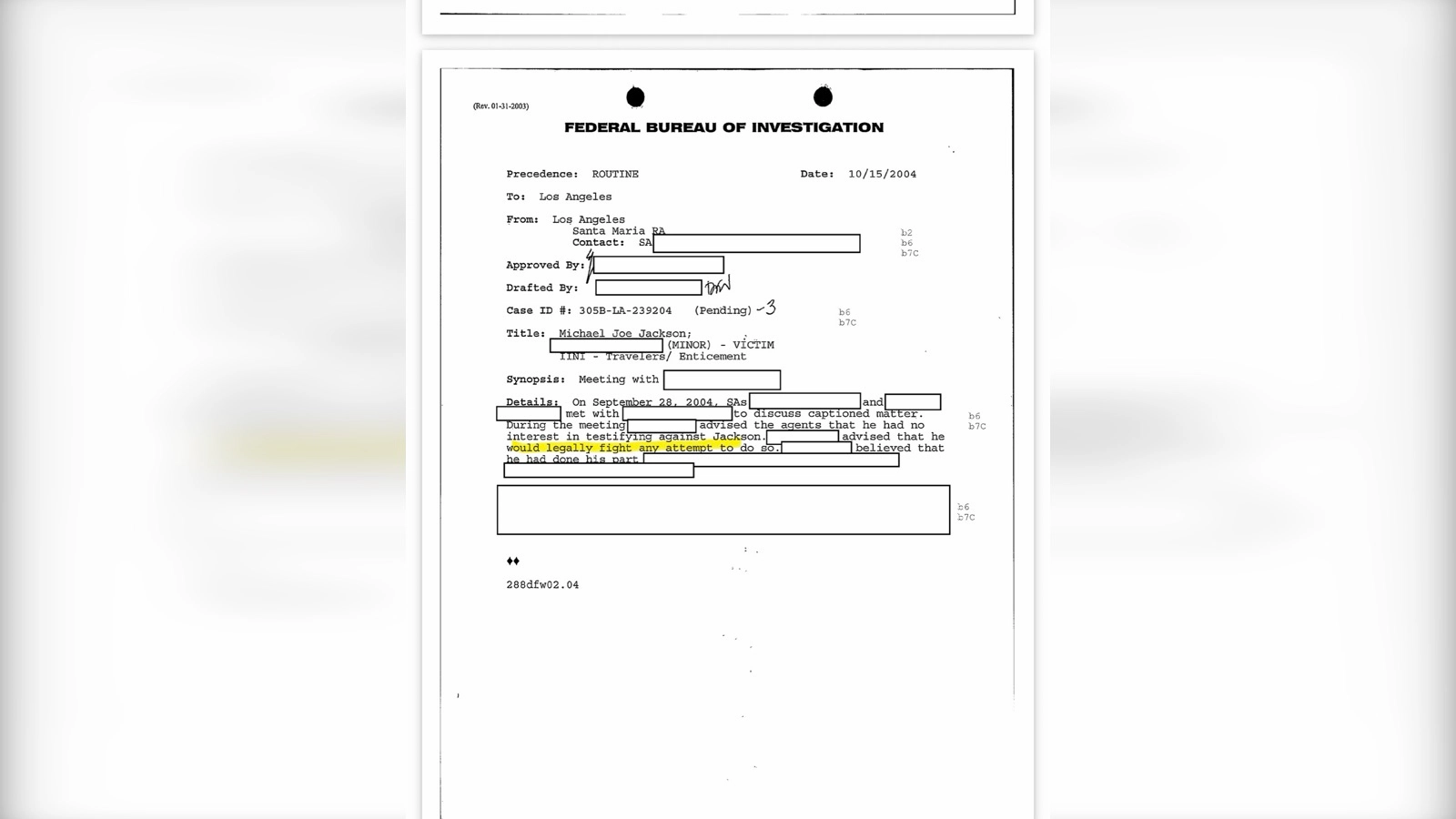
Part 7, Page 4 of the FBI’s Michael Jackson Files
Arraignment Security and a Crucial Clarification: Part Eight
The eighth, and officially designated as the final, installment of the FBI’s Michael Jackson records was not included in the initial 2009 public release. These 18 pages were quietly made available in 2023.
The documents date to January 2004 and center on security preparations for Jackson’s arraignment in Santa Maria. Local law enforcement requested FBI assistance, fearing the globally publicized event could be a “soft target” for terrorism. The bureau assessed whether the Nation of Islam (NOI) or associated individuals posed a threat to witnesses or court proceedings. While the FBI’s review noted the NOI’s anti-Semitic and anti-government rhetoric, it uncovered no evidence of planned violence, a conclusion corroborated by the Los Angeles Police Department.
Crucially, on pages 7 and 8 of this file, investigators explicitly noted that there was no indication that any child pornography had been collected or discovered during the Neverland Ranch search and their review of material handed over to them. The documents further reveal that the Santa Barbara District Attorney’s office declined outside assistance regarding the review of evidence, with the sole exception of duplicating recorded video media. After compiling all available intelligence, the FBI concluded there were no credible threats. By June 13, 2005, the bureau formally closed the case, noting “no outstanding leads or evidence items.”
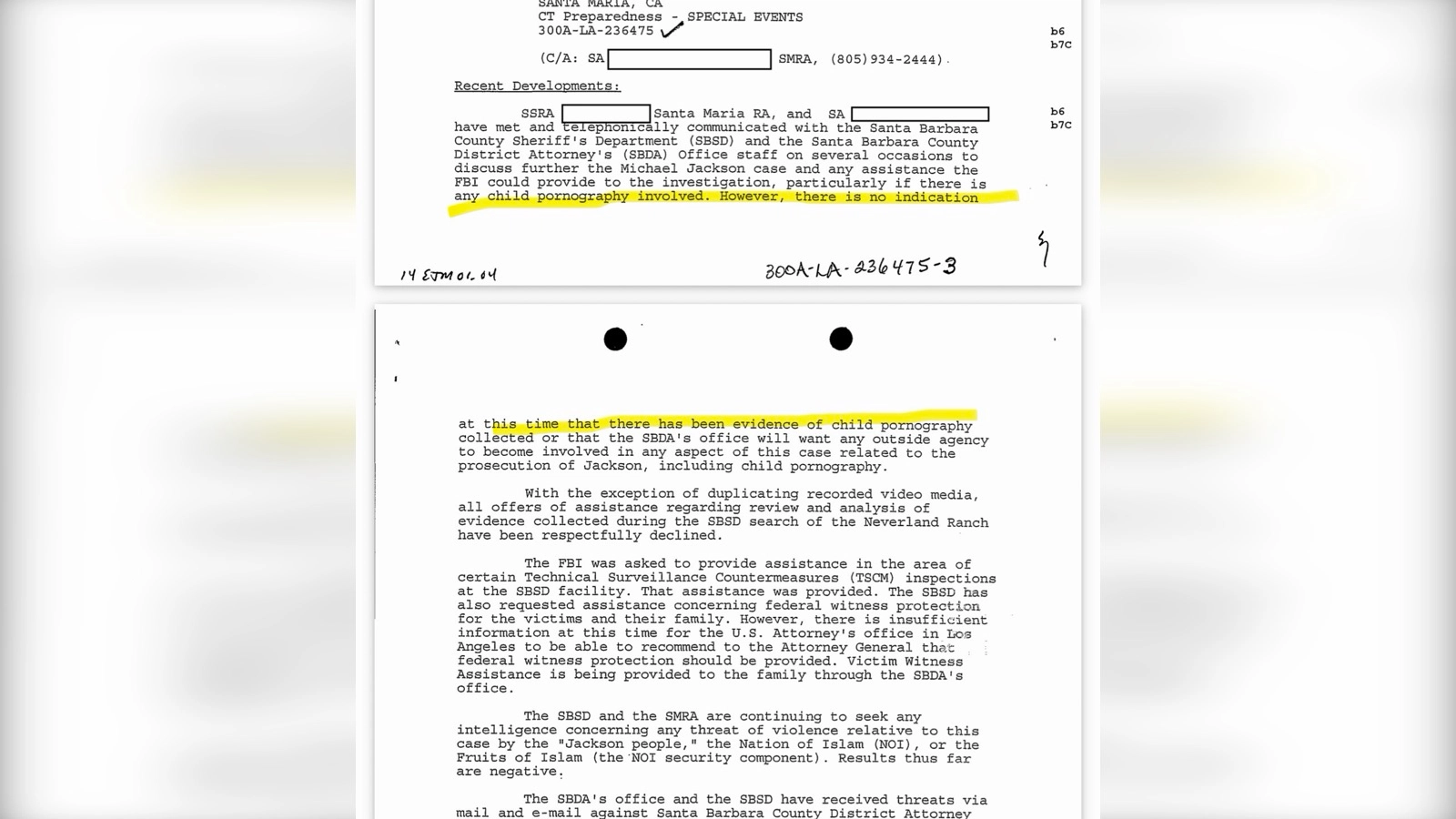
Part 08, pages 7-8 of the FBI’s Michael Jackson Files
Public Reaction and Media Scrutiny
News outlets worldwide, including The Guardian, CNN, Billboard, ABC News, CBC News, BBC, France 24, USA Today, Variety, MTV, and Reuters—immediately began covering the files’ contents following their December 22, 2009 release.
During a Good Morning America segment, former Jackson family attorney Brian Oxman noted the release was startling. He emphasized:
“In all these pages, hundreds of pages, many, many hours of investigations … there’s not one scrap of evidence that Michael Jackson ever did anything wrong, committed any crime. It’s almost a vindication, when you look at this. The FBI looked at all of these matters and said, ‘There’s nothing here.'”
The files resurfaced in 2013 when a London tabloid claimed “secret FBI files” revealed Jackson paid millions in hush money to dozens of alleged abuse victims. Journalists quickly questioned these reports. CNN’s Drew Griffin dismissed them as “recycled tabloid reports from 20 years ago.” Thomas Mesereau, Jackson’s 2005 criminal defense attorney, noted the FBI case had been closed and the tabloid’s claims appeared nowhere in the files, calling them “a bunch of utter nonsense.” Even tabloid queen herself, Diane Dimond, no defender of Jackson, acknowledged “there’s no evidence to back up the claim that Jackson made that many payoffs.” It’s also important to note that presiding Judge Melville had previously signed a press statement confirming that no child pornography or illegal materials were ever discovered in Jackson’s possession or on his properties.
A Decade of Scrutiny. Zero Findings. Endless Noise.
When the FBI closed its final case on Michael Jackson, the bureau didn’t hedge, soften, or leave the door cracked open. Its conclusion was blunt: no outstanding leads, no evidence items, no criminal conduct. After more than ten years of federal scrutiny, the nation’s top investigative agency found nothing that justified a single charge.
The files, hundreds of pages spanning multiple investigations, international coordination, digital forensics, interviews, threats, and alleged victims, reveal a pattern so consistent it borders on monotonous. Agents sifted through hard drives. They analyzed videotapes. They chased down rumors. They evaluated claims. They followed every thread the tabloids insisted would unravel something explosive.
Every thread snapped.
No child pornography.
No incriminating computer files.
No credible evidence of abuse.
No substantiated allegations.
No federal charges.
Buried deep in the documents is the line that quietly ends the debate:
“There are no outstanding leads or evidence items.”
It appears again and again, a bureaucratic refrain that becomes, unintentionally, a verdict.
But the FBI files don’t exist in a vacuum. They sit inside a culture that had already made up its mind. By the early 1990s, Michael Jackson wasn’t just a global superstar, he was a cultural battleground. The press had discovered that Jackson’s name guaranteed ratings, clicks, and circulation. Tabloids industrialized him. Late‑night hosts turned him into a punchline. Pundits treated speculation as fact. And a public conditioned by sensationalism learned to mistake repetition for truth.
In that environment, innocence wasn’t news. Nuance wasn’t profitable. Complexity wasn’t clickable.
Accusation became entertainment.
So while federal agents quietly documented a decade of dead ends, the culture loudly insisted on guilt. The gap between the evidence and the narrative didn’t just widen, it became the story. Jackson wasn’t fighting allegations; he was fighting an ecosystem built to consume him.
For Jackson, hounded, caricatured, and tried in the court of public opinion, the FBI files amount to a posthumous correction. For the public, they offer a rare, unfiltered look at how the government actually handled one of the most scrutinized figures in modern history. And for those who built careers, headlines, and narratives on insinuation, the files stand as a stubborn, immovable fact: the evidence never existed.
In the end, the FBI’s Michael Jackson files are remarkable not for what they reveal, but for what they refuse to confirm. After a decade of investigation, the bureau’s final word is the one the culture least expected, and least wanted:
There was nothing there.
About the Author
Andrew Greene is a quality-obsessed, results-driven powerhouse with nearly two decades of experience transforming complexity into clear, actionable solutions. His secret weapon? A mix of analytical sharpness, problem-solving precision and a communication and leadership style that’s equal parts clarity and charisma. From Quality Assurance to political data analysis, you can think of him as the Swiss Army knife of operational excellence, minus the corkscrew (unless it’s a team celebration).