
Every June 13, Michael Jackson’s fans mark what they call Vindication Day: the anniversary of the afternoon in 2005 when a Santa Maria jury, after months of evidence, returned not guilty on every charged count against him, with the lesser alcohol-related alternatives rejected too. Twenty-one years later, the anniversary arrives with that trial back on television. Three separate programmes this year, two of them built around a question the jury already answered. Not that it matters to some.
Netflix wanted its say, and they had the production pedigree to match: James Goldston, the former ABC News president who had produced Martin Bashir’s original 2003 documentary, attached as executive producer, and a wider documentary ecosystem already shaped by Martin Bashir and Leaving Neverland. They were selling it as a sober forensic reckoning with the 2005 verdict. For a project claiming neutrality, that was quite a lineup.
Before watching it, I knew exactly who would not appear in it and why.
Aphrodite Jones had a seat in that Santa Maria courtroom for the duration of the trial. She was there as a Fox News crime reporter, covering the case for The O’Reilly Factor, fully expecting a conviction along with everyone else in the press corps. And she was no rookie filling column inches. This was the woman whose first book, The FBI Killer, kicked off a run of bestsellers, one of which, All She Wanted, became the film that won Hilary Swank an Oscar (Boys Don’t Cry, if you’re reaching for it). She had sat through the O.J. Simpson circus. She would go on to make True Crime with Aphrodite Jones, six seasons of it on Investigation Discovery. If anyone in that room knew how guilt gets packaged and sold to a television audience, it was her, and for months, she had been the one doing the selling, telling Fox viewers that Michael Jackson was guilty as charged.
When the verdicts came back on June 13, 2005, she was live on air with Bill O’Reilly, and he wanted a reaction. What he got was a woman tripping over her own words, because the thing she was about to say was not the thing she had spent the trial expecting to say. She thought the jury got it right. And part of her was still in shock as it came out of her mouth.
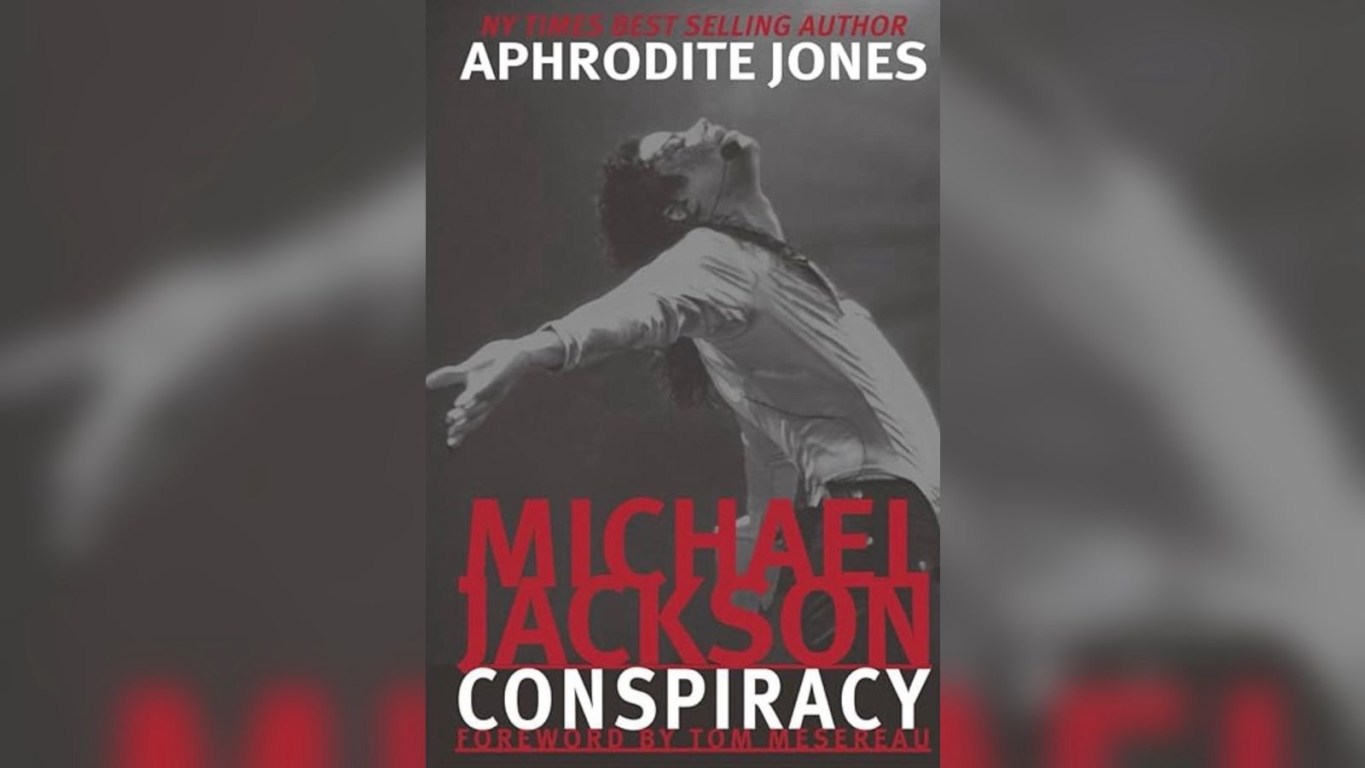
What followed was a reckoning she eventually committed to paper: a book, Michael Jackson Conspiracy. By her account, no American publisher would touch it, so she self-published. The foreword came from Tom Mesereau himself, the lawyer who had won the acquittal. That it exists at all is the surprise. When Mesereau first saw Aphrodite in the Santa Maria courthouse, he wanted nothing to do with her; he writes that he gave her a stare cold enough to bury her, associating her with the media machine he believed was set on destroying his client. That he later put his name to the beginning of her book is its own verdict on how far she had moved. The book opens with an author’s note that most journalists would never have the nerve to write. In it, Jones confesses: “I realised that I had become one of the media folks who had predetermined the outcome of the trial, wrongly. Many people around me were so sure of Jackson’s guilt. Certain reporters had slanted TV and radio coverage to suit the prosecution, and I was one of the people who followed that dangerous trend. Somehow, I had missed the truth.”
She went to the gates of Neverland to make peace with the fans. They didn’t believe her. She went back to Santa Maria, obtained a court order from Judge Melville to review and photograph all the trial evidence, and made multiple trips to the basement of the Superior Court Complex, working through documents and transcripts. It changed how she read the entire case. What she found in that basement became the spine of the book, and the sharpest piece of it, a videotape she kept rewinding, is something we’ll come to.
Her hope for the book, she stated plainly. “I hope this book reaches beyond Jackson supporters,” she wrote in 2007, “and gets to the millions of folks who’ve been trusting the tabloid media, way too much. If the truth prevails, then one way or another, people will open their hearts.”
The credential that makes her voice irreplaceable isn’t that she believed Jackson was innocent. It’s that she didn’t, and then she went back through the evidence and found out why she’d been wrong.
So, I wanted to talk to her, unlike Netflix.
Getting Her on the Call
Getting Aphrodite Jones to talk was not supposed to be straightforward. Her website had a contact form, the kind that looks functional while quietly routing everything into a folder nobody opens. I’d tried it once before and heard nothing back. Fair enough. I left it.
On 26 May, I gave her personal email a go and hoped for the best.
She replied the same day. Not just replied; she came out swinging. The Netflix documentary would be a hit piece dressed up to look fair, obviously. She’d love to do something once she’d watched it, after she was back from a trip away. I told her to enjoy it as the good old British rain lashed across my window.
June 3rd arrived. I emailed. She responded within hours, having already watched the first episode and most of the second. Her verdict on The Verdict: Not positive. At all. Diane Dimond was the documentary’s centrepiece, which she found rich. More on Dimond later. She’d also clocked the Mesereau clips in the series, lifted from her own twenty-year-old interview with him and used without her permission.
We settled on Sunday, the 7th. One in the afternoon her time, six o’clock mine.
In the days before, I’d been working through Michael Jackson Conspiracy, jotting questions and observations into a notebook.
The confirmation landed with fifteen minutes to spare, and at six o’clock the call connected. On screen was Aphrodite Jones. Composed, dressed sharp, the kind of professional who has been in front of cameras long enough that they simply stop being a thing she thinks about.
One of the first things she said was to ask whether this was going to be uploaded or just transcription. I told her the latter. She turned her head away, let out a small laugh, and said she wished she’d known that, as she wouldn’t have bothered with the makeup. Three decades on camera, and the professionalism still doesn’t switch off.
We got chatting. Aphrodite had studied at Oxford for her Master’s in literature, the PhD coming years later. She knew England properly. Stratford-upon-Avon, naturally, for a literature degree. The Cotswolds she loved; the Lake District had been gloomy during her stay. I suggested places for a future trip, which felt pleasingly absurd given what we were there to discuss.
Then we got to work.
What the Documentary Leaves Out
The documentary’s central claim is that it gives you enough to decide for yourself. Aphrodite didn’t take long with that one. “It pretends or proposes to be even-handed, and to allow the viewers to make their own decisions about Michael Jackson’s guilt or innocence in this particular case,” she said. “And it does anything but.”
She’d watched it with a friend. The friend’s verdict: fair. “And I’m thinking, oh my God, this is what people who don’t know anything about this story think!”
Not propaganda in the blunt, obvious sense. Something more precise. A film constructed so that ignorance reads as balance. If you know the case, you see the gaps immediately. If you don’t, the gaps are invisible. Her own verdict on the film was unsparing: “I think the film was disingenuous. I think the film was fraudulent. There’s no question in my mind. And it was clever in the fact that it tries to present as being fair.”
The most concrete version of that comes from the witness stand. Mesereau called several witnesses whom the documentary barely touches on, despite the damage their testimony did to the Arvizos’ credibility.
Aphrodite was quick to point out the most vital omissions.
The jury heard from Jay Leno. This matters because Leno was no Jackson partisan; he mocked him nightly on The Tonight Show and had no interest in helping his defence. Yet he testified that the boy left him a string of oddly effusive voicemails, calling a comedian in his fifties his hero, and that the approach struck him as “a little scripted.” He stopped short of the prosecution-damning framing on offer. Asked directly whether “scripted” meant “coached,” he didn’t take it, and he was clear that the family never asked him for money, and he never sent any. But a man professionally disposed to ridicule Michael Jackson still found the contact strange enough to take the stand over, and his testimony fit the defence’s broader argument: this family had a pattern of working celebrities, and those approaches were not always straightforward.
Actor Chris Tucker testified about what happened when the Arvizos descended on the Rush Hour 2 set in Las Vegas. He warned Jackson directly about them, and later told the court the accuser was unusually sophisticated and cunning for his age. A warning, on the record, before any of the alleged events occurred.
Comedian George Lopez testified about the wallet. The defence filing described the Arvizos claiming Gavin had left a wallet containing several hundred dollars at Lopez’s house; Lopez and his wife found only a few dollars inside, and the episode ended the family’s relationship with him. Aphrodite put it more bluntly: “George Lopez, another star, testified that this family went after him to do blood drives and whatever for Gavin’s cancer, and that they claimed Gavin left his wallet at Lopez’s house, and there was $200 in it. And Lopez’s assistant gave the Arvizos $200, and Lopez was furious.” The idea that Gavin was casually leaving cash-filled wallets at celebrity homes doesn’t withstand scrutiny under the family’s actual circumstances.
The defence also put the Arvizos’ prior history before the jury through the 1998 JCPenney civil case. The family received a $152,500 settlement after claiming assault during a shoplifting incident, and the defence used that episode to challenge Janet’s account of her injuries and her later failure to disclose the settlement when applying for benefits. Aphrodite kept returning to how poorly the family’s conduct fit the prosecution’s story. “The Arvizos didn’t have 3 cents. They were living in a one-room studio, if you want to call it, with mattresses on the floor and curtains to separate, quote-unquote, rooms. That’s how they lived, in a barrio.” And yet, during the period she was supposedly being held captive at Neverland: “Janet Arvizo used Michael Jackson’s cars to go back and forth to the nearest town over, Solvang, where she had full body waxes, and she had her kids’ braces done, taken off, put back on. She spent every penny she could possibly spend while at Neverland.” Behaviour wildly inconsistent with someone held against their will.
The jury saw it the same way. Its foreman, Paul Rodriguez, later explained that the panel rejected the conspiracy charge because the family had supposedly escaped Neverland three times and kept returning on their own, with nobody forcing them back. It was hard to believe, he said, that a captive family would keep coming back.
Star Arvizo’s testimony contained clear inconsistencies, including insisting that a copy of Barely Legal, dated August 2003, months after the family had left Neverland, was one Jackson had shown them. Netflix includes a fair amount of this. Star naming the magazine under cross-examination, before Mesereau revealed the August 2003 date, the JCPenney history, the welfare fraud, Janet Arvizo coming apart on the stand. What it does not assemble is the structure around those moments: the independent celebrity witnesses, the civil-lawyer timeline, the DCFS finding, the shrinking allegation window, and the prosecution-side histories of the people it asks you to trust as narrators. The moments are there; the architecture that gives them their force is not.
The Police Interview
But the omission that keeps coming back is not Gavin Arvizo’s presence. It is the forensic weight of his own interview that Netflix has once again shown through careful selection.
When Jones obtained her court order and returned to Santa Maria, what she found herself watching repeatedly was Gavin’s police interview. Sitting in the courthouse basement, she rewound the tape and asked the clerk monitoring her notes whether boys of thirteen already know about their own sexuality. “Of course boys know about that,” the clerk said, “certainly by age thirteen.” Which, in Jones’s reading, made Gavin’s claimed ignorance about ejaculation a serious credibility problem, and exactly the kind of contradiction a forensic documentary should have confronted. Her own conclusion was blunter: “This kid is lying.”
The police interview itself she found telling. When officers asked Gavin what had happened, he produced no narrative foundation at all. No buildup, no gradual disclosure of the kind you’d expect from a child recounting genuine trauma. He went straight to the conclusion. “He grabbed me.” Her reading of it: “The kid doesn’t have the mentality to lay a foundation. In other words, we were laying in the bed together, and he was hugging… no, no, no, no. He grabbed me.”
That was the tell, as she saw it: a child repeating a learned conclusion goes straight to the destination.
The jury reached the same place. Aphrodite later interviewed Rodriguez about the molestation counts. “We looked at that footage of the boy, the accuser, maybe five times, maybe six times,” he told her, studying his disposition and body language, what he was actually saying. Their unanimous read, she says: “This kid is lying.”
Gavin’s brother Star gave his own evidence about witnessing abuse, but the two boys’ accounts didn’t line up cleanly on the number or circumstances of the alleged incidents. Brothers supposedly present for the same events, diverging on the basic facts. A problem the documentary does not place at the centre of its account.
The Narrators
Aphrodite has two names she returns to when discussing who the documentary chose to platform, and she doesn’t spend long warming up to either of them.
First: Diane Dimond. “Diane Dimond. Let’s talk about her. She becomes the star of this entire three-hour documentary. Are you kidding me? This woman devoted her career to going after Michael Jackson.”
The documentary presents Dimond as a journalist. What it doesn’t present is context. Aphrodite described the ordinary rhythm of a big trial, the reporters who’d go for dinner together after court. Dimond was never among them. “She never, ever went with any journalists. Never. Nobody.” The reason, by her account, was that Dimond was privately finishing a book designed to put the definitive nail in Michael’s coffin, and believed she had a pre-arranged understanding with prosecutor Tom Sneddon. Dimond’s own book publicity leaned on the fact that her crews were the only cameras present during the 2003 Neverland raid.
None of what follows rests on Aphrodite’s word. It’s in the court record, and it didn’t begin with the 2003 case. Files from Jackson’s slander suit against Dimond, Paramount and others show that, as early as January 1995, Dimond contacted Santa Barbara District Attorney Tom Sneddon about reports that his office was looking for an alleged explicit videotape involving Jackson. Sneddon told her he was “not at liberty to comment” but that the investigation was “still open,” a response Dimond later said she took as confirmation she was on the right track.
The tape was never found, and nobody ever proved it existed. The freelance writer who originated the claim, Victor Gutierrez, fared worse than Dimond for it. Jackson sued him for repeating it and won: in 1998, a jury ordered Gutierrez to pay 2.7 million dollars, a debt he fled to Mexico to escape and reportedly still owed when Jackson died. Dimond, who had reported Gutierrez’s claim, was also sued, and she won, but it’s worth being precise about why. The court did not rule that the tape was real or that her reporting was true. It ruled that Jackson, as a public figure, hadn’t cleared the high legal bar such people face: proving she either knew what she broadcast was false or aired it recklessly, not caring whether it was true. Part of what gave her that defence was the prosecution’s own conduct; the DA’s office really had been looking for a tape, and Sneddon’s “still open” reply was on the record. Jackson couldn’t meet the standard, so the suit was thrown out before trial. That is a long way from a finding that she got it right.
Years later, Dimond’s own book publicity emphasised that she and her camera crew were the only media present when authorities raided Neverland in November 2003. In a recent interview, she recalled receiving a call that there was “going to be a raid at Neverland” and said she was the only journalist standing outside as the police vehicles arrived. A heads-up about a sealed police raid comes from someone with inside knowledge. Who, exactly, has never been established, and it isn’t the point. What it shows is that her access to the prosecution’s world was not casual, and that presenting her as a neutral courtroom narrator without this history leaves out essential context.
When not guilty came back on every count before the jury, Court TV did not renew her contract, ending it three months early. The official explanation was a network format change. Mesereau had publicly and repeatedly accused her trial coverage of favouring the prosecution. The timing, at the very least, invites scrutiny.
Dimond would later write about Gavin Arvizo’s 2013 wedding, where retired prosecutor Ron Zonen, one of the prosecutors in the case against Jackson, was also present.
Then there’s Stacy Brown. “Stacy Brown was a main figure throughout the documentary. Stacy Brown wrote the book with Bob Jones (Jackson’s former publicist). Trashing and smearing Michael Jackson. And they were pushing it on the journalists during the trial. They were giving free copies of that book away.” During proceedings. To the press.
The book’s origins are worth knowing. Brown and Jones began writing it in January 2004, two months after Jackson’s arrest. Jones had just been let go, after nearly thirty years of service, by Jackson’s brother Randy. Brown later testified under oath that Jones told him he was broke and needed money. Both authors also admitted, on the stand, that the more sensationalist a book is the easier it is to sell. The financial motive is not in dispute. Both men confirmed it themselves.
The pattern did not stop with Bob Jones. Less than two months after the acquittal, two jurors who had voted not guilty, Eleanor Cook and Ray Hultman, publicly said they believed Jackson was guilty and were attached to tell-all book projects. Cook’s was to be titled “Guilty As Sin, Free as a Bird”. Hultman’s, “The Deliberator”, was reported as being written with Stacy Brown. Larry Garrison’s SilverCreek Entertainment was overseeing the projects, with reports that American television networks were already circling a possible movie based on both books. Hultman later sued to get out of the contract, saying he and his wife had been “suckered” into signing it.
So when Brown appears in The Verdict as a voice of courtroom memory, the viewer is missing another piece of the story. By 2005 he wasn’t only the co-author of Bob Jones’s anti-Jackson book. He was also reported as co-writing a tell-all with one of the jurors who had voted to acquit, a book whose whole premise was that the jury had got it wrong.
Aphrodite’s question about Brown was simple. “So we’re supposed to believe him, who has a material reason for making this thing happen in his direction?”
Two of the documentary’s central voices. One had been circling the prosecution’s world since 1995, by her own account and the court record both. The other began a sensationalist Jackson book two months after the arrest and, by 2005, had his name on a juror tell-all selling the idea that the acquittal was a mistake. Netflix made them the primary authorities on what happened in that courtroom.
The Timeline
There is one more thing about the timeline worth sitting with.
When the world went crazy, and still continues to this day, over hearing Jackson saying he “shared” his bed with Gavin, ignoring, as Netflix did via their selective omissions, the fact that Jackson mentioned that he slept on the floor, they pictured the healthy, cancer-free boy who rested his head on Jackson’s shoulder during the Bashir interview. But that’s not the case.
His spleen and one kidney had already been removed. He was undergoing chemotherapy and, by Jackson’s own later description, was bald, frail, and sometimes needed to be carried or pushed in a wheelchair. Jackson heard about him through comedian Jamie Masada at the Laugh Factory, called him, sent gifts, and later visited him in hospital. During the family’s early visits to Neverland in 2000, the bedroom issue would become central: in the Bashir footage, Gavin himself described asking if he could stay in Jackson’s bedroom, while Jackson insisted he gave Gavin the bed and slept on the floor.
The grooming narrative follows a specific sequence that requires you to accept it. Jackson identifies a bald, dying ten-year-old in a hospital as a target. Cultivates the relationship for years. Lets the child invite himself into his bedroom on the first visit and gives him the bed. Waits until the boy beats cancer. Then waits further still, until the single most scrutinised week of his life after the Bashir documentary goes global, and chooses that window.
“You think Michael Jackson is molesting that kid who’s in a wheelchair with no hair on his head?” Aphrodite asked. “What? I mean, it’s craziness.” The documentary never makes the audience hold those two images together, the dates and the dying child, because the moment you do, the story stops cohering.
“The timeline is critical in this case,” Aphrodite told me. “They didn’t talk about it.”
She’s right that they didn’t. But the timeline does more damage to the prosecution’s case than the documentary would ever let on.
Gavin initially told police in November 2003 that the alleged molestation occurred across a wider date range. By the time of the grand jury indictment, the dates had shifted. Then the prosecution’s own phone records, introduced during the trial, placed Jackson away from Neverland for several days inside the indictment window, including dates around when the accuser said the abuse had happened. He had been staying at a Beverly Hilton suite, registered under another name. The window kept shrinking as the evidence ate away at it.
Then there’s the question of what the Arvizo family was doing while all this was allegedly happening. In February 2003, right in the middle of the alleged molestation window, the Los Angeles Department of Child and Family Services investigated the allegations jointly with the LAPD, prompted by a school official who had watched the Bashir film. They interviewed the family, who insisted nothing inappropriate had happened, the mother saying the children were never left alone with Jackson, and the case was closed as unfounded. At that point, the Arvizos were on record denying any abuse had taken place.
Shortly after leaving Neverland in March 2003, the family contacted civil lawyers. One was Larry Feldman, the same attorney who had negotiated the 1993 Chandler settlement, the one that put a $15.3 million trust fund in the boy’s name. He became involved after the family’s first attorney, William Dickerman, and before the allegations reached the criminal justice system through the psychologist’s mandated report.
The sequence complicates the claim that money played no role: the civil lawyer who secured the last Jackson payout was retained before the allegations entered the criminal system.
Bashir
“That trial killed him. But how did that trial begin? It began because of Martin Bashir,” Aphrodite told me.
She doesn’t hedge on Bashir. “He destroyed the two most beloved, famous people on Earth, Princess Diana and Michael Jackson. Single-handedly destroyed them.”
The entire framing of The Verdict depends on you believing Bashir’s 2003 documentary simply captured what was already happening, that Jackson had this relationship with this family, and that Bashir filmed it. The reality, according to Aphrodite and the outtake footage she watched in court, is that Bashir engineered the circumstances he then presented as revelatory. He staged the hand-holding scene. He set up the bed conversation. And the direction ran the opposite way to the one the film implies: “Bashir is the one, by the way, who suggested they bring the Arvizos to Neverland, not the other way around.” She calls it one of the documentary’s lies. All the while he was selling Jackson a vision: “Bashir brings up the International Children’s Holiday, and that’s why we’re doing this, and we’re going to go to Africa, and we’re going to create this, and that’s a special day that you want for children, just like at Neverland, where I saw you with all these children here the other day, and from all over, all the inner cities, and you help them, and you give them joy.” A global campaign, equivalent to Mother’s Day or Father’s Day, for the three-quarters of the world’s children living in poverty.
Jackson had spent decades travelling the world and had seen poverty firsthand. He once described visiting institutions in Romania and Russia, where children were chained to walls and lying in their own waste, and how he and Lisa Marie Presley would go in and free them, returning day after day with clothes and toys. As Aphrodite put it, “Michael went around the globe more than anyone else we know. And his thought is, these children that are in poverty, they don’t have a day. So it wasn’t about some kooky idea. Michael wanted to heal the world.”
There is one detail here that almost nobody knows. When Bashir asked Jackson to invite children he’d helped, Jackson wanted to feature a young man known as Dave Dave, born David Rothenberg, whose father had doused him with kerosene while he slept and set him on fire when he was a child, burning the overwhelming majority of his body. Jackson had first reached out to Dave Dave in December 1983, when the boy was seven. He had supported him for decades and given him work at Neverland, a friendship that lasted the rest of Jackson’s life. Dave Dave later described it: “Michael Jackson was like a father figure for me. He’s been my friend throughout everything I’ve been through. He’s my only friend that I can say has been there for me always.” He attended Jackson’s funeral and spoke there.
By Jones’s reading of the outtakes and the trial record, Bashir set Dave aside because, by 2002, Rothenberg was already an adult, and chose the still-thirteen-year-old Gavin Arvizo instead. The trial record, however, contains a striking confirmation from Gavin himself: under oath in 2005, he said he had met “this person who was burned” around the time of the Bashir filming, that Jackson had introduced them, and that Dave Dave was supposed to be in the film. The prosecution’s own key witness put the burn survivor at the centre of the story that Bashir’s final cut left out.
Jackson agreed to all of it without payment and without a written contract. He trusted Bashir on one basis: Bashir was the man who had interviewed Princess Diana. “He just falls hook, line, and sinker,” Aphrodite said. “This is the man who interviewed Diana. This is the man I want.” What Jackson didn’t know was that the Diana interview had been obtained through fabricated bank statements, shown to Diana’s brother to convince him that those close to her were betraying her. The independent Dyson inquiry confirmed this in 2021. Bashir had admitted asking for the statements to be “mocked up”; the inquiry found serious breaches of BBC editorial guidelines, and Bashir left the BBC shortly before the report was published. To much of his American audience, Bashir was still the journalist who had exposed Michael Jackson. The reputation that carried him there had been built through fraud. In the episodes I reviewed, the Dyson findings go unmentioned, even as the series leans on Bashir as one of its key talking heads.
The International Children’s Day, the Africa trip behind it. “And then, of course, that all went to the cutting room floor. We never heard about that.”
What actually aired was roughly ninety minutes of carefully selected and framed moments that invited shock: Jackson admitting children slept in his bedroom, footage of Gavin Arvizo resting against him and holding his hand, and Bashir’s narration presenting all of it as cause for serious concern. Fifteen million viewers in the UK. Twenty-seven million in the States. Jones says the outtakes showed Bashir telling Jackson off-camera that he was wonderful with children, that it made his heart bleed and break to see how wonderful he was. She watched the full two and a half hours of outtakes in court, sitting next to the jury, who saw the same gap between what Bashir said to Jackson’s face and what he put on television. They came back with not guilty on every count before them. When Mesereau later put it to Bashir whether he had praised Jackson’s vision for a children’s day and complimented his relationship with children, Bashir would not answer.
“Bashir set that up. And yet he now wants to pretend, oh no, none of that was my idea, I love Michael, he’s the greatest entertainer. What! You killed Michael. That’s what you did.”
After the Acquittal
After winning the trial, Mesereau advised Jackson to leave Santa Barbara County and not come back, on the reasoning that Sneddon would keep looking for new accusers. Mesereau later wrote that in the run-up to the 2004 indictment, Sneddon had already travelled to at least two countries, Australia and Canada, searching for victims, and that the Santa Barbara Sheriff’s Department had set up a website seeking information on Jackson. The acquittal hadn’t ended anything.
And it cost the press something they’d been counting on. Mesereau later confided to Aphrodite, who recounts it in the book, that he had been told Jackson’s exoneration cost the worldwide media billions. The logic was grimly simple. A conviction would have been a self-renewing story: his safety inside, his life behind bars, his fellow inmates, a press pack arranging to track his daily schedule, a fresh headline every time someone visited him. They would have sold his suffering by the day, every fear and every rumour about his state behind bars, for as long as it lasted. The acquittal switched it off in an afternoon. The press didn’t just lose a story. It lost an asset.
By Aphrodite’s account, Frank DiLeo, Jackson’s manager, sat with her during the trial and told the biographer J. Randy Taraborrelli that Jackson would “never be able to walk away from this” and that it would “be the end of Michael.” DiLeo understood the man behind the stage. “Michael always had a fragile state of mind,” he told her, “other than when he was on stage. You know, the stage is where he lived.”
During the trial itself, by her account, the strain on Jackson was constant. Throughout her conversations with Mesereau, she was told what the public never saw: that Jackson could barely sleep, and would call his lawyer in tears at all hours of the morning, needing to be reassured he would not be going to prison.
“He has no haven anymore,” Aphrodite said. “That was Neverland. Neverland was 3,000 acres and two plus hours away from LA. He had a haven. Now he can’t have that anymore, and he’s the most famous person on the planet, and he can’t move without being swarmed, and he can’t walk anywhere, go anywhere. He has no home anymore. He has no roots anymore.”
Jackson moved to Bahrain as a guest of the royal family, then to Ireland, which he loved but which was never home. After interviewing his dermatologist there, Dr Patrick Treacy, Aphrodite came away with an image that stuck with me. She told me what Treacy had told her: there was a day Jackson was meant to meet the Queen, had spent hours getting ready, looked immaculate, and then at the last moment simply said, “I’m not going.” On stage, a dynamo, she said; off stage, “still a crumpled little child that’s afraid.” His three children lived behind gates wherever they went, unable to move normally, roaming a planet their father could no longer navigate.
Final Thoughts
Aphrodite’s mission is stated plainly: “My mission at this point in my life is to shame the media into telling the truth.” Not petition it. Shame it. The book was part of that, an attempt to reach the people who’d taken the tabloid version on trust and never heard the rest.
That book is nearly twenty years old now, and her view of the press hasn’t softened since; if anything, the fracture she described has only widened. “Don’t tell me half a story. We get it on Fox, we get it on CNN. Everybody is seeing this globally now, right? And what we are seeing are two worlds that have nothing to do with each other, and nobody knows who’s lying and who’s real and what’s real and what’s not.”
The Netflix documentary is the latest iteration: even-handed on the surface, engineered so that knowing nothing feels like seeing both sides. If you’re going to watch Netflix’s edited highlights, shaped by many of the same tabloid-era assumptions that have trailed Jackson for decades, then you owe it to yourself to read her book before deciding the trial was as simple as the documentary makes it feel. The book walks through the transcripts, the contradictions, the timeline, and what the jury actually heard.
One reporter followed the evidence all the way to the point of being wrong about herself. The people who made The Verdict followed it only as far as the story they could sell.
Aphrodite Jones’s Michael Jackson Conspiracy is available to purchase through Amazon in print and Kindle editions.