Set your watch by it. Michael Jackson has a good year, and the trial comes back round like a tax demand.
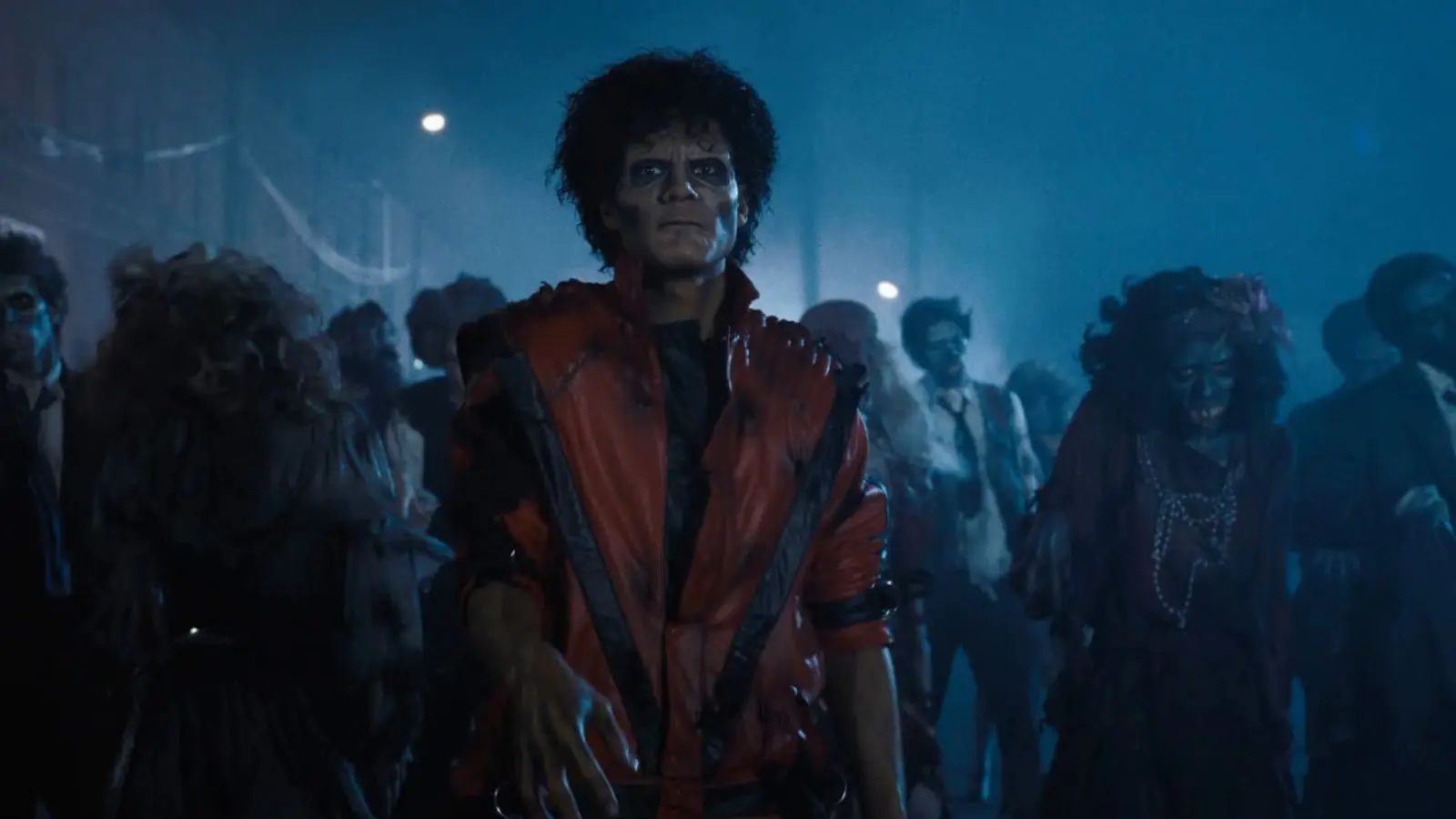
This time the good year is enormous. Michael, starring Jaafar Jackson, has pulled more than $855 million worldwide as of early June 2026, knocking on the door of the all-time top 100 and sitting as the clear second-highest-grossing music biopic ever made, with only Bohemian Rhapsody’s $911 million standing between it and the crown. Whatever you make of Jackson, the audience has already voted with its wallet, and it wasn’t close.
RELATED: A New Studio Champion? How ‘MICHAEL’ Just Shattered Universal’s All-Time Record in Brazil
Table of Contents
Right on cue, Netflix opens the cupboard and out tumbles Michael Jackson: The Verdict, three parts on the 2005 trial, aimed squarely at an audience that just spent two hours in a cinema feeling warm about the bloke. The filmmakers pitch it as history. Netflix’s own publicity describes it as a “forensic look at the trial as a whole,” and Tudum says the result is “a complete historical record of a trial the public never truly got to see.” It is, in truth, the second major trip through this trial within months. Channel 4 set it out first, in February, with its own four-part series, The Trial; Netflix has simply reheated the same story for a bigger room.
Capitalizing off the Success of ‘MICHAEL’
Hold them to that, then. Claim the authority of history and you inherit its duties, and the first of those is context. In practice, it plays like the old prosecution mood buffed up with prestige streaming polish. You get the same dread and the same insinuations, propped up by the old faith that if the music gets cold enough, doubt starts to look like guilt.
Twelve jurors heard the case. Twelve jurors acquitted him on every count. Took them about 32 hours, and the first straw poll reportedly came in 9-3 for acquittal before it went the rest of the way. The prosecution got its full run at him: the prior allegations, the raids, the expert witnesses, the lot. It still came up empty. No physical evidence ever bridged the gap to guilt beyond reasonable doubt. The jury saw the shifting timelines, the credibility cracks, and the financial undercurrents up close. They rejected it.
The rollout matters too. Netflix did not spend months publicly warming the audience up for this. The series surfaced on 20 May with a 3 June release date, barely a fortnight of public runway after the biopic’s warm glow. That has a familiar echo. Leaving Neverland came out of nowhere too, and turned a festival premiere into a detonation before anyone could draw breath. Maybe that is simply how prestige allegation documentaries are launched now: short fuse, maximum blast radius. But with Jackson, timing is never just background noise. If The Verdict was already in production before Michael became a box-office event, then the reader can decide whether that looks deliberate. The resemblance to the HBO playbook is hard to miss, though.
Here’s the part worth clocking: look at the players. They arrive with mud on their shoes.
The Same Old Debunked Talking Points
James Goldston, one of The Verdict’s executive producers, carries his own history in this story. Before ABC News, before Candle True Stories, before this Netflix return to the courtroom, Goldston was a producer on Martin Bashir’s 2003 programme Living with Michael Jackson. That programme put Jackson’s relationship with Gavin Arvizo in front of the world and helped trigger the chain of events that led to the 2005 trial. The man connected to the programme that lit the fuse has now helped produce the programme about the explosion. Put that on screen.
Goldston’s connection matters because Bashir’s film is the original wound this series keeps picking at. Bashir wasn’t some random tabloid ghoul with a microphone. He’d done the Princess Diana Panorama interview, about as big as British telly got in the nineties, and that reputation was the whole reason Jackson opened the door. Years later, the Dyson inquiry tore through it, finding that Bashir had used deceitful methods to secure access to Diana and that the BBC’s handling of the scandal fell far below its own standards. Bashir apologised for the fake documents while denying they influenced Diana’s decision to speak. The stain remains.
Bashir’s credibility was part of the sales pitch. Living with Michael Jackson was constructed television, shaped by a journalist whose most famous triumph has since been officially discredited at the level of method and oversight. Any account treating Bashir’s Jackson film as clean historical evidence has to sit with that before it starts building mood out of his images.
The shiver Bashir helped create became a shockwave. Netflix returns to the same bed-sharing footage while leaving out Jackson’s clarification that he slept on the floor while Gavin and his brother took the bed. Through selective editing, the viewer gets the same shiver that viewers got in 2003, while the vital context drops out. Then everyone pretends the shiver was the evidence. What worked for HBO years ago, Netflix is betting works again.
On 8 February 2003, days after Bashir’s film aired in Britain, the actor Alan Rickman set down his reaction in the diary later published as Madly, Deeply: The Diaries of Alan Rickman:
Watching Martin Bashir’s documentary on Michael Jackson. Disgraceful, self-serving journalism. How much did that cost? Compare MJ’s actions with those of a million pederasts & paedophiles a day or the thousands of kids dying daily in South Africa from Aids. Make a film about that with your concerned face.
Two decades on, the concerned face is back on the screen, and Rickman’s question travels with it: how much did that cost.
Then there’s the parade of talking heads. Diane Dimond appears as a media authority. She was one of the loudest American reporters around the Jackson allegations, a Court TV and Hard Copy figure who covered the case for years. Stacy Brown turns up too. He co-wrote Michael Jackson: The Man Behind the Mask with former Jackson publicist Bob Jones, a book that grew out of one of the nastier fallings-out in Jackson’s circle. J. Randy Taraborrelli is a different proposition. A childhood friend turned biographer, broadly in Jackson’s corner, whose book has been revised and republished across the decades. He consulted for CBS during the trial. And yes, he is at home under studio lights. The point isn’t that these voices shouldn’t be there. It’s that the programme flattens their histories into wallpaper instead of telling you who’s talking and why.
The series frames the 1994 settlement in a way that needs challenging. One voice in the documentary calls Jackson’s young accuser “California’s newest millionaire.” Deputy DA Ron Zonen says the reported $23 million settlement was “to keep Michael Jackson out of prison.” That second line is a heavy claim dressed as common sense, and coming from a prosecutor it needs a legal warning label stapled to its forehead. A civil settlement cannot stop a criminal prosecution. It never could. Prosecutors said as much at the time. The criminal investigation carried on after the cheque cleared and kept going, right up until Jordan Chandler wouldn’t get in the box. That’s what closed it, not the money. The state still had power, still investigated. The distinction matters because the settlement keeps getting dragged around like a confession in a suit. “He paid them off” sells better than “the criminal case failed,” and the blur has done thirty years of work.
The Repeated Issues
The programme also leans on the familiar idea that Jackson’s fame bent reality around him. The record says otherwise. Here was a man subjected to raids, strip-search scrutiny, public humiliation, aggressive prosecution by Tom Sneddon’s office, which had chased him since the 1993 allegations, bail pressure, and months of trial by spectacle. Fame gave him money and visibility. The state kept the raids, the prosecutors, the court orders and every other lever of public humiliation. The documentary’s moral grammar depends on Jackson seeming untouchable, even as the trial record shows the opposite.
One of the series’ habits is that it protests that money cannot possibly explain every claim around Jackson. Taken seriously, that is a fair caution. Motive is rarely one clean thing. But a programme that warns against reducing everything to money then has to show the money where it actually surfaces in the record. Bill Dickerman, the Arvizos’ civil lawyer, had a fee-sharing arrangement with Larry Feldman, who represented the Chandler family in the earlier settlement. Civil recovery was baked into this case from the start, so the jury had every right to ask who stood to gain financially.
Underneath Tom Sneddon was deputy District Attorney Ron Zonen. Zonen himself, presented as a sober legal authority, later married Louise Palanker, who also appears in this series, a friend of the Arvizo family and a prosecution witness. That does not erase their personal views, but context is the price of trust. In an episode, Zonen draws attention to a painting above Jackson’s bed, describing it as a version of The Last Supper with Jackson in the Christ position. Nate Giorgio, the artist who painted it for Jackson, has disputed that reading in a recent post on his Facebook page. It was called Heroes: historical figures like Lincoln and Einstein gathered in discussion for world peace. Small in isolation, maybe. But it tells you something about the programme’s method: atmosphere over precision.
Vincent Amen is the figure the series points at Jackson like a torch, and the one its own footage can’t hold steady. Amen worked for Jackson in 2002 and 2003, brought in alongside his childhood friend Frank Cascio, also known as Frank Tyson. On camera he tells the most alarming story in the series. During the post-arrest raids, he says, Cascio cleared his house of anything from Neverland and handed him a Nike bag. Amen says he filmed himself opening it and found a magazine with its mail-order video section ringed in marker, advertising, in his account, footage of naked children. He says he confronted Cascio, who allegedly told him it was “just a phase that Michael and I went through” and that Jackson had marked the titles he wanted. Amen calls it the moment he realised something was wrong. If he truly filmed that in 2004, the obvious question is where it went, because the raids and the trial that followed turned over everything and the prosecution would have wanted nothing more.
The harder problem is Amen himself, because his account has pointed the other way for two decades. His own résumé says his work for Jackson was used as evidence countering the conspiracy charge. Contemporaneous reporting by Roger Friedman has him giving an interview under use immunity in December 2004 whose substance was more helpful for the defence than the prosecution. Then, in 2013, nearly a decade after the bag he now calls his turning point, he sat down and wrote Jackson a tribute.
It runs to several pages in the charity anthology A Life for L.O.V.E. In it, Amen calls the 2005 case “a set up, an entrapment” and says he himself had been falsely accused by Janet Arvizo, who he writes “truly failed in front of the world.” He does not stop at the trial. He praises Jackson’s hidden charity and quotes him saying, “I want to help all the children of the world,” then concludes that he managed it. He goes further still. Jackson’s “true inspiration were children,” Amen writes, and it was “the innocence of children” that inspired the man and his music. He addresses Jackson directly, telling him he saw first hand his wish to make the world a better place and that he “truly excelled.” That is the same subject the documentary now recasts as something sinister, set down tenderly by the same hand nearly a decade after the moment that supposedly broke his faith. A man who opened that Nike bag in 2004 does not, in 2013, publish a tribute praising Michael’s love of children and calling the case against him a frame-up. Either the essay was the lie or the documentary is, and the series needs you to forget the essay exists. The man it trusts to hold the torch has held it pointing both ways, and only one of those is on screen.
Monetary gain, a prominent theme when it comes to Michael Jackson, rears its head once again. Pressed on Piers Morgan Uncensored about whether Netflix paid him, Amen said he could not be paid for his appearance but was paid for his information, then went quiet enough that Morgan let it drop. A series that leans this hard on a single man might have told its viewers it paid for what he brought.
The filmmakers told Tudum they wanted “a forensic look at the trial as a whole” and “a historical account, presenting the facts as they unfolded in court.” They said they spoke “only [to] eyewitnesses who played a part in those events.” They even named the original sickness: the public’s view, they said, had been “filtered by commentators and presented piecemeal.” Now set that against what they made.
The cure for commentators turns out to be more commentators: Diane Dimond, J. Randy Taraborrelli and Stacy Brown brought in to read a man none of them could read from the witness box. The “facts as they unfolded in court” include the film’s most damaging sequence, Amen’s Nike bag, which never unfolded in court at all and was never tested by cross-examination, reaching the viewer two decades late and uncorroborated. And a forensic record is not meant to sell you a feeling, yet the closing promise is that you will “feel closer to what happened.” Forensics deals in proof. Feeling is what you reach for once the proof has acquitted him.
I’m firm on this. The 2005 case against Michael Jackson was a contradiction-riddled, overcharged mess, pushed by prosecutors who had already spent years chasing him and then carried into the culture by media figures with every incentive to keep the monster story alive. The jury saw the evidence up close and rejected it. That has to count for something. Otherwise, trials become trailers for streaming packages built twenty years later, the moment the verdict turns commercially inconvenient.
The Bottom Line
An acquittal has limits. It says the state failed to prove its case beyond reasonable doubt, and in this case the failure was structural. The years since have only made the story more contested, not least with Wade Robson, who testified for the defence in 2005 before later reversing his position, and James Safechuck, who has also since alleged abuse. Their civil suit against Jackson’s companies seeks close to $400 million, with trial reportedly slated for November 2026. Reed has already made a sequel about the legal run-up, before a juror has been sworn. The narrative machine is already warming up. If the jury sides with the companies, does anyone believe the genre will call that the end?
We don’t need this on a loop unless the loop is honest about itself. The case was tried, and Jackson was acquitted on every count. Whatever the full truth of him is, this Netflix three-parter plainly doesn’t hold it. It has mood, access, old footage, familiar and new faces, and the confidence of a verdict it never earned. What it lacks is the authority to turn a failed prosecution into a hidden conviction.
Watch it if you fancy. Just know what you’re watching: a courtroom loss dressed up as unresolved prophecy, a failed prosecution with a Netflix budget. And somebody, somewhere, keeps setting the clock.
Featured Photo: Shutterstock
Author Bio
As a freelance journalist, Ryan Smith’s work is driven by a commitment to restoring what has long been absent from institutions meant to uphold truth and accountability: honesty and transparency. Alongside his analysis works on the life, career, trials and tribulations of Michael Jackson, whose unfair treatment over the years paved the way for the path he is on, Smith also dissects and examines popular culture, such as books, movies and video games, always aiming to shed light on what’s beneath the surface.