
06/03/2026
We remember them without ever having met them. That is the miracle. Franklin Delano Roosevelt and Michael Jackson did not shake your hand. They did not sit in your living room. And yet you know the cadence of their voices, the weight of their pauses, the way they made you feel seen across an impossible distance. This is not nostalgia. This is architecture.
Most history books separate them by category; one a president, one a pop star; one in marble halls, one in rhinestone gloves. But that separation is a lie. The truth is that Roosevelt and Michael Jackson are the twin pillars of the modern world. One built the global systems that keep nations from eating each other alive. The other built the global language of rhythm, wonder, and belonging that keeps billions from starving for connection. Their methods were different. Their scale was identical. And their greatest gift, to make an audience of billions feel like a single, breathing heart, has never been matched. This is how FDR and Michael Jackson built the modern world.
Table of Contents
The Intimacy that Scaled the Globe
Before Roosevelt, presidents spoke to nations through official statements; dense, formal, designed for newspapers. Before Michael, pop stars performed for crowds, but the crowds remained separate: a German fan had little in common with a Brazilian one, culturally or otherwise.
Roosevelt changed everything with a box of static and a warm, unhurried voice. His Fireside Chats were not just for Americans. They were listened to in London, in Moscow, in the bombed-out cities of occupied Europe. When he said “the only thing we have to fear is fear itself,” a factory worker in Manchester and a farmer in New South Wales both exhaled. He had invented something new: a global listener. Someone who could speak to a citizen of anywhere as if that citizen mattered. He knew that leadership, true leadership, was not about commanding territory but about quieting anxiety.
Michael Jackson did the same thing, but with a beat and a high note. When Billie Jean dropped, a teenager in Manila and a teenager in Mumbai both learned the same foot slide on the same week. No translation needed. He reached across the Iron Curtain, across the Pacific, across every border drawn by fear or empire. In 1991, the Dangerous album leaked in Moscow before it officially released, bootleg tapes passed hand to hand, because Michael’s voice was worth a risk of arrest. He didn’t just want fans; he wanted a global family. That is not fame. That is infrastructure.
Both men understood the same secret: intimacy scales. You do not need to meet ten million people. You need to make ten million people feel met. Roosevelt did it with “my friends.” Michael did it with “hee-hee.” Two syllables, each a key to a hundred million doors.
The Architecture of a New World
Let us name what Roosevelt actually built, because it is easy to forget.
He did not just save the United States from the Depression. He created the blueprint for the entire post-war global order. The Bretton Woods system was FDR’s vision, a dollar-backed international monetary system that stabilized currencies for decades. The United Nations was conceived by Roosevelt, who fought for it even as his body failed. The World Bank, the IMF, the very idea that economic cooperation could prevent another world war, all of it traces back to his administration. He understood that no nation could be safe while its neighbors starved. So he built systems, not just speeches.
And then there is the New Deal. But the New Deal was not merely American. Its DNA traveled. The welfare states of Western Europe, the labor protections of post-war Japan, the social safety nets of Canada and Australia—all of them owe a direct debt to the template Roosevelt laid down. He proved that a government could be both powerful and compassionate without becoming tyrannical. That idea, the compassionate superpower, shaped every major democracy for the rest of the century.
Michael Jackson built a parallel world, but in the realm of culture.
Before Michael, popular music was regional, relatively bland, and very white. An American hit might cross to England, but rarely to Thailand. Michael collapsed distance. In 1996, his HIStory tour played to 3.5 million people across five continents. In Mumbai, 70,000 people danced to “Black or White” in a stadium. In Santiago, Chile, the military government relaxed curfew for his concert because they knew people would riot if they couldn’t attend. He became the first artist whose tour was a truly global event, not a series of local shows, but a single conversation happening everywhere at once.
And his influence did not stop at the concert gate. Watch K-pop today. The precision choreography, the fusion of R&B and electronic production, the fashion that blends military and fantasy, all of it is Michael Jackson filtered through Seoul. Listen to Afrobeats. The syncopation, the vocal delivery, the way a single dancer can command a stage of thirty—Michael is there. He did not just make music. He made a grammar that every subsequent pop culture on earth learned to speak. He is the reason a teenager in Lagos and a teenager in Osaka can share the same dance vocabulary without a single shared word. He’s the reason why someone in non-English speaking countries learned English to begin with, or is able to sing his songs, not in their native tongue, but Michael’s.
The Direct Connection: “If Roosevelt Was Living, He Wouldn’t Let This Be”
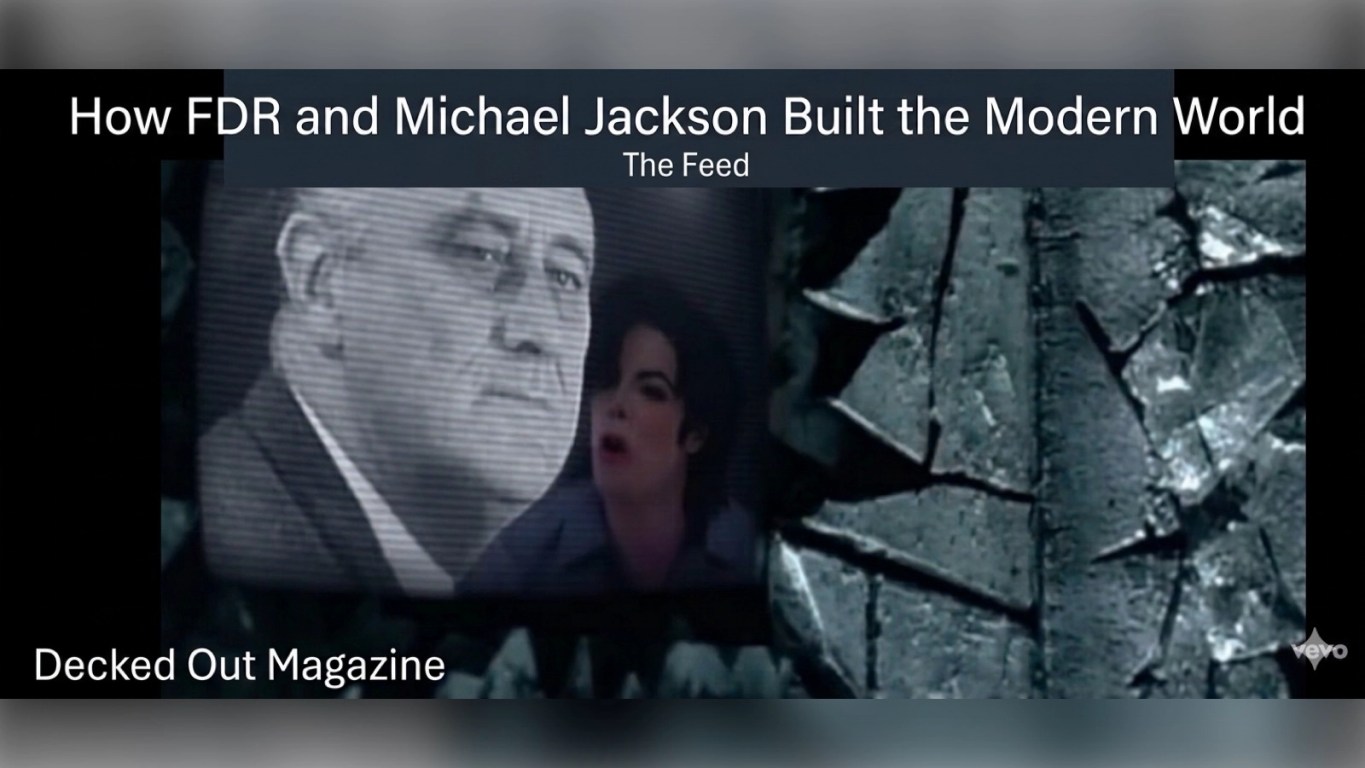
But the most profound link between the two men is not a parallel; it is a direct line drawn in ink and emotion. It happens in the 1995 protest anthem “They Don’t Care About Us.” After cataloging a world of injustice, racism, and state indifference, Michael Jackson fires one of his most devastating lyric:
“The government don’t wanna see / But if Roosevelt was living / He wouldn’t let this be, no, no.“
In one line, Michael places himself in a direct lineage with the 32nd President. He is saying that the world FDR fought to build, a world of security, of hope, of institutional care—has been abandoned. And in his own way, through his music, his spectacle, and his vulnerability, he is one of the few trying to rebuild it. The line is not a history lesson; it is a revolutionary cry from someone who sees FDR’s promises broken by a world absent of FDR’s powerful and meaningful presence.
This lyric is the hinge upon which their connection swings. Michael is not just a pop star singing about feelings; he is an activist invoking the ghost of the most consequential leader of the 20th century to shame the leaders of his own. He is saying that the true legacy of FDR is care, and that the modern world has failed it. He is appointing himself the guardian of that legacy, a role he would fill for the rest of his life. It is the moment the King of Pop steps into the arena of global governance, using the same intimate, powerful voice FDR perfected to demand accountability.
The single was accompanied by two music videos directed by Spike Lee, both of which amplified its global protest message. One was filmed in the favelas of Rio de Janeiro and the historic center of Salvador, Brazil, focusing on poverty and government neglect. The other stark prison-set version directly depicted human rights abuses and police brutality. Jackson invoked FDR not from a place of sterile academic history, but from the gut of a global movement.
A Legacy of Care, Not Criticism
Neither man was perfect, but focusing on their perceived flaws misses the point entirely. Their greatness lies in their impact.
Roosevelt gave us the safety net: Social Security, the SEC, the FDIC. But more than that, he gave us the idea that a leader could be both powerful and tender. Before FDR, strength meant stoicism. After FDR, strength meant the courage to admit fear while offering hope.
Michael Jackson gave us the global pop spectacle, the stadium tour, the charity single, the video as event. But more than that, he gave us the idea that an artist could be both transcendent and broken. He showed that vulnerability was not a weakness to be hidden, but a weapon for connection. He raised over $1 Billion (Inflation factored in) for various charities. Songs like “Earth Song” became anthems for environmental awareness and climate justice on a global scale. He used his platform to advocate for human rights, and his lyrics became banners carried by protesters from Ferguson to Johannesburg. When Spike Lee released a new version of the “They Don’t Care About Us” video in 2020, intercutting its footage with protests following the murder of George Floyd, he proved that Jackson’s voice was not a memory but a living presence in the fight for justice.
Between them, they invented the emotional and practical architecture of modern life. Every time you see a president or a pop star speak to you through a screen as if you are the only person in the world, you are feeling the ghost of their innovation. Every time you see international cooperation, or hear a protest song that transcends borders, you are witnessing the world they built.
The Final, Unbearable Similarity
They both died in rooms filled with witnesses, and both were mourned by people who had never met them.
April 12, 1945. Warm Springs, Georgia. FDR collapsed while sitting for a portrait. The nation heard the news on the radio, the same radio that had carried his voice into their kitchens. And millions wept for a man they had only ever heard.
June 25, 2009. Los Angeles. Michael Jackson stopped breathing. The internet crashed. In every time zone, people gathered on sidewalks, singing Man in the Mirror, holding candles, mourning a man they had only ever seen on a screen.
That is not coincidence. That is consecration. Both men achieved the highest form of human influence: they became interior voices. You do not need to meet someone to be raised by them. Millions of Americans were raised by FDR’s confidence. Millions of humans were raised by Michael’s strangeness and grace. One built the global structures that held the world together; the other built the global soundtrack that made it feel like a home. And in one searing line of a protest song, Michael Jackson turned and saluted his only true peer, acknowledging that the fight for a caring world is one long, beautiful, heartbreaking conversation… and he was proud to be part of it.
Clocked. Thats the Tea
About the Author
Andrew Greene is a quality-obsessed, results-driven powerhouse with nearly two decades of experience transforming complexity into clear, actionable solutions. His secret weapon? A mix of analytical sharpness, problem-solving precision and a communication and leadership style that’s equal parts clarity and charisma. From Quality Assurance to political data analysis, you can think of him as the Swiss Army knife of operational excellence, minus the corkscrew (unless it’s a team celebration).