
04/27/2026
There was a time, not so long ago, that saying the name Michael Jackson in public required a risk assessment. You had to scan the room, gauge the person across from you, and wonder: Is this person still living inside the old narrative? Are they still carrying the tabloid mythology? Will they smirk, or flinch, or pretend that unproven allegations were ever proven in a court of law? That world, the world where Michael Jackson was a punchline, a sensationalized headline, a caricature, no longer exists like it once did, nor should it.
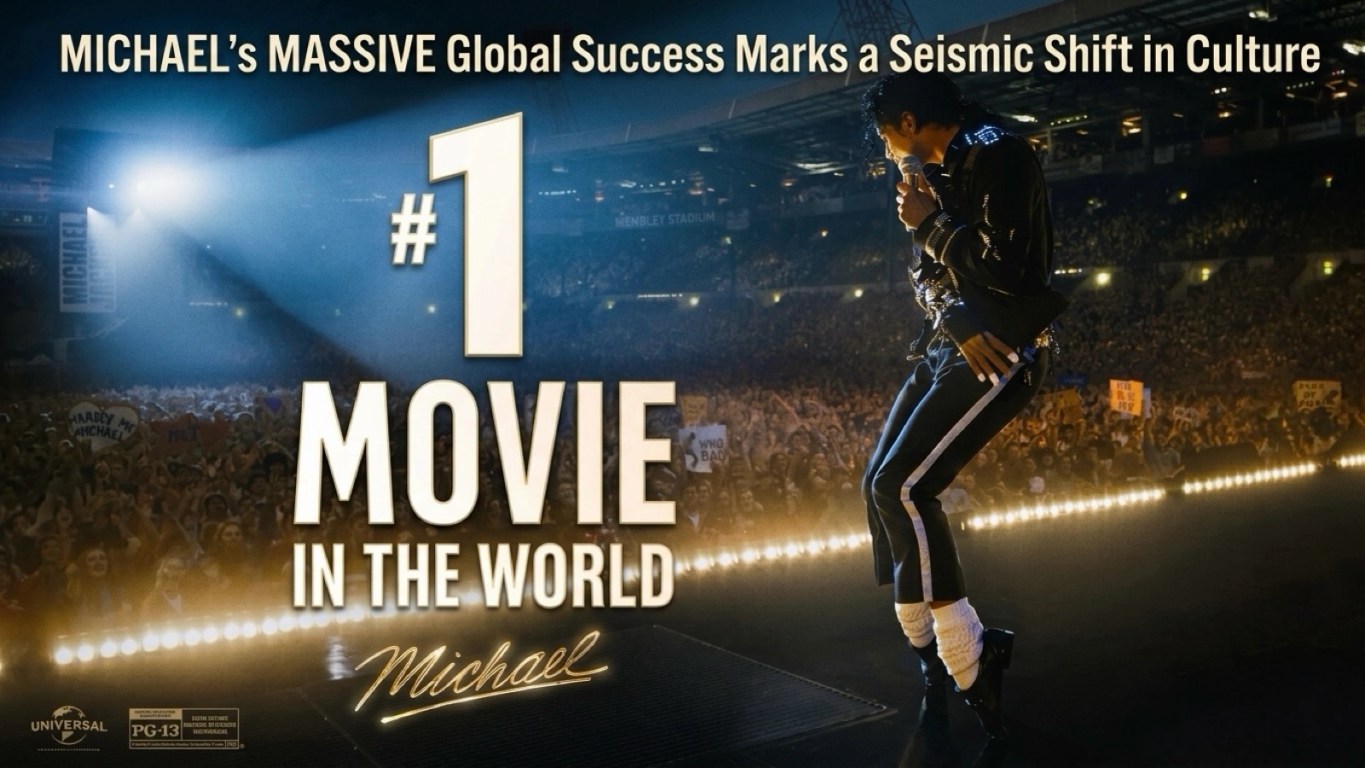
This weekend, MICHAEL, Antoine Fuqua’s bold and unflinching biopic, didn’t just break records. It rearranged the cultural landscape. It signaled a seismic shift in culture, a global reset in how Michael Jackson is understood, remembered, and honored.
The actual numbers, at the time of writing this, alone are historic:
· Domestic (US & Canada): $97.1 million
· International: $121.6 million (82 markets)
· Global Total: $218.9 million
This opening surpasses Oppenheimer, Bohemian Rhapsody, Straight Outta Compton, American Sniper, and The Passion of the Christ, making it the largest global opening for any biopic in history. But if you think this is about money, you’re missing the point. This is not merely a box office story; it is a deeply interior one, a cultural story, and, most critically, the moment the old narrative finally cracked under the weight of reality.
Table of Contents
The World That Was: The Old System and Its Machinery
For nearly thirty years, a powerful system existed, an ecosystem of tabloids, late‑night monologues, sensationalist reporting, and opportunistic commentary, that fed on Michael Jackson. It was a machine built to distort, to exaggerate, to dehumanize. It turned eccentricity into deviance, vulnerability into guilt, and global fame into a target. The 1980’s created the myth of the “weird genius”; the 1990’s weaponized it; the early 2000’s industrialized it into a profitable, relentless crusade.
Michael Jackson became a caricature long before he was ever treated as a human being. The allegations: unproven, contradicted, and legally dismantled, were repeated so often that repetition itself became the false currency of evidence. This was not truth; this was conditioning. And conditioning is powerful: it shapes memory, it shapes perception, and it shapes entire generations. But conditioning has a critical vulnerability: it requires constant reinforcement. When the drumbeat stops, when a new generation encounters the source material without the filter of a sneering voiceover, the spell begins to fray.
Here is the deeper reality that the old system never accounted for: conditioning only works as long as people stop questioning it. And people have started questioning it. A new generation, free from the nightly smear campaigns of the 1990’s and early 2000’s, has gone back to look at the evidence, or rather, the lack of it. They have read the court transcripts. They have seen the extortionists caught on tape. They have realized that a man who donated hundreds of millions to children’s charities, who opened Neverland to terminally ill kids, who wrote “Heal the World” and “Earth Song” from a sincere place, that such a man might have been the victim, not the villain.
The old system still exists, clinging to relevance, clinging to the narrative it built, clinging to the version of Michael Jackson that justified decades of profitable sensationalism. You can still see it in certain detractors, in certain commentators, in certain legacy media, in the predictable talking points that haven’t evolved since 1993. But their grip is slipping, because the world has changed, because culture has changed, and because a seismic shift in culture has made the old narrative feel outdated, unconvincing, and hollow at its core.
The World That Is: A Global Reassessment
Look at the top markets:
· UK: $15.6M+
· France: $10.2M+
· Mexico: $9.7M+
· Brazil: $8.2M+
· Italy: $8.1M+
· Germany: $7.2M+
· Spain: $6.8M+
· Australia: $6.6M+
· China: $4.8M+
This is not nostalgia, and it is not mere fan service. This is a global correction of the record and the film has yet to be released in South Korea, Japan (expected second largest market for MICHAEL), and a rare Russian release. In regions where the American tabloid machine never dominated, across Asia, Latin America, the Middle East, and Africa, Michael Jackson was never reduced to a punchline. They never internalized the caricature or accepted the distortion. They kept the truth alive, dancing to his music while the Western media machine tried to bury him. And now, the rest of the world is aligning with them. The international total of $121.6 million, beating Oppenheimer’s overseas debut by more than $23 million, is not an anomaly, it is an overdue realignment.
Domestically, the 97% Audience Score, the highest for any music biopic ever, reveals something even deeper: Americans are no longer buying the old story either. The film has crossed every demographic divide, and the conversations spilling out of theaters are no longer about guilt or innocence; they are about grief, about gratitude, and about the relief of finally seeing Michael Jackson as he was. Parents are bringing children who only know the music. Older fans are weeping for the years they spent defending him in silence. This is not only a hit movie, it is also a referendum, a cultural verdict, and a long-overdue reckoning.
The Turn: Why Now? Why This Film?
Because time exposes what hysteria hides. A new generation grew up without the nightly smear campaigns of the 1990’s and early 2000’s. They discovered Michael Jackson through music, dance, TikTok, weddings, family gatherings, and the enduring threads of global pop culture. They encountered the art before the noise. And then they asked the question the old system hoped no one would ever ask again: Where is the proof?
The answer, legally, factually, historically, is the same now as it was then: there is none. Not a single piece of admissible, corroborated evidence that withstood judicial scrutiny. What remains is a mountain of acquittals, sworn testimonies of extortion attempts, and a media landscape that chose profit over fairness. The 2005 trial was not a hung jury or a plea deal; it was a clean, unanimous acquittal on every single count. That fact was buried beneath headlines screaming “Michael Jackson” next to words like “accused,” but the truth never died. It just waited.
This film arrives at the exact moment when the world is ready to confront that truth. It is not rewriting HIStory; it is revealing it. That is why the film’s success feels like a seismic shift in culture: because it is one. A shift from suspicion to recognition. From caricature to reality. From collective amnesia to collective memory. And unlike the old media’s drive-by narratives, this shift is permanent, because it is built on millions of people voluntarily choosing to see, to feel, and to remember.
The Old Narrative Is Collapsing
To the detractors who still cling to the past: your era is ending. The world no longer accepts the version of Michael Jackson you constructed. The public has outgrown the caricature; the global audience has rejected the conditioning; the spell has broken. This weekend, more people watched Michael Jackson dance across a screen than have watched any “exposé” about him in the last decade combined. The gap between the box office and the ratings of those documentaries is a mathematical indictment of the old system’s relevance, or lack thereof. The truth is not just resurfacing; it is winning.
The Global and Domestic Importance of This Shift
Domestically, America is finally confronting the fact that it participated in a cultural crucifixion. The film’s success signals a willingness to re‑evaluate, to reconsider, and to acknowledge that the dominant narrative was shaped by profit, prejudice, and sensationalism, certainly not by evidence. It is an uncomfortable mirror, but one that audiences are choosing to look into. This is not cancel culture or anti-cancel culture, may I introduce you to correction culture. A society that rushed to judgment is now rushing to the theater to atone through attention, through tears, through sold-out showings.
Globally, the world is reclaiming Michael Jackson as what he always was: a unifying force, a cultural cornerstone, a global humanitarian, and a once‑in‑a‑civilization artist. From the favelas of Brazil to the streets of Tokyo, from the plazas of Mexico City to the suburbs of London, his music never stopped playing, and now, his truth is being heard. The international box office numbers are not just impressive; they are a map of where the old American narrative never took root. In those places, Michael Jackson has been a saint for decades. Now the rest of us are finally catching up.
This is a global correction, a cultural realignment, and an awakening. And awakenings, once experienced, are not easily reversed. Think about that last line.
The Seismic Shift in Culture: Michael Jackson as Pop Mythology
Michael Jackson’s work is so foundational to global culture that he cannot be erased. His influence is too vast, too embedded, too essential. Pop culture needs him; music needs him; dance, fashion, and global entertainment need him. He is not a footnote, not a controversy, not a cautionary tale. He is pop mythology. He is pop scripture. And in cultural terms, he is a figure whose impact is so immense that attempts to diminish him only amplify his legend and brings even more attention to the truth. Every attempt to rewrite his legacy, every one-sided or slanted documentary, every recycled accusation, has had the opposite effect. It has sent people back to his music, back to his performances, back to the undeniable truth of his artistry and his documented kindness and his innocence.
History is writing the truth, and each year, history moves further in his favor. The film’s $218.9 million opening weekend is not the beginning of this shift, the beginning started long ago, it is the confirmation. The shift has been building in dorm rooms, in streaming playlists, in viral dance challenges, internet forums, new forms of media consumption, and in quiet family conversations. The movie simply gave it a megaphone.
The Final Word: The Truth Has Outlived the Noise
This weekend did not just break records; it broke a spell. The world no longer lives in the 1980s, 1990s, or early 2000s. The false narrative that once defined Michael Jackson has lost its power; the caricature has collapsed; the truth has risen. Michael Jackson is respected. Michael Jackson is beloved. Michael Jackson is the victim of unproven allegations, not the perpetrator of them. The world has changed, the culture has shifted, and the truth has prevailed.
Michael, eternal, vindicated, unstoppable, stands exactly where he always belonged: at the center of global culture, at the top of the world stage, beyond the reach of those who tried to diminish him. The seismic shift in culture is complete. And the sound you hear now is not controversy, not accusation, not doubt. It is applause. It is vindication. It is history correcting itself and the noise taking a backseat to the truth.
It sounds like a glove snap.
And it is beautiful.
About the Author
Andrew Greene is a quality-obsessed, results-driven powerhouse with nearly two decades of experience transforming complexity into clear, actionable solutions. His secret weapon? A mix of analytical sharpness, problem-solving precision and a communication and leadership style that’s equal parts clarity and charisma. From Quality Assurance to political data analysis, you can think of him as the Swiss Army knife of operational excellence, minus the corkscrew (unless it’s a team celebration).