
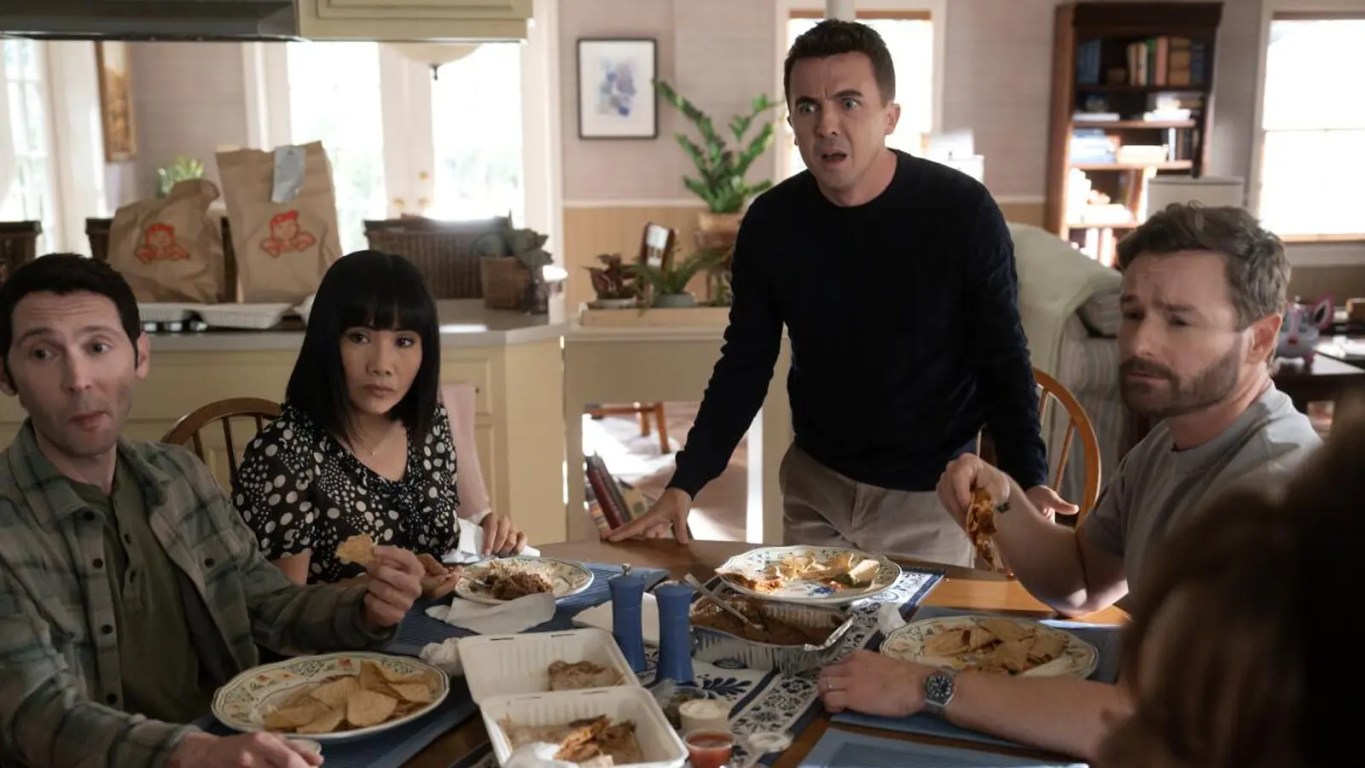
Twenty years is a long time to run from your family. Malcolm Wilkerson has managed it, more or less. Founder of a charity routing unsold grocery inventory to food banks, single father, functional human being. He breaks the fourth wall in the opening minutes of Life’s Still Unfair to tell us exactly this, with the slightly too-intense cheerfulness of a man who has read a lot of self-help. His secret, delivered straight to camera: avoid the Wilkersons at all costs. Use charity emergencies as cover. Keep the two halves of your life permanently apart. It has worked, he insists, brilliantly.
It hasn’t. Hal and Lois are celebrating their 40th wedding anniversary, and they want their son there. Malcolm dodges the calls. They turn up unannounced. And just like that, the careful fiction he’s built around himself is gone. His girlfriend, Tristan, didn’t know about his family. His teenage daughter, Leah, thought the family was dead. His family didn’t know Leah existed.
RELATED: [THE FILES] 100 | Fast & Furious (2009) – The ‘Soft Reboot’ Protocol
Table of Contents
Genius Isn’t Enough: Malcolm’s Mid-Life Reality Check
Life’s Still Unfair is something stranger and, in its best moments, more honest than most sitcom revivals ever dare to be. The original series finale, “Graduation,” had Malcolm arrive at a conclusion he’d spent seven seasons resisting: no matter how far you run from your family, you carry them with you. Inescapable. He said it, headed to Harvard, and the audience assumed he’d managed it. This is the reckoning that speech was always pointing toward. What the revival understands — and this is where it separates itself from the nostalgic comfort food most critics expected — is that the toxicity, the dysfunction, and the trauma were never separable from the bond. They’re the same material. Every family has some version of this. The Wilkersons just have it louder and with less insurance.
The show has aged into its own damage and found the love still tangled up inside it. It’s more self-aware, more introspective, more conscious of what it has cost these people — and what kept them together anyway. Occasionally it tips into sermon territory, written in the 2020s for an audience that’s grown up and started asking harder questions about the families that shaped them. But Boomer knows the original’s rhythm well enough that he rarely lets sentiment sit uninterrupted. There’s almost always a joke running in the background of the sermon, sometimes literally in the background of the shot.
None of which would land without Hal.
Hal and Lois: Proof That Some Things Never Change
Bryan Cranston has always been the emotional architecture of this show, through unconditional warmth — the quality no writers’ room can manufacture, and Cranston carries like it weighs nothing. The revival makes its priorities clear early. This is an ensemble, yes. But the camera keeps finding Hal. He reunites his a cappella group, The Gentlemen Callers, to serenade Lois with Bruno Mars’ “Locked Out of Heaven” in the aisles of the Lucky Aide — where she works — as a declaration of love. He microdoses something in episode three, takes considerably more than intended, and proceeds to hallucinate multiple alternate versions of himself, including, memorably, Evil Hal, in a sequence that is funny on the surface and genuinely sad underneath, which is the show’s oldest trick. Because beneath the psychotic break lies years of panic, pressure and buried hurt. When Hal destabilises, everything around him destabilises. The show knows this. That’s not a coincidence. That’s Boomer knowing exactly what holds the whole thing up.
Malcolm is still irritated, overwhelmed and faintly miserable. Fatherhood just makes it harder for him to pretend he escaped any of this.
Kelly, the baby from the original finale’s closing scene, now a self-possessed teenager, is the revival’s most interesting and unstable element. They’re the first Wilkerson the house didn’t fully shape. They clock Reese immediately — the odd jobs around the house, the financial dependency dressed up as devotion, all of it scaffolding for a man with failed marriages and no footing of his own. Kelly names it. It’s almost a killjoy move, and the show is aware of that. They don’t belong among these people the way the others do. The original sustained itself on permanent chaos because there was no fulcrum of sanity inside the house. Kelly changes the geometry. Leah has inherited Malcolm’s fourth-wall breaking and his hyper-awareness in equal measure, and their dynamic is the revival’s quietest gift. Two people with the same overdeveloped capacity to observe their own dysfunction from above, now stuck inside it together. The unanswered question of her mother — who left three days after Leah’s birth — sits in the background of every scene they share, unresolved and unexplained. The show is wise not to reach for it. Too complicated for four episodes, and its unresolved weight is more honest than any tidy answer would be.
Four episodes are both the making and the limitation of this revival. The format runs out before the characters do. Leah’s life at school surfaces and disappears without resolution. Dewey, confined to a laptop screen, is given enough to remind you how much you’ve missed him and not nearly enough to satisfy that. Francis and Piama are expecting a child, a new generation entering the same battered architecture, and that alone could fuel another series. Every time you find yourself wanting five more minutes with a character the show has run out of room to serve, that’s the argument for a full series.
Every familiar face returns. And for those who couldn’t — Cloris Leachman, Daniel von Bargen, others who helped build this world and are no longer here — the show finds them in photographs on walls, in the background of scenes, present without ceremony. It doesn’t make a speech about it. It just remembers. That’s the difference between nostalgia and a love letter, and Life’s Still Unfair is firmly the latter.
There are moments where you expect the show to apologise for its own existence. To wince at what it used to be. It never does. Because the whole point, the point Malcolm finally lands on after two decades of running, is that family does not stop being family just because it hurts. The damage is real. So is the love. What matters is whether you stop running long enough to face what that damage did to you. Lois’s pressure, the expectation carried from the original series that Malcolm would be president, wasn’t simple control. It was love wearing the only shape she knew how to give it: if life is going to be hard, you’d better be harder. The revival says this plainly, without flinching, in the middle of a diarrhoea joke, and moves on with its day. The final moment delivers a laugh and a smile, and the quiet promise that the new and the old can coexist. That’s harder to pull off than it sounds. Most revivals pick one or the other and hedge. Life’s Still Unfair doesn’t hedge.
Why ‘Life is Unfair’ is the Perfect Anthem for 2026
The show is more aware of its dysfunction than it has ever been. It doesn’t apologise for a second of it, even when it occasionally sounds preachy. The chaos was always the point. The love was just what the chaos was made of. And this revival clearly delights in the chaos it was built upon.
4/5
All four episodes of Malcolm in the Middle: Life’s Still Unfair are streaming now on Hulu and on Disney+ internationally.
RELATED: The Blueprint: 5 Films to Watch Before the ‘MICHAEL’ Premiere
Featured Photo: Disney; Hulu
Author Bio
As a freelance journalist, Ryan Smith’s work is driven by a commitment to restoring what has long been absent from institutions meant to uphold truth and accountability: honesty and transparency. Alongside his analysis works on the life, career, trials and tribulations of Michael Jackson, whose unfair treatment over the years paved the way for the path he is on, Smith also dissects and examines popular culture, such as books, movies and video games, always aiming to shed light on what’s beneath the surface.
![[THE FILES] 106 | The Blade: How the Motorola Razr V3 Cut Through the Tech Mainframe](https://deckedoutmagazine.com/wp-content/uploads/2026/04/motorola_razr_hero_image.webp)

![[THE FILES] 105 | NBA Live 99 (1998) — The Soul of Hoops](https://deckedoutmagazine.com/wp-content/uploads/2026/04/nba_live_1998_hero_image.webp)

What’s interesting is how Michael Jackson was a big fan of Malcolm in the Middle and he even said to Frankie Muniz how Malcolm was very similar to him, which stunned the actor, who mentioned it in a tweet the day Michael passed away. From what I have seen, the show never went into dissing MJ, unlike sitcoms like The Nanny or even Family Matters which threw a nasty jab toward Lisa Mary Presley over her marriage to Michael, which stunned me as Jaleel White loves MJ and one of the actors in the show is a friend of MJ. Here is the tweet of Frankie over MJ for those who are curious. (http://twitter.com/frankiemuniz/status/2333947633).