
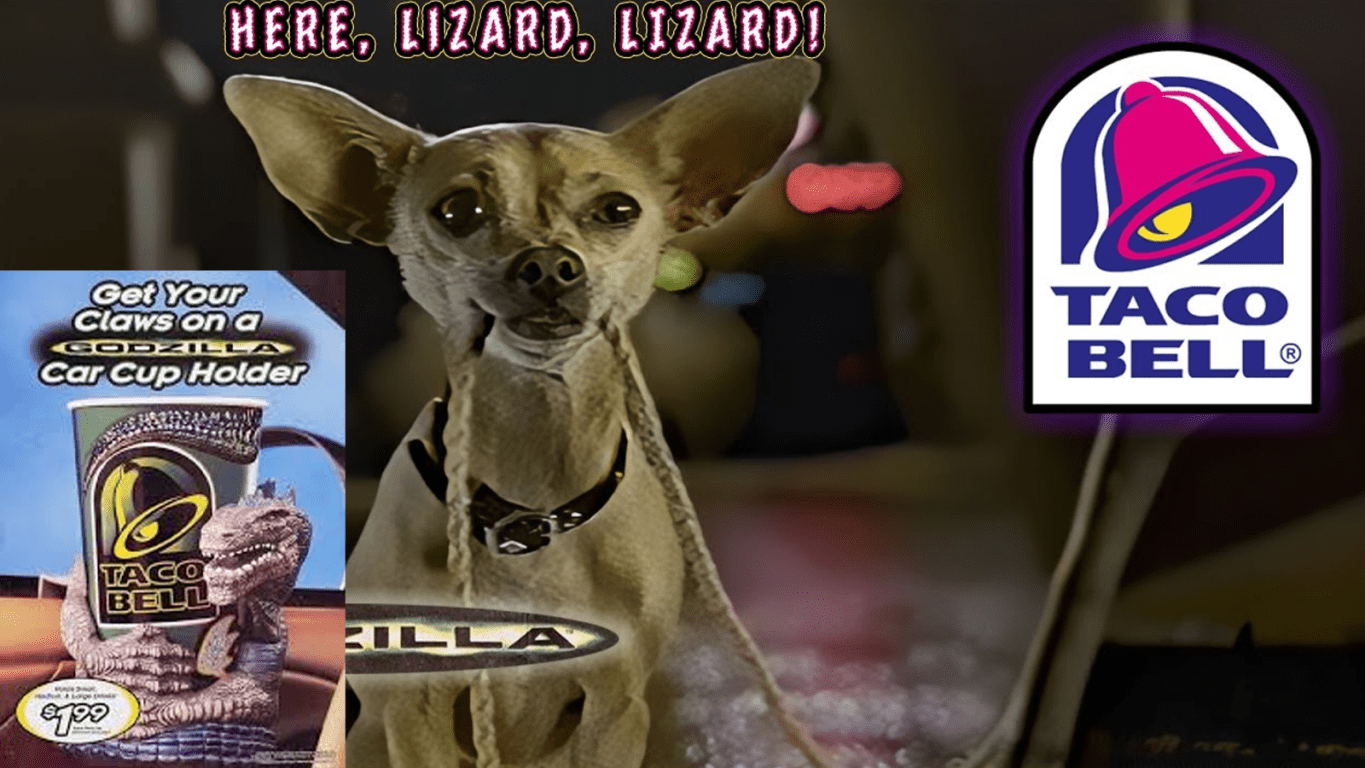
- Date of Record: May 19, 1998
- Operational Status: Discontinued / Archival
- Primary Asset: The Taco Bell Chihuahua x G-Force
In the summer of 1998, the film industry was bracing for a seismic shift. TriStar Pictures was so protective of Roland Emmerich’s Godzilla redesign that they famously withheld the monster’s full appearance from the trailers, opting instead for a cryptic, footprint-heavy “Size Does Matter” campaign. While there’s much to be said about the movie, its primary corporate partner, Taco Bell, executed one of the most successful tactical marketing takeovers in fast-food history.
This wasn’t just a toy tie-in; it was a full-scale rebranding of the Taco Bell “Hardware.” Led by a 12-pound Chihuahua (Gidget) and a $60 million media spend, the campaign shifted the brand’s focus from traditional Mexican-inspired fare to “Big Food.” It was the era of the G-Force, where every cup, box, and burrito was up-specced to match the scale of a 20-story kaiju.
RELATED: [THE FILES] 058: Burger King Cini-Minis (1998)
Table of Contents
Technical Architecture: The Gordita Launchpad
The Godzilla collab served as the national test for what would become one of Taco Bell’s most iconic pieces of hardware: The Gordita.
- The Structural Shift: Before 1998, Taco Bell was a “Thin-Shell” ecosystem. The Gordita introduced a thick, pillowy flatbread that allowed for heavier amounts of seasoned beef and cheese. Marketed as “Big Food for a Big Monster,” the Gordita was designed to feel more substantial than the standard taco, catering to the “Size Matters” aesthetic of the era.
- The G-Force Aesthetics: Every item was housed in custom tactical packaging. Utilizing high-contrast greens and deep blacks, the wrappers and boxes mimicked the military surveillance equipment seen in the film.
Virtual Hardware: The “Here Lizard” Logic
The campaign’s MVP wasn’t the giant lizard—it was the Taco Bell Chihuahua. In a series of legendary 30-second audits, the dog attempted to capture Godzilla using a cardboard box and a stick, delivering the iconic line: “Here lizard, lizard, lizard.”
The gameplay of the promotion functioned through “Find Godzilla” Decoder Cups. These 32oz translucent plastic vessels featured “Hidden Design” art that could only be deciphered using a special “Sleeper Decoder” peel-off sheet. Successfully “finding” the monster unlocked a hierarchy of prizes, ranging from free food to a $1 million grand prize, effectively gamifying the dining experience decades before mobile apps took over.
Cultural Impact: The Chihuahua Outlasts the King

Photo: Taco Bell
The 1998 Godzilla is often cited as a critical failure, but the Taco Bell tie-in was a high-performance win. The Chihuahua became such a massive cultural “Mainframe” that it briefly outshone the film’s lead, Matthew Broderick.
- The Legacy of the Gordita: The “Godzilla Gordita” (a Supreme variant with extra zesty sauce) was so successful during the “Size Matters” window that it became a permanent fixture of the menu for over two decades.
- The “Lizard” Loop: To this day, the “Here Lizard” campaign is studied in marketing circles as the perfect example of how a brand can “hijack” a movie’s hype even if the movie doesn’t deliver. Taco Bell didn’t need a good movie; they just needed a “big” idea.
Performance Data
- Campaign Duration: May – July 1998
- Lead Creative: TBWA/Chiat/Day
- Estimated Spend: $60 Million (Global)
- Status: Ranked as a “Gold Standard” in the Movie Tie-In Archive.
Featured Photo: Taco Bell
RELATED: [THE FILES] 043 | The Pizza Hut Bigfoot (1993)
Author Bio
Jael Rucker is the founder of Decked Out Magazine. She has previously worked as the Associate Commerce Editor at PureWow, focusing on analytics and trends to pitch stories and optimize articles that build and engage their audience. Her work has also been seen in Footwear News and WWD. Prior to 2024, she was the style and pop culture editor at ONE37pm for over three years, contributing numerous product reviews, brand profiles and fashion trend reports, which included interviewing Steph Curry, Snoop Dogg and more.
![[THE FILES] 089 | The History of Xbox: From Project Midway to the 25th Anniversary](https://deckedoutmagazine.com/wp-content/uploads/2026/04/xbox_25_anniversary_2001_hero_image.png)

![[THE FILES] 088 | Ludacris – ‘Act a Fool’ (2003) Tactical Visuals](https://deckedoutmagazine.com/wp-content/uploads/2026/04/ludacris_act_a_fool_hero_image.png)