

04/04/2026
Clocking It: The Political Rundown — The Verdict
Earlier this week, Halfway Clocked laid out the historical record in clinical detail. The Ku Klux Klan was founded by Confederate veterans in Pulaski, Tennessee, in 1865, men who were, at the time, overwhelmingly Democrats. The Republican Party freed the slaves. And then, over the course of roughly four decades, the parties realigned. Black voters moved to the Democratic Party starting in the 1930s, drawn by FDR’s New Deal. White Southern conservatives, the Dixiecrats, the segregationists, the heirs to the Klan’s political legacy, moved to the Republican Party, triggered by the Civil Rights Act of 1964 and accelerated by Nixon’s Southern Strategy.
That was the Halfway Clocked picture: a party realignment documented by every credible historian of American political development.
But facts, as we have learned over the past decade, do not automatically defeat falsehoods. The claim that “Democrats are the party of the KKK” is a falsehood and has circulated for years. It has been debunked repeatedly. And yet it persists.
Now comes the question that the historical record alone cannot answer. Why does this lie keep rearing up? What cultural and political work does it perform? And what does its persistence tell us about the state of American political discourse in 2026, a year when a Black influencer can say these words on a public platform and receive thousands of likes in response?
The verdict arrives now.
The Convenience of Historical Amnesia
Nick Cannon’s claim is not original. It has been a staple of right-wing talking points for at least two decades, recycled whenever the speaker wants to deflect criticism of modern Republican policies by pointing to Democratic sins of the distant past.
The structure is always the same: freeze the Democratic Party in 1865. Ignore every change that happened in the 160 years since. Pretend that the party of Andrew Johnson, the white supremacist responsible for black people not getting their “40 acres and a mule” succeeded Lincoln and opposed Reconstruction, is the same party that nominated Barack Obama, Kamala Harris, and the most racially diverse political coalition in world history.
This is not ignorance. It is selective amnesia. And it is extraordinarily convenient for those who wish to avoid accountability for the present.
Because if Democrats are still the party of the Klan, then Republicans never need to answer for the Dixiecrats they welcomed into their ranks. If Democrats are still the party of slavery, then Republicans never need to explain why white Southern segregationists felt so at home in the GOP by 1970. If the parties never switched, then modern Republicanism bears no responsibility for the politics of racial resentment that it deliberately cultivated.
The falsehood is not just historically inaccurate. It is strategically useful.
Was Lincoln’s Republican Party Conservative or Radical?
To understand why the “Democrats are the party of the KKK” falsehood collapses under scrutiny, you have to understand what conservatism meant in the 1860s, and who was defending the status quo.
Abraham Lincoln’s Republican Party was not “conservative” in any modern sense. It was the anti‑slavery, pro‑federal‑power, pro‑modernization party, built by reformers who wanted to remake the nation’s economic and moral foundations. In the political vocabulary of the 19th century, they were widely described as “Radicals,” “Reformers,” and “Progressives,” the people pushing the country forward, not preserving the existing order.
The actual conservatives of the era were the Southern Democrats and their Northern allies, who defended slavery, states’ rights arguments, and the racial hierarchy that had structured American life since the founding. They were the ones fighting to preserve the old order, literally the definition of conservatism in that period.
Lincoln’s Republicans, by contrast:
- Opposed the expansion of slavery
- Supported federal investment in infrastructure and education
- Championed the Homestead Act and land‑grant universities
- Backed the 13th, 14th, and 15th Amendments
- Embraced a strong national government capable of reshaping society
These were transformational positions. They were disruptive. They were, in the language of the time, radical.
Even within the Republican Party, the faction that pushed hardest for racial equality, the Radical Republicans, was considered extreme by 19th‑century standards. They demanded full citizenship for freed people, federal enforcement of civil rights, and the restructuring of Southern political power. Their opponents called them “fanatics.” History calls them something else: the architects of Reconstruction.
So when modern commentators claim that the Republican Party of Lincoln was “the conservative party,” they are retrofitting 21st‑century ideological labels onto a 19th‑century political landscape that does not map cleanly onto today’s categories. The party that freed the slaves was not defending the old order. It was trying to overthrow it.
And that is the point: the coalitions changed. The meanings of “conservative” and “liberal” changed. The parties changed. The people who once resisted racial equality did not stay where they were. They moved, and the political map moved with them.
The Realignment Denial Industry
There is an entire ecosystem dedicated to denying that the parties realigned. Its arguments take several forms.
One approach is to point out that some Northern Republicans supported civil rights legislation, which is true, but misses the point. The question is not whether individual Republicans crossed party lines. The question is where the coalitions ended up. And by the 1970s, the Democratic Party was the party of civil rights, and the Republican Party was the party of white Southern conservatives who opposed them.
Another approach is to claim that the Southern Strategy is a myth. This argument has been advanced by conservative commentators and think tanks, but it collapses under the weight of evidence. Richard Nixon’s own strategists, including Kevin Phillips, openly discussed the strategy in writing. Phillips argued that the Voting Rights Act would “precipitate the ‘Negrophobe whites to quit the Democrats and become Republicans.'” This was not a secret plot uncovered by liberal historians. It was a public electoral calculation, discussed in memos and books.
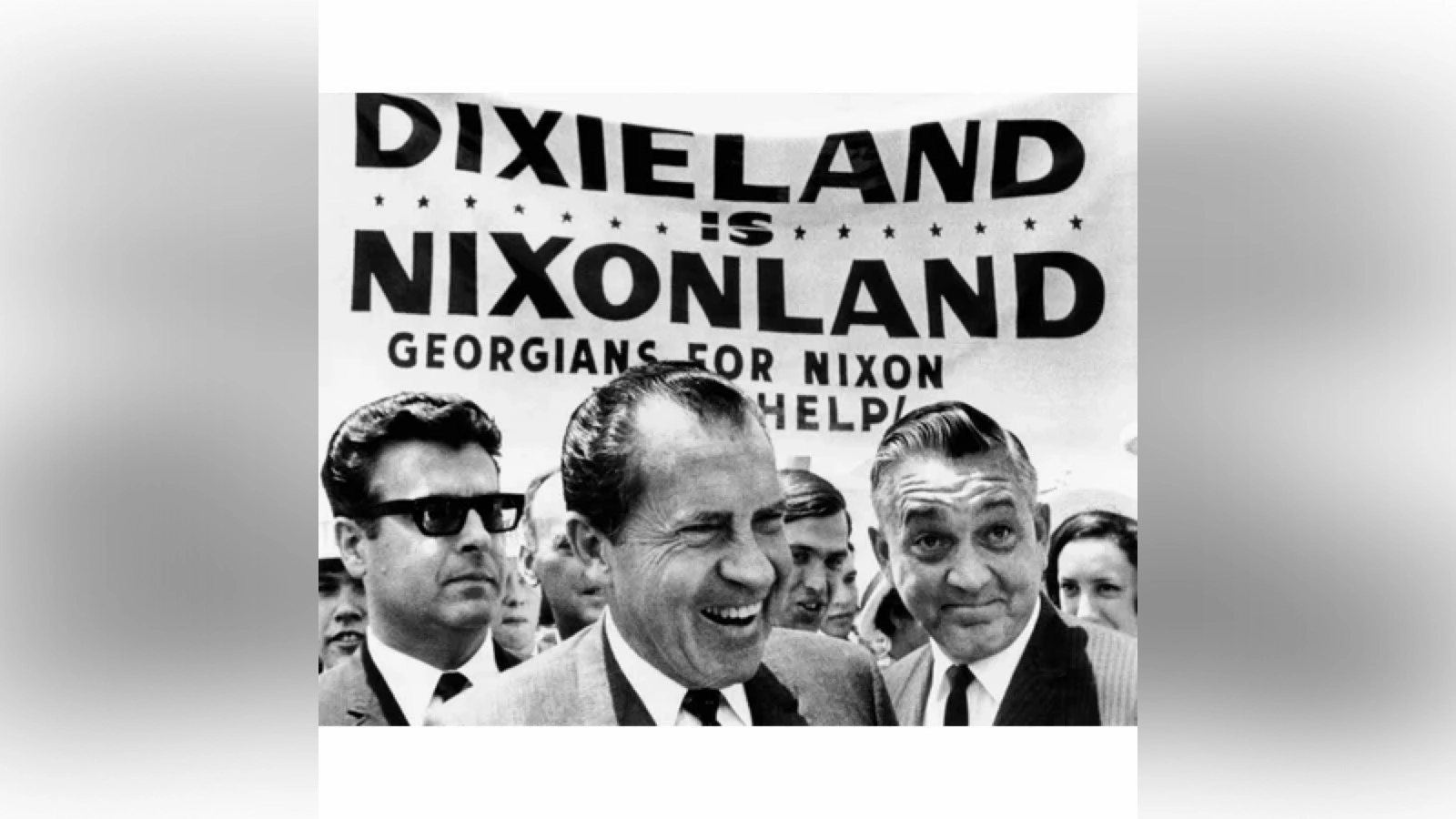
A third approach is to insist that the Klan’s modern descendants are still Democrats, a claim that requires ignoring every poll, every election result, and every demographic trend of the past fifty years. White Southerners who express the highest levels of racial resentment vote Republican. They have for decades. The data is unambiguous.
The Cultural Work of the Falsehood
Why does this matter beyond the realm of historical accuracy?
Because the “Democrats are the party of the KKK” talking point does something specific in American political discourse. It allows the speaker to claim the moral high ground of the civil rights movement while simultaneously opposing every policy that movement produced. It allows the speaker to invoke Abraham Lincoln while supporting politicians who have called for deportations, walls, and travel bans based on race and religion.
It is a form of political jiu-jitsu, using the opponent’s historical weight against them while pretending your own side has no weight at all.
And it works. It works because many Americans learn civics through slogans, not through history. It works because the realignment is rarely taught in schools. It works because a ninety-second clip travels further than a nine-hundred-page history book.
Nick Cannon is not the first person to fall for this framing. He will not be the last. But he is a significant vector for it, a Black celebrity with millions of followers, now amplifying a talking point that lets the modern Republican Party off the hook for the segregationists it absorbed.
The Irony of Cannon’s Position
There is a deeper irony here that deserves attention.
Cannon, in the same interview, invoked W.E.B. Du Bois, paraphrasing his famous line: “There’s no such thing as two parties. It’s just one evil party with two different names.”
Du Bois was a brilliant historian, sociologist, and civil rights activist. But he was writing in a different era, the early twentieth century, when both parties were, in fact, complicit in white supremacy. The Democratic Party of the South was the party of Jim Crow. The Republican Party, for all its historical symbolism, had largely abandoned Black voters to the mercies of the South.
Du Bois did not live to see the realignment. He died in 1963, one year before the Civil Rights Act, one year before Goldwater’s Southern breakthrough, one year before the parties began their final migration to their current configurations. If he had lived another decade, he might have revised his assessment. Because by the 1970s, the parties were no longer interchangeable on race. One had become the home of the civil rights coalition. The other had become the home of the people who opposed it.
Cannon’s invocation of Du Bois is sincere, but it is also anachronistic. The two parties are not morally equivalent on racial justice today. They have not been for half a century.
The Verdict — The Parties Switched, the Lies Remain
Here is the cultural reality that matters most:
Nick Cannon is not stupid. He is not evil. He is a smart, successful, culturally influential figure who has been exposed to a misleading historical narrative, and, for whatever reason, chose to repeat it on a public platform.
The claim that “Democrats are the party of the KKK” is a falsehood. It was never true in the way it is being deployed. The Klan was founded by Confederate veterans, not by the Democratic Party as an institution. And the political heirs of those Confederate veterans, the white Southerners who resisted civil rights, who supported segregation, who voted for Thurmond and Goldwater and Nixon and Reagan, did not stay Democrats. They became Republicans.
This is not a matter of opinion. It is a matter of historical record. The realignment is documented in every major work of American political history published in the last half-century. It is visible in election results, in demographic shifts, in the voting patterns of every Southern state from 1960 to the present.
And yet the lie persists. It persists because it is useful. It persists because it is easy to repeat. It persists because many people would rather believe a convenient falsehood than grapple with a complex truth.
That is the real indictment, not of Nick Cannon, but of a political culture that rewards historical amnesia and punishes nuance. A culture in which a viral clip is worth more than a library. A culture in which the party realignment is considered niche knowledge, not basic civic literacy.
Halfway Clocked revealed the evidence. This week’s Verdict has drawn the conclusion. The parties switched. The racists changed teams. The Democratic Party that exists today is not the Democratic Party of the Klan. And anyone who claims otherwise is selling a story, not a history.
Clocked. That’s the tea.
Sources
· “Nick Cannon Calls the Democratic Party the ‘Party of the KKK’ and Says ‘I F— With Trump,'” Yahoo News, March 28, 2026
· “Nick Cannon Dubs Democrats the ‘Party of the KKK’ While Revealing MAGA Pivot,” Billboard, March 30, 2026
· “The Ku Klux Klan founded,” History Today, December 24, 1865
· “GOP pundits rewrite history,” MySanAntonio, April 11, 2013
· “Goldwater in Dixie: Race, Region, and the Rise of the Right,” University of Arizona Press, via Project MUSE
· Southern Strategy, Wikipedia
· “A Black/Non-Black Theory of African-American Partisanship,” University of North Texas, 2008
· “Chapter 6: The African American Realignment and New Deal Liberalism,” Princeton University Press, via Project MUSE
· “Strom Thurmond: A Featured Biography,” United States Senate
About the Author
Andrew Greene is a quality-obsessed, results-driven powerhouse with nearly two decades of experience transforming complexity into clear, actionable solutions. His secret weapon? A mix of analytical sharpness, problem-solving precision and a communication and leadership style that’s equal parts clarity and charisma. From Quality Assurance to political data analysis, you can think of him as the Swiss Army knife of operational excellence, minus the corkscrew (unless it’s a team celebration).