
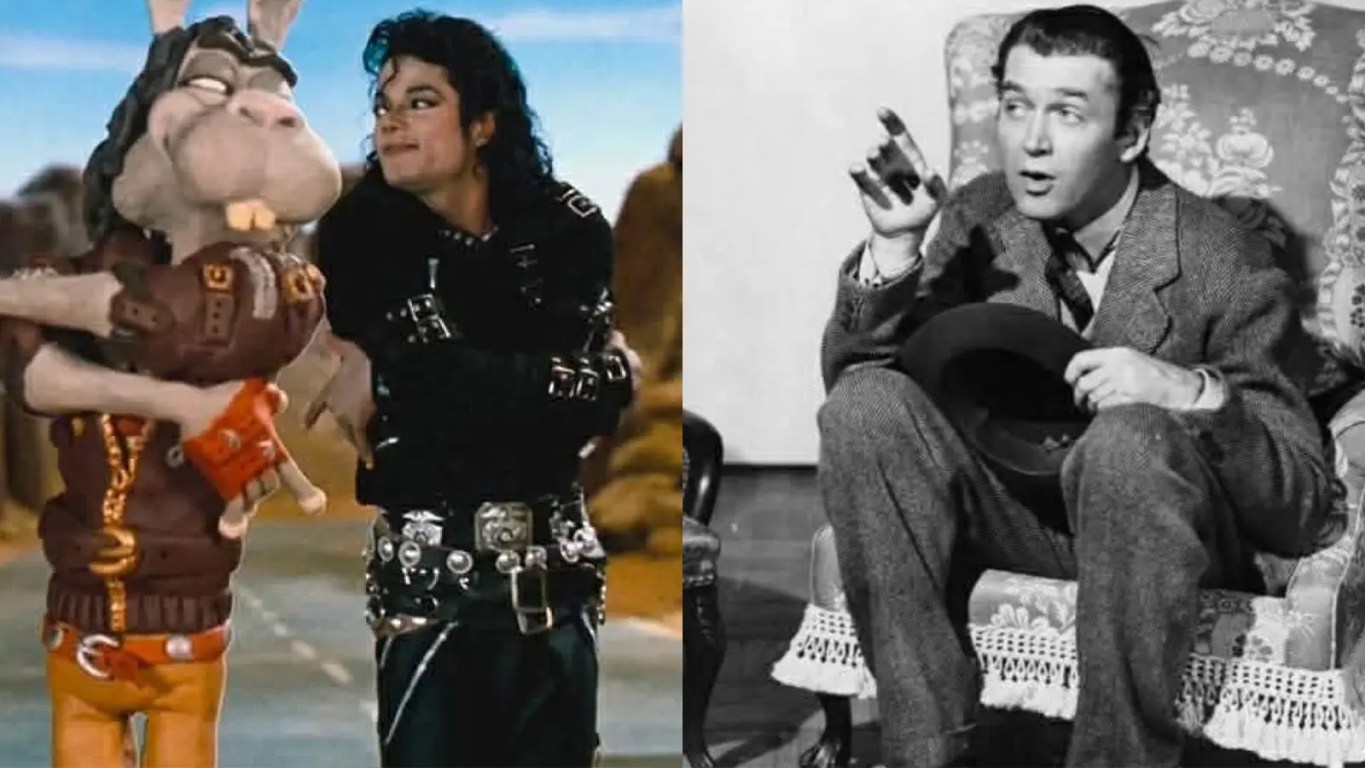
There is a shorthand that has developed, over decades of cultural commentary, for understanding Michael Jackson. When writers and critics want a cinematic parallel for Michael Jackson, something that explains him, or contains him, or at least names what they’re looking at. They go to the same small shelf. Edward Scissorhands, dangerous hands, the world decided, before it had thought to ask what he might make with them. Willy Wonka: the compound, the gates, a logic no adult could follow and no child needed explaining. The Elephant Man. Put on show. A person the world had no interest in understanding. It just wanted to look.
RELATED: The King of Popcorn: Regal and Cinemark Unveil ‘Michael’ Biopic Collectibles
Table of Contents
These comparisons earn their place. The Scissorhands parallel captures the way Jackson’s gifts and his vulnerability were the same thing, inseparable, self-wounding. The Wonka comparison captures the Neverland logic, the deliberate construction of a world outside normal adult coordinates. The Elephant Man captures the grotesque public theatre of the tabloid years, the surgical alterations, the oxygen-chamber photographs, the years eating him alive in public while he watched.
But all three frameworks share a structural limitation worth naming. These are films about strange people that normal people watch from their sofas and feel moved by, and then the credits roll and everyone goes home the same. The pity moves toward him and stays there. You watch Edward Scissorhands navigate a hostile world. You never inhabit his logic so completely that the hostile world starts to look like the problem.
There is another film nobody has reached for yet. Less discussed in this context, perhaps because it does not look, on the surface, like the kind of film you would reach for when trying to understand the most famous person who ever lived. It is a 1950 American comedy about a cheerful middle-aged man who spends his days in bars introducing strangers to his best friend, an invisible six-foot-three-and-a-half-inch white rabbit named Harvey. The play it was adapted from won the Pulitzer Prize. James Stewart considered it the finest work of his career. And of all the films that have ever been made, it may be the one that comes closest to what animated Michael Jackson underneath it all. Not what the world did to him. What lived underneath it, in the part no amount of tabloid coverage, prosecution, or institutional machinery ever quite got to.
The film follows Elwood P. Dowd. Gentle, wealthy, spends his days in bars introducing strangers to Harvey, a six-foot rabbit no one else can see. His sister Veta has had enough. She arranges to have him committed. The doctors have a formula for this. It will make him perfectly normal. Elwood’s crime, as far as anyone can establish, is that he is genuinely, indiscriminately kind to ex-convicts, to nurses, to sanitarium orderlies, and that he refuses to regulate it. The film is ostensibly a comedy. It is also a sustained argument about what normality costs, conducted from the inside out: by the time the credits roll, the audience has been moved far enough into Elwood’s logic that the world trying to fix him looks like the thing that needs examining.
A man and his rabbit. The rabbit vanishes when authority arrives and reappears in the rocks when it leaves. Harvey (1950) is the film that built that grammar. Whether Jackson knew it or not, he lived it.
The desert canyon. Dawn. Michael Jackson pulls his motorbike to a stop and removes the rabbit costume. The costume stands up. His name is Spike, six feet of claymation rabbit with animatronic eyes and his own bike, and he wants a dance-off. They dance. Then a motorcycle cop arrives, points to a sign that reads “No Dancing Zone,” and demands that Jackson account for himself. Jackson turns to show the cop that he was competing with the rabbit. Spike has vanished. The cop hands him a ticket and asks for his autograph, the precise thing the entire mob of fans and journalists had been chasing him for throughout the sequence. Jackson signs it. The cop leaves. Jackson prepares to ride away, and then the rocky mountain in front of him shifts. Spike’s head materialises in the stone, nods at him, and winks. Jackson smiles and drives away.
The scene is from the Speed Demon segment of Jackson’s Moonwalker, written and financed by Jackson himself. Most people remember it as a charming absurdist spectacle: a mad chase sequence, Will Vinton’s claymation doing something genuinely strange with celebrity, pursuit, and shape-shifting. It is that. It is also a startlingly precise self-portrait. And to understand why, you need Mary Chase, the creator of Harvey.
Rumpots and Crackpots
Mary Coyle was born in 1907, the youngest of four, to Irish immigrant parents. They’d come to America looking for a fortune. They found the wrong side of the tracks in Denver’s Baker neighbourhood instead. She grew up immersed in the folklore her mother and four bachelor uncles brought with them from the old country: the pookas, the banshees, the changeling spirits that moved through the world in animal form, visible only to those with the particular kind of openness required to receive them. Her uncle told her about pookas specifically: mischievous fairy spirits that appeared here and there, now and then, to this one and that one at their own caprice. Always very large. Very fond of rumpots and crackpots.
Mary was still a girl when her mother watched some youths throwing snowballs at an old woman picking her way along the street with a cane. She chased the youths off. Then she turned to her daughter and said, “Never be unkind or indifferent to a person others say is crazy. Often they have a deep wisdom. We pay them a great respect in the old country, and we call them fairy people, and it could be that they are sometimes.” That sentence lodged somewhere in Mary Coyle and stayed there for the rest of her life.
Chase rewrote Harvey evenings after the children were in bed, a paper box on the kitchen table for a stage, empty thread spools for characters, moving them around in the dark. It opened on Broadway in November 1944, into a country three years deep in grief, and audiences laughed until they wept.
Harvey was built out of everything Chase was made of: the folklore her uncles carried over from Ireland, the snowballs, the grief she watched swallow her street. And a dream, one early morning, of a psychiatrist being chased across a bedroom by a giant white rabbit. Out of all that, she built a portrait of human goodness rare in American film. She did it while raising three boys, living on the wrong side of the tracks, and getting none of the credit she was owed.
The Pleasant Man
Every time Elwood walks in with his rabbit, the respectable world walks out. He isn’t dangerous. He’s embarrassing. And the laughs in Harvey come from somewhere much closer to grief than to wit.
Elwood explains the nature of his friendship in a bar to anyone who will listen:
“Harvey and I sit in the bars, have a drink or two, play the jukebox. And soon the faces of all the other people they turn toward mine and they smile. They are saying: we don’t know your name, mister, but you’re a very nice fella. Harvey and I warm ourselves in all these golden moments. We’ve entered as strangers, soon we have friends. And they come over and they sit with us and they drink with us and they talk to us. They tell about the big terrible things they’ve done and the big wonderful things they’re going to do. Their hopes, and their regrets, and their loves, and their hates. All very large, because nobody ever brings anything small into a bar. And then I introduce them to Harvey, and he’s bigger and grander than anything they offer me.”
The first person Elwood seeks out in the film is a man named Meegles, recently released from prison, sitting alone at a bar, expecting to be avoided. Elwood is genuinely interested in how he is doing, pays no mind to the time served, and immediately invites him to dinner. But this is not a pattern of specifically seeking out the marginalised. Elwood extends exactly the same quality of attention to the sanitarium director, the doctor, the nurse, and the orderly who manhandles patients. He disarms all of them. He matchmakes two of them. He softens the brutish Wilson simply by treating him as someone worth knowing. Elwood makes no distinction between categories of persons because the distinction never occurs to him. What he does is treat everyone as if they matter completely, which means the people most starved of that treatment feel it most acutely.
Neverland was open to underprivileged children and families, yes. But the deeper mission was identical regardless of who walked through the gate: to give people back something the adult world had quietly taken away. To reconnect them to the child still inside, the one who had learned to apologise for existing. Lost childhood is not class-specific. Neither was his response to it.
Dr William Van Valin, the physician whose friendship with Jackson is documented in his book Private Conversations in Neverland, recorded one story that captures this more precisely than any other. Jackson had known David Rothenberg, better known as Dave Dave, since the man was seven years old. He’d watched him through the years. He’d read in the paper that Dave Dave had tried to kill himself, depressed, the article said, because who would hire someone who looked like him. Jackson sent a driver, brought him to Neverland, and when Van Valin asked whether he had a job for Dave Dave, Jackson said, “Not really, I kind of made one up.” He gave him letters to carry to other cities, a car to take him everywhere he wanted to go, and a place to call home. He told Van Valin: he’d lost his sense of purpose, and I wanted him to know he had one. After dinner, he took Van Valin out to the lake. Dave Dave’s paintings were there. Stick figures. V-shapes for birds. Jackson looked at them and said: I don’t care if he doesn’t become a great painter. I just think it’s important for him to do this while he’s here. I always want to keep him occupied.
Jackson gave Dave Dave a purpose when everyone else had finished with him. The alternative was leaving someone alone at the bar.
Meegles
In 2000, Michael Jackson sat down with Rabbi Shmuley Boteach for a series of recorded conversations. They were made with eventual publication in mind, though Boteach released them shortly after Jackson’s death in circumstances Jackson never sanctioned and could not shape. In one exchange, Jackson describes arguing with Lisa Marie Presley. Two boys in Bootle had killed another child. Ten years old. Sentenced to detention at Her Majesty’s pleasure, no fixed release date. Jackson wanted to go to the prison and visit them. Lisa Marie said, “You idiot, you are just rewarding them for what they did.” Jackson told Shmuley, “I said, how dare you say that. I said, I bet if you trace their life you can find they didn’t have parents around, they didn’t have any love, nobody there to hold them, look in their eyes and say I love you. They deserve that, even though they’re going to get life. I just want to say I love you and hold them. She said, well, you’re wrong. I said, no, you’re wrong. Then the information came out that they came from broken families, were never watched as little kids, attended to. Their pacifier was those Chucky movies with the stabbings and the killings. And that’s how they became conditioned to that.”
Jackson was not making a forensic case. He was responding to what he believed had been broken in them. He had been inside the machinery of fame since he was six years old, from the stage, from the dock, from the press gallery. He knew what it felt like to be seen as a transaction rather than a person. That knowledge didn’t turn inward. It found its object.
Elwood invites the ex-convict to dinner. Jackson wants to hold the children who killed a child in a Merseyside shopping centre. The same instinct, operating at the same depth, aimed at the same category of person: the ones everyone else has already finished with, the ones who bring everything large because they have nothing left to lose. Lisa Marie’s position is the response of someone who has already been cured of the capacity to understand it: certain that visiting condemned children is a reward rather than an act of love so fundamental it does not require the children to have earned it.
The Wound That Stayed Open
Elwood stayed and cared for his mother until she died. That sustained, devoted attention, years of it trained on one person, left him with a surplus that had nowhere left to go once she was gone. Harvey takes shape in that vacuum. The capacity for total, indiscriminate care was always there; losing its object sent it everywhere.
The hunger did not begin with fame for Jackson. It was already fully articulated in a child hiding in his own house, crying, before a South American tour. Michael, in his own words: “I just want to be like everyone else. I just want to be normal.” His father found him and put him in the car anyway. The concert date and contracts involved did not care what young Michael wanted.
What the Kingdom Hall gave him was the only answer that hunger ever received. He was the only one of the Jackson 5 to be baptised by personal choice, not by inherited faith. What he was choosing, and what Jermaine Jackson confirmed in his book “You Are Not Alone: Michael Through a Brother’s Eyes”, was a space where the theological structure made it impossible to treat him as anything other than an equal. Witnesses are only permitted to make a fuss of Jehovah. So they called him Brother Jackson, the same as everyone else, and he knocked on doors in disguise twice a week because the thing on the other side of those doors, ordinary human contact at name-level and peer-level, was the thing the rest of his life had been systematically stripping from him since he was six. Jermaine put it plainly: the Kingdom Hall brought him a sense of normality that, in the outside world, dwindled year upon year.
He fought to stay inside it for three years after the friction began. Reproved over Thriller in 1984, still going door to door. Still attending in 1985, 1986. His letter to the congregation arrived in May 1987. The exit was framed as voluntary. Sources close to him said he was asked to leave. Either way, the community that had held the one frequency he could not find anywhere else was gone.
He bought Neverland in 1988.
That sequence is not incidental. Neverland is not the primary text. Neverland is grief made architectural. He’d been thrown out of the only place that had ever treated him like a person, and he built. Edward Scissorhands builds his isolation first and retreats into it. Wonka raises the gates and pulls up the drawbridge. Michael lost his community, then built it back. The gates came after the foreclosure. The same quality of contact Elwood had in surplus, Jackson spent his life searching for. Different origins, identical reach. The Speed Demon sequence already knew this. The rabbit that vanishes when authority arrives was never just a cartoon joke. It was a self-portrait with the geometry inverted, and that inversion is everything.
Where Elwood had love that lost its object and went everywhere, Jackson had an object: every child in pain, every child written off by those around him. He spent his life becoming the love he was never given. Katherine Jackson once told Boteach that her son, as a child, would sit beside her and weep at the suffering of others, and tell her: “I know I can’t heal the whole world, Mother, but I can at least make a start.” The mission was already articulated before the wounds of adulthood reached full weight. Neverland was the proof of that. You can only give it its full form from inside the wound, not because the wound creates the capacity, but because it gives the capacity its full dimension.
But here the parallel breaks open. Elwood is essentially invulnerable to the institution. The sanitarium’s full institutional weight (the commitment papers, the doctors, the injection itself) barely scratches him. He walks through all of it smiling, because he is operating from surplus. Harvey lives somewhere no instrument can reach. What the institution cannot do, though, love nearly can. Elwood comes within a breath of surrendering Harvey for Veta’s sake, the same indiscriminate care that built the rabbit is the thing that almost hands it over. His one vulnerability is love-shaped, not institution-shaped.
Jackson was built differently, but not in the way the conversion argument implies. The wound did not manufacture the quality. Katherine had already confirmed it was running before the wounds reached full weight. What the wounds did was aim it. Children in pain were the version of himself he most recognised: the one hiding in his own house before a South American tour, wanting to be normal, put in the car anyway. The suffering gave the quality its specific target and its architectural scale. It did not generate the capacity. That was just there. That was just him. And where Elwood’s love for his sister nearly cost him Harvey, Jackson’s love ran in the opposite direction entirely. To surrender the open door would have been to betray every child who had ever been that version of him. His Harvey was built through the wound, not from it. Closing the door on children in pain meant closing it on himself. That foreclosure was the one thing his love forbade. Elwood required no such loyalty. He does not lose light. He does not have the wiring for it.
Which means the two men are not equivalent. Elwood’s Harvey is structurally protected. It lives where no machinery can follow. Jackson’s Neverland was architectural: physical rooms, real gates, actual children. It could be raided. It was. The parallel holds, but the gap between them is where the argument finds its full weight. Elwood keeps going because nothing can stop him. Jackson kept going anyway, from a position of genuine vulnerability, under sixteen years of sustained institutional assault, with the original wound still open. That is a different category of persistence. It carries a different moral gravity entirely.
Spike
Spike is the Harvey of Jackson’s inner world, but the geometry is inverted, revealing everything. Harvey is invisible. Only Elwood can see him, and the tragedy is that no one else can. Spike is a costume Jackson puts on. He becomes the rabbit. He wears innocence as a disguise, and it works better than his actual face does. The crowd chasing him through that canyon wants Michael Jackson the autograph. They can’t see through the rabbit because they were never looking at him in the first place.
The costume comes off, and Spike becomes independent, no longer something Jackson is wearing but something Jackson has. The cop writes Jackson a ticket for dancing in a No Dancing Zone and, in doing so, gets the autograph that the entire mob had been chasing him for. Even at the end of an escape sequence, he can’t just be. It becomes a citation. A taking.
He is left looking like a madman, alone with authority demanding something from him, the precise position he would occupy, in rather less cartoonish circumstances, for the rest of his life. The moment authority arrives with its clipboard and its sign, the rabbit vanishes not because it was not real but because its reality is incompatible with the official version of events. The cop cannot follow Spike into the rocks, and when the official version withdraws, the frequency remains, still winking from the stone.
The Injection
The climax of Harvey turns on a proposed injection, a formula that will make Elwood a perfectly normal human being. His sister, exhausted and embarrassed, has consented. The doctors are ready. Then a cab driver speaks, and what he says stops everything. He has been driving this route for fifteen years, bringing people to this place and driving them home after they have the formula, and he knows, with empirical certainty, what comes out the other side:
“On the way out here, they sit back and enjoy the ride. They talk to me. Sometimes we stop and watch the sunsets, and look at the birds flying. And sometimes we stop and watch the birds when there ain’t no birds. And look at the sunsets when it’s raining. We have a swell time. And I always get a big tip. But afterwards, oh oh. They crab, crab, crab. They yell at me. Watch the lights. Watch the brakes. Watch the intersections. They scream at me to hurry. They got no faith in me, or my buggy. Yet it’s the same cab, the same driver, and we’re going back over the very same road. It’s no fun. And no tips. After this, he’ll be a perfectly normal human being. And you know what stinkers they are.”
Nothing external changed. The road, the cab, and the driver are identical. The only thing that changed is what is inside the passenger. The cab driver is describing something more corrosive than sadness: the transformation of loss into aggression, the way the stolen capacity for wonder curdles into contempt for those who still have it. The injection doesn’t simply take Harvey away. It makes Elwood’s former world intolerable to him. He comes back craving the lights and the brakes and the hurry, wanting everything to be as small and fast and manageable as it was before Harvey, because looking directly at what he lost would finish him. Call it maturity if you want. It’s damage that never healed right, and the bitterness of that turned outward on anyone it could reach.
Harvey is what keeps it from collapsing in on itself. The passengers going in are watching sunsets, stopping for birds that aren’t there, open to the full texture of the road. The passengers coming back are aggressive, crabbing, screaming, and demanding speed.
“After this, he’ll be a perfectly normal human being.” The cab driver is being precise. The bitterness, the screaming at the brakes, the contempt for the road. That is normality. That is the statistical outcome of damage with no exit. Most people never find one. The cured passengers are not failures or cautionary tales. They are the majority.
What the formula removes is not merely a rabbit. It is the capacity to be stopped by a sunset. To listen for birds that might not be there. To have patience for the road, for strangers in bars, for condemned children who never had anyone look them in the eyes. Jackson spoke to Boteach about this directly. He described pointing to a beautiful sky and being met with “Yeah? It’s nice.” He said, “There must be something wrong with me. Why do I see it and they don’t?” He went to a museum in Paris and broke down crying in front of a painting. His bodyguards had to carry him out. The guide asked what was wrong with him. They said: he is so moved by what he has seen. His instinct, confronted with the gap between his register and everyone else’s, was to assume the deficiency was his. The formula had already told him that. He had half-adopted the cured passengers’ verdict on his own vision.
But the other side of that was always present too. If he were ordinary, he could not do what he believed he was here to do. The abnormality was not just the wound. It was the instrument. You cannot build a children’s hospital from a normal life. You cannot reach the scale of the mission on a normal platform. The very thing that made him feel defective was the only tool large enough for the job he had set himself. He knew both things at once. The longing for normality was genuine. So was the understanding that getting it would have cost him the only reason the longing mattered.
There is a specific grief that belongs to the passengers after the formula, which is not available to those who never climbed into the cab. To lose the capacity for that quality of empathy, the inconvenient, socially expensive, institutionally incomprehensible kind that doesn’t audit its recipients, is a different order of loss from never having had it. The ones who never had it are simply normal. The ones who had it and lost it become its opposite: armoured against exactly what they once carried, unable to tolerate those who still do. The contempt is the wound. Lisa Marie’s position was the majority position. Most of us have been through Chumley’s Rest. “You idiot, you are just rewarding them.” The cab driver could have told her exactly why she held it. She would have been entirely right to say it. And it would not have made Michael wrong. What he carried, that particular refusal to let the sunsets become merely nice, to let the birds stop mattering, to let the empathy calcify into the reasonable, protective business of surviving, is the anomaly. To lose it is a larger shame than never having possessed it.
Veta halts the injection. She finds her coin purse, the one Harvey hid so she couldn’t pay the cab and leave before she heard the speech, and in finding it, understands what has been protecting her brother all along.
There is one place where the parallel breaks, and it matters. Elwood nearly surrendered Harvey, not because the institution overpowered him, but because Veta asked him to. The love that produced the rabbit was the same love that made him willing to lose it. He was saved by a coin purse, by accident, by his own rabbit working against the outcome from inside a pocket. Passive salvation. Jackson’s equivalent moment had already passed before the machine loaded. Cory Rooney, songwriter, Senior VP at Sony, and one of the few industry insiders who spent real time with Jackson in the studio between 1993 and 2009, recalled him saying it plainly: he would never deny a child love, and if it meant crucifixion or jail, then that was what they were going to have to do. That is not the speech of a man who nearly took the injection. That is a man who looked at the needle, named the price of refusing it, and kept the door open regardless. Elwood’s Harvey survived because Veta changed her mind. Jackson’s survived because he decided it would.
Trials and Tribulations
The months of coordinated press pressure before a single charge was filed. The Chandler family’s civil suit lodged before any criminal complaint. A settlement reached, not because guilt required it, but because the alternative was years of deposition testimony dragged through a media cycle that had already decided. Settlements are not admissions of guilt under American civil law. They are risk calculations. The tabloid apparatus did not report the distinction. It didn’t need to. The story was already written before the legal machinery had finished loading.
Read through this lens, it becomes the injection. Not because it succeeded in the courts. It didn’t. But because the institutional apparatus was pointed at the one thing that made Jackson irreducible: his credibility as a person who, by every account examined here, loved children in a way those around him had learned to distrust. A Michael Jackson who survived 1993 unbroken, who kept Neverland open, who kept welcoming sick children into his world, and who kept building the counter-proposal with his life, was still making the argument, still holding the door open. A Michael Jackson who closed Neverland, who accepted that his particular openness was too dangerous and too costly — that is the injection. Same man. Same road home. The thing that made him who he was got removed, whether anyone planned it that way or not.
Neverland stayed open. The fact that he wouldn’t close it, that he kept visiting the wards, kept wanting to stand in a prison cell with children who had done the worst thing imaginable and say the thing nobody had ever said to them, was an accusation that could not be answered by anyone who had already been through Chumley’s Rest and come out the other side craving the lights and the brakes and the hurry.
In 2005, it came for Jackson again, this time with a courtroom and five months of daily testimony. The press campaign had failed. Maybe the law would do it instead. The verdict came back not guilty on all counts. He walked out acquitted of everything.
He never slept in Neverland again.
That is the part worth sitting with. The institutional apparatus failed by every measurable standard (no conviction, no sentence) and still the house was gone. The raid had turned it into something else in the public imagination, somewhere that could no longer be what it was built to be, and no acquittal could undo that. He left for Bahrain. Then Ireland. A man found not guilty of everything, living in voluntary exile because the thing the machinery had really been aimed at, the credibility of the open door, had been damaged past the point where the door could stay open in the same way. The legal route failed. The architectural one succeeded. They reached the perimeter: the house, the conditions, the public architecture of the open door. The centre held.
And here is where Elwood’s gift becomes the thing that costs him the house. Elwood invites everyone to dinner. That is not a selective quality. It does not audit the guest list. It finds Meegles and it finds the people who correctly identify it as the most exploitable thing in the room. Much of what collapsed financially around Jackson traces back to exactly that: the indiscriminate welcome extended to people who had come specifically to take what the welcome offered. The same openness that built Neverland helped hollow it out. The generosity and the vulnerability are not two separate things. They are the same quality, seen from different angles, and the world contains both Meegleses and people who are not Meegles.
This Is It was announced in 2009 under the weight of all of that, financial obligations compacted into fifty dates, a schedule that required him to be the commodity again at the precise moment the commodity had become the only thing standing between him and ruin. Sixteen years of sustained institutional pressure, the loss of his home, his fortune partly stripped by people he had let inside because he was constitutionally unable not to, and underneath all of it, the question the machine had been trying to answer since 1993: whether enough pressure, applied specifically enough, at the right angle, could reach the thing at the centre and close it down.
Brett Barnes saw both sides of that question from closer than almost anyone. He was part of an Australian family who first encountered Jackson at an airport in 1987 (the year the Kingdom Hall closed its doors) handed a letter to one of his dancers, and received a phone call at home years later. The kind of ordinary, unremarkable human contact Jackson spent the rest of his life hunting for. Barnes knew him for nineteen years after that, from the age of five until the phone call that never came, and had thirty years of sustained cultural pressure to revise his account of those years. He never did. In his first media interview since 1993, he was asked whether he noticed any change, and he didn’t reach for loyalty or deflection. He said there was “a little bit of light lost in his eyes.” The carefreeness, the sense of adventure: those things dulled. Then he added something more precise: the root of it all is exactly the same. Even the dependency that eventually developed traces back to the same source. A mind that had been running at that register since the days the Jackson 5 made sure normality would never be obtainable, always on, always searching, never taught how to stop, found its own exits where it could. He wanted to sleep. The most ordinary thing in the world. Everything he ever built to reach what other people arrived at without thinking: the disguises to knock on doors, the 2,700 acres to have a home, the anaesthetic to close his eyes, was extraordinary precisely because the ordinary was never available to him through ordinary means. The same wound at a different depth.
Few public figures were targeted so specifically, for so long, on a charge so precisely aimed at what defined them. The very quality that defined him became the evidence against him. The openness itself was reframed as predation. Under that sustained weight, for sixteen years, keeping the door open had its price. And what remained when it had stripped everything else back was still the room layouts. Still the children. Still Spike, winking from the rocks.
The Murray recording answers that.
The Murray Recording
In 2009, Conrad Murray secretly recorded on his phone while Michael Jackson was in his care. Murray was a cardiologist, hired at $150,000 a month by Jackson’s concert promoter AEG Live to serve as his personal physician during rehearsals for the This Is It residency. He had been administering propofol to Jackson almost every night for two months, a surgical anaesthetic being used, improperly and without monitoring equipment, as a bedtime sleep aid. He would later be convicted of involuntary manslaughter. The judge called it a horrific violation of trust. Jackson did not know the recording. The propofol was already pulling him under when he spoke. What came out of his mouth in that state, unguarded, no performance, no press, no image management, no knowledge of an audience, was the children. The giving. The thing sixteen years of machinery hadn’t touched.
They’re sick because they’re depressed. Don’t have enough hope, no more hope. That’s the next generation that’s going to save our planet. They walk around with no mother. They drop them off, they leave. They reach out to me. Please take me with you. That will be remembered more than my performances. My performances will be up there helping my children and always be my dream. I love them. I love them because I didn’t have a childhood. I had no childhood. I feel their pain. I feel their hurt. I can deal with it.
Everyone who uses that recording as evidence of a broken man stops at the slurring. They don’t get to the words. With the anaesthetic coming up and the defences completely down, he was still there, still planning, still believing things could be gentled if you held them right.
Everything Jackson had been given, the gifts, the fame, the money, was in his mind a means toward this end. A place where sick children could come, where there would be game rooms and movie theatres and someone who understood what it meant to be a child in pain and treated it as the most serious thing in the world. Faith made architectural, made measurable in rooms. He was still dictating room layouts with the anaesthetic pulling him under.
The Same Road
The established critical shorthand for Michael Jackson runs through Edward Scissorhands, Willy Wonka, and The Elephant Man. Each captures something real. Scissorhands captures what the world did to him: how it commodifies difference and then destroys it. The Elephant Man captures the gaze, how even kindness can be a form of looking. Wonka is the retreat; the gates go up when engagement costs too much. All three get at something real. What none of them reach is what was running underneath all of it. Harvey does something structurally different. By the time the cab driver speaks, you have been inside Elwood’s logic long enough that the cured passengers are the horror. The pity has reversed without you noticing. That is the one thing the other frameworks were never built to do. They keep you on the sofa, moved, sympathetic, but outside. Harvey moves you to the road.
Elwood was written to be complete. Jackson was not written at all. He was real, which meant the machine got inside him too, and the hunger for normality it could never fully extinguish was also the thing it spent thirty years trying to use against him. The parallel holds not because Jackson was Elwood, but because the same frequency existed in a real human being navigating a world far more brutal than anything Chase put on the page, and it survived anyway. Elwood’s survival is a given. He is fictional. Jackson surviving as long as he did, as intact as he did, is the actual argument. Part of why Elwood is hard to inject is that circumstances never installed Harvey. The sanitarium has no protocol for something that arrived pre-existing. The machinery can treat damage. It cannot reach what was never damaged into existence. Jackson was hard to break for the same reason. Sixteen years of sustained institutional assault, aimed precisely at the thing that defined him, and the propofol recording is what it couldn’t reach. The injection fails Elwood because Harvey lives where no instrument can follow. It failed at the centre for the same structural reason. You cannot remove through pressure what pressure did not put there.
Mary Chase’s mother knew what to call people like this. The old country had a name for them: the ones who move through the world on a frequency most people can’t receive, who stop for birds that aren’t there, who see the sky the way it actually looks, who sit with ex-convicts and condemned children and ruined men because the distinction between those worth sitting with and those who aren’t never occurs to them. Fairy people. Rumpots and crackpots. The ones others say are crazy, who carry a wisdom the cured passengers will never have access to, because they already took the formula and came back screaming at the brakes.
Elwood could see Harvey because he never took the formula. Jackson could see Spike for the same reason. The pookas are always there, large, mischievous, appearing here and there, now and then, to this one and that one at their own caprice. They appear to be the ones still able to receive them. Had Jackson not been that person, had the formula reached him, had the wiring been different, there would have been no Michael Jackson worth the name. No calls to ordinary families to make them feel extraordinary, and in doing so, feel normal himself. No Neverland for anyone to connect with their childhood. No dying dream of a children’s hospital built from the inside of a world populated almost entirely by screaming passengers. The world has always known what to do when it finds the ones who can still receive. It has always been very certain that there is something wrong with them. It has always had a formula. The passengers are still screaming. He was acquitted on all counts, and they haven’t forgiven him. They couldn’t see Harvey, but they’ve been seeing something in that room for thirty years that no jury, no evidence, and no courtroom has ever been able to locate. The ones who couldn’t receive the rabbit have their own visions. They just aren’t friendly. One of them won a BAFTA. The jury’s verdict — reached in open court, after five months of sworn testimony — has never won anything.
Jackson came out the other end of everything they did to him, still planning the children’s wards with the anaesthetic in his arm.
The capacity for Spike and Harvey: that’s what survived. A man who had lost almost everything else was still drawing up one last haven for those who would see a rabbit in the rocks.
Featured Photo: Epic Record, Warner Bros.
RELATED: ‘Michael’ Biopic Tickets: Release Time, Prices and How to Buy Online
Author Bio
As a freelance journalist, Ryan Smith’s work is driven by a commitment to restoring what has long been absent from institutions meant to uphold truth and accountability: honesty and transparency. Alongside his analysis works on the life, career, trials and tribulations of Michael Jackson, whose unfair treatment over the years paved the way for the path he is on, Smith also dissects and examines popular culture, such as books, movies and video games, always aiming to shed light on what’s beneath the surface.


![[THE FILES] : Def Jam: Fight for NY (2004)](https://deckedoutmagazine.com/wp-content/uploads/2026/05/def_jam_fight_for_ny_hero_image.webp)

![[THE FILES] : Butt-Ugly Martians: Zoom or Doom! (2002) Game Profile: History, Mechanics & Legacy](https://deckedoutmagazine.com/wp-content/uploads/2026/08/butt_ugly_martians_doom_gloom_game_hero_image.png)