
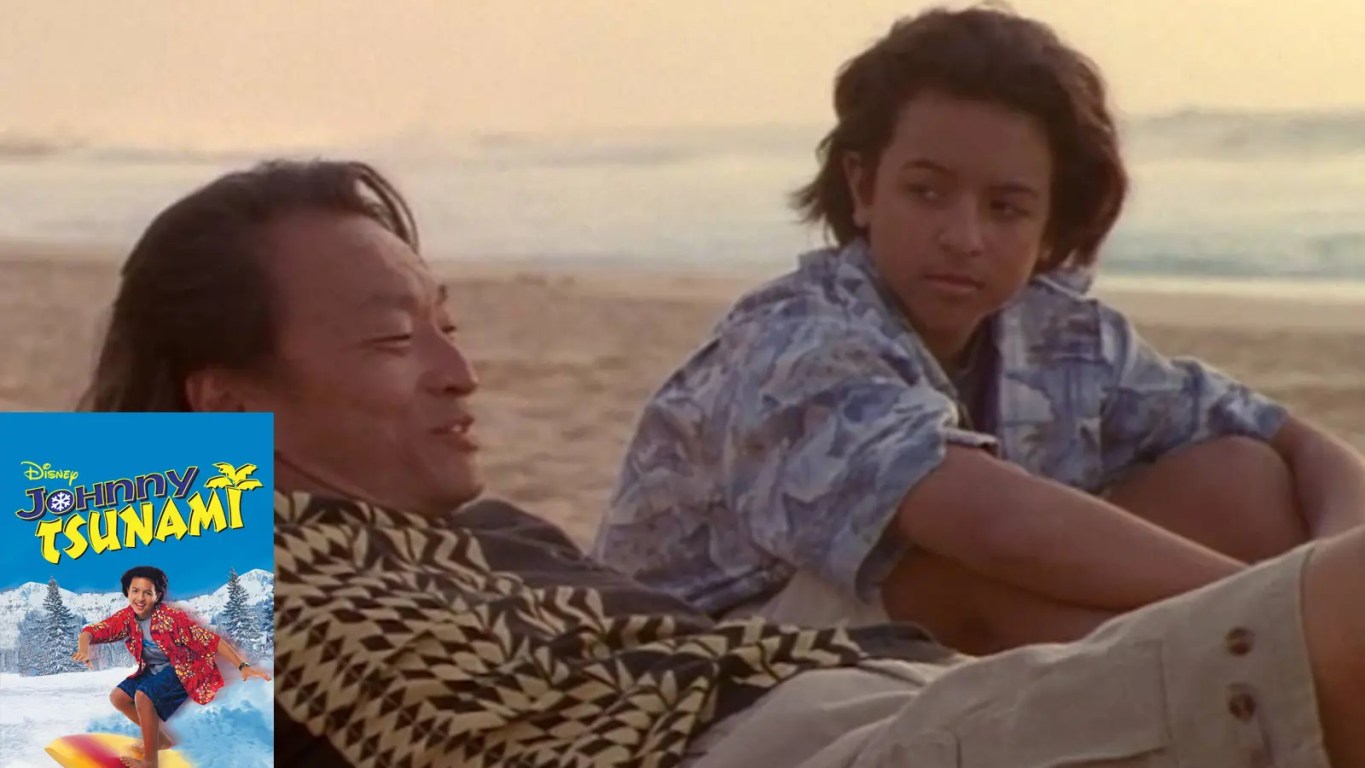
Next up, Johnny Tsunami. Released on July 24, 1999, Johnny Tsunami was the 10th official Disney Channel Original Movie and arguably the first to master the “Technical Sports Drama.” While its predecessor, Brink! (1998) established the “Soul vs. Sponsor” dynamic, Johnny Tsunami engineered a complex cross-climate narrative. It follows Johnny Kapahala from the high-fidelity surf culture of Oahu to the rigid, vertical snowscapes of Vermont. Today, we break down the gear that defined a generation of AAPI representation and DCOM sports.
Johnny Tsunami is the next file to be entered into our library.
RELATED: [THE FILES] 026 | Brink! (1998): Engineering the Soul-Skater Era
Surfing vs. Snowboarding
The film’s central technical conflict is the transition between liquid and solid water.
- The Surf Spec: The early Oahu scenes feature Johnny on traditional shortboards, emphasizing the dynamics of North Shore surfing. These scenes were filmed on location at Sunset Beach and ‘Ehukai, using the actual boards and wax of Hawaii’s elite surf community.
- The Snowboard Interface: When the family moves to Vermont (filmed at Brighton Ski Resort in Utah), Johnny has to adapt his “Surfer Stance” to a fixed-binding snowboard. The film highlights the technical difference in weight distribution—moving from a rear-foot-drive surf style to a front-edge-leading mountain style.
- The “Urchin” vs. “Sky” System: The rivalry between the public-school snowboarders (Urchins) and the private-school skiers (Skies) serves as a commentary on system compatibility. One group uses dual-lateral poles (Skiing), while the other utilizes a single-plane center of gravity (Snowboarding).
The Legacy: The Lilo & Stitch Connection
It’s safe to say that Johnny Tsunami is the structural precursor to Lilo & Stitch (2002) in the Disney “Hawaii Vertical.”
- Cultural Infrastructure: Three years before Lilo taught us about Ohana, Johnny Kapahala showed us the importance of Kupuna(Grandparental) guidance. Johnny’s relationship with his grandfather, the legendary Johnny Tsunami (Cary-Hiroyuki Tagawa), established the “Foundational Wisdom” blueprint that Lilo & Stitch would later expand on.
Conclusion: The 1999 Pivot
Johnny Tsunami proved that a DCOM could be a legitimate study of cultural and athletic adaptation. By treating the gear—the boards, the wax, the bindings—with technical respect, Disney created a file that still holds up as a “Golden Era” gear check. It paved the way for the nuanced AAPI storytelling we see in modern cinema today.
Photo: Disney Channel
RELATED: [THE FILES] 028 | Gotta Kick It Up! (2002): The Engineering of the “Si Se Puede” Spirit
RELATED: [THE FILES] 016: Double Teamed (2002)
Author Bio
Jael Rucker is the founder of Decked Out Magazine. She has previously worked as the Associate Commerce Editor at PureWow, focusing on analytics and trends to pitch stories and optimize articles that build and engage their audience. Her work has also been seen in Footwear News and WWD. Prior to 2024, she was the style and pop culture editor at ONE37pm for over three years, contributing numerous product reviews, brand profiles and fashion trend reports, which included interviewing Steph Curry, Snoop Dogg and more.
![[THE FILES] : Center Stage (2000)](https://deckedoutmagazine.com/wp-content/uploads/2026/06/center_stage_heroistory_hero.webp)

![[THE FILES] : Ludacris – Rollout (My Business) (2001)](https://deckedoutmagazine.com/wp-content/uploads/2026/06/Ludacris.webp)
![[THE FILES] : Just Wright (2010)](https://deckedoutmagazine.com/wp-content/uploads/2026/06/just_wright_history_hero_imagewebp.webp)