
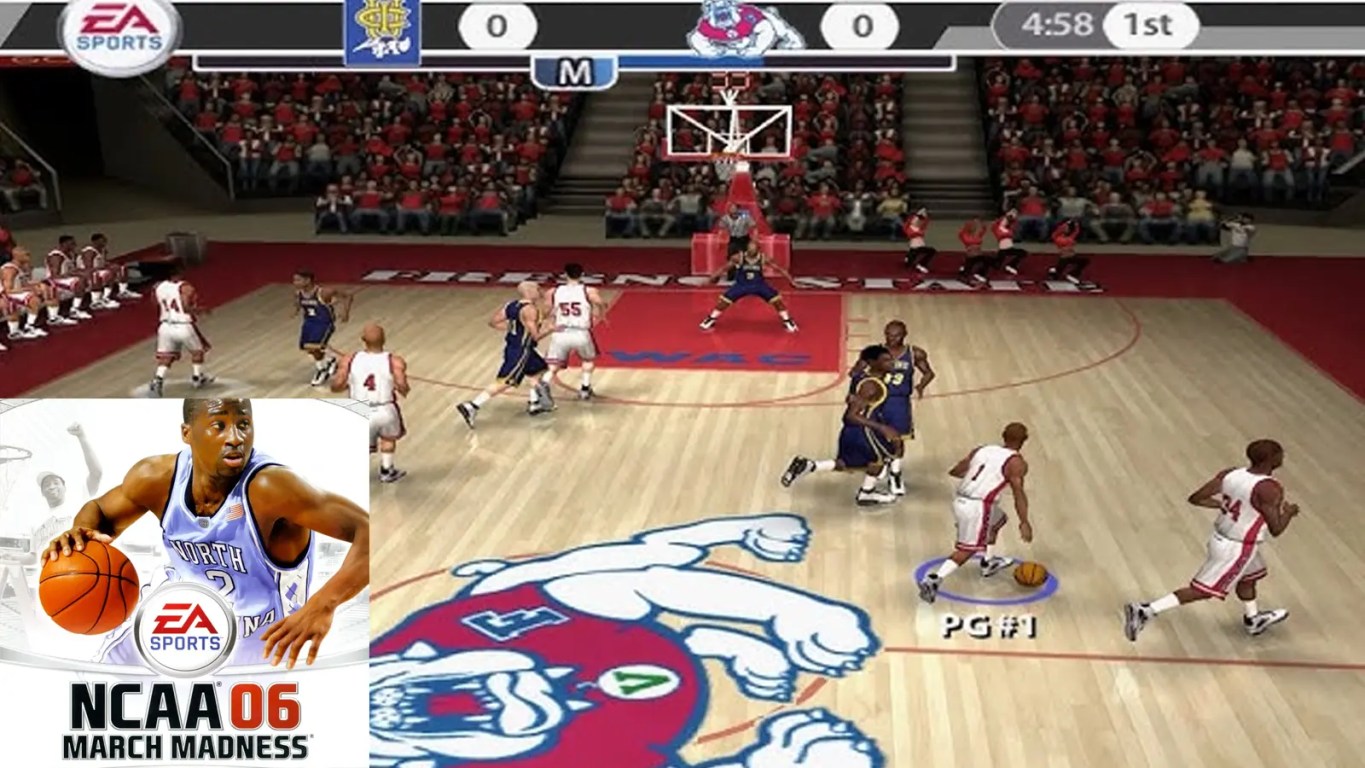
Released in October 2005 for the PS2 and Xbox, NCAA Madness 06 was a pivotal moment in sports gaming architecture. While its competitors focused on offensive highlights and flashy dunks, EA Sports engineered a “Defense-First” philosophy that remains the high-water mark for collegiate basketball simulation. As we enter the chaos of the 2026 tournament, we’re looking back at the internal mechanics of a 128-bit engine that prioritized the technical grind over the highlight reel.
NCAA Madness 06 is the next file in our library.
RELATED: [THE FILES] 024 | NBA 2K2 (2001): The Technical Blueprint of the AI Dynasty
Table of Contents
The Mechanics: The Lockdown Stick & Arena Pulse
- The Lockdown Stick: This was the game’s primary hardware innovation. By utilizing the right analog stick, players could “shade” defenders, deny passing lanes, and force five-second violations. It turned the defensive side of the ball into a high-stakes mini-game of positioning and physics, rewarding players who understood footwork over those who just mashed a button.
- The Arena Pulse: The game introduced a technical “Atmosphere Engine” that tracked the crowd’s energy in real-time. If you were playing at a “Top 25” toughest venue like Cameron Indoor or Allen Fieldhouse, your player’s attributes (the “Human Hardware”) would fluctuate based on decibel levels, causing rattled point guards to miss passes and shooting percentages to plummet.
- Dynasty Infrastructure: The game’s Dynasty mode introduced a deep “Discipline System.” You had to manage a budget for recruiting and training, but you also had to suspend players for academic or team violations—a technical look at the administrative “Hardware” of college coaching long before the NIL era.
The Tactical Overlay: Floor General & Senior Leadership
The middle tier of the March Madness 06 was defined by real-time tactical execution.
- Floor General Playcalling: For the first time, players could cycle through both offensive and defensive sets on the fly using the D-pad without pausing the game. This allowed for an “Adaptive Coaching” style—switching from a 2-3 zone to a full-court press immediately after a made basket to maximize the Arena Pulse momentum.
- The Senior Leader Unit: The game introduced the “Senior Leader” mechanic, which acted as a performance multiplier. When your leader was “heated up,” they didn’t just play better—they boosted the ratings of everyone on the floor. It was a mechanical representation of “Vocal Leadership,” where the experience of a single player could stabilize the team’s overall CPU logic during a hostile road game.
The Infrastructure: 30-Year Dynasty & Discipline
The game’s Dynasty mode was a 30-year technical simulation of program building.
- The Discipline System: You had to manage a budget of “Discipline Points.” You were required to suspend players for academic or team violations—fail to do so, and the NCAA would hit your program with “Hardware-level” sanctions like reduced recruiting budgets or postseason bans.
- Recruiting Logic: Long before the transfer portal became the dominant headline of 2026, March Madness 06 required a meticulous scouting report system where you had to “learn” an opponent’s tendencies before facing them in the tournament.
The ‘Decked Out’ Verdict: The 20-Year Legacy
March Madness 06 didn’t just play the game; it modeled the psychological architecture of the sport. From the Raymond Felton cover art to the “Floor General” play-calling system, it was a technical blueprint for how a sports game can capture the soul of a tournament. It remains a classic for any serious sports gamer.
The Archival Staple
![[THE FILES] 029 | The 128-Bit Court: Why March Madness 06 Remains the Gold Standard of Hoops Sims -](https://deckedoutmagazine.com/wp-content/uploads/2026/03/ncaa_march_madness_2006_cover.webp)
NCAA March Madness 06
For the OG sports lovers.
Featured Photo: EA Sports
RELATED: [THE FILES] 022: NBA 2K1 (2000) – The Architecture of Online Competition
RELATED: [THE FILES] 019: NBA 2K (1999) – The Visual Disruption
Author Bio
Jael Rucker is the founder of Decked Out Magazine. She has previously worked as the Associate Commerce Editor at PureWow, focusing on analytics and trends to pitch stories and optimize articles that build and engage their audience. Her work has also been seen in Footwear News and WWD. Prior to 2024, she was the style and pop culture editor at ONE37pm for over three years, contributing numerous product reviews, brand profiles and fashion trend reports, which included interviewing Steph Curry, Snoop Dogg and more.




![[THE FILES] 006.3 | Janet Jackson – When I Think of You (1986)](https://deckedoutmagazine.com/wp-content/uploads/2026/03/janet_jackson_when_i_think_of_you_technical_review_video_still_album_cover.webp)