
02/25/2026
Clocking It: The Political Rundown — Halfway Clocked
The State of the Union just wrapped, and if the goal was to reassure Americans, it didn’t land… at all.
If anything, the speech deepened the disconnect.
Trump painted a picture of momentum, revival, and economic strength. But public sentiment tells a very different story. Polling shows Americans remain deeply dissatisfied with the economy, skeptical of immigration enforcement tactics, and increasingly distrustful of the administration’s direction overall.
And the numbers are not subtle. They are structural. They are geographic. They are national.
The Approval Collapse Is Nationwide
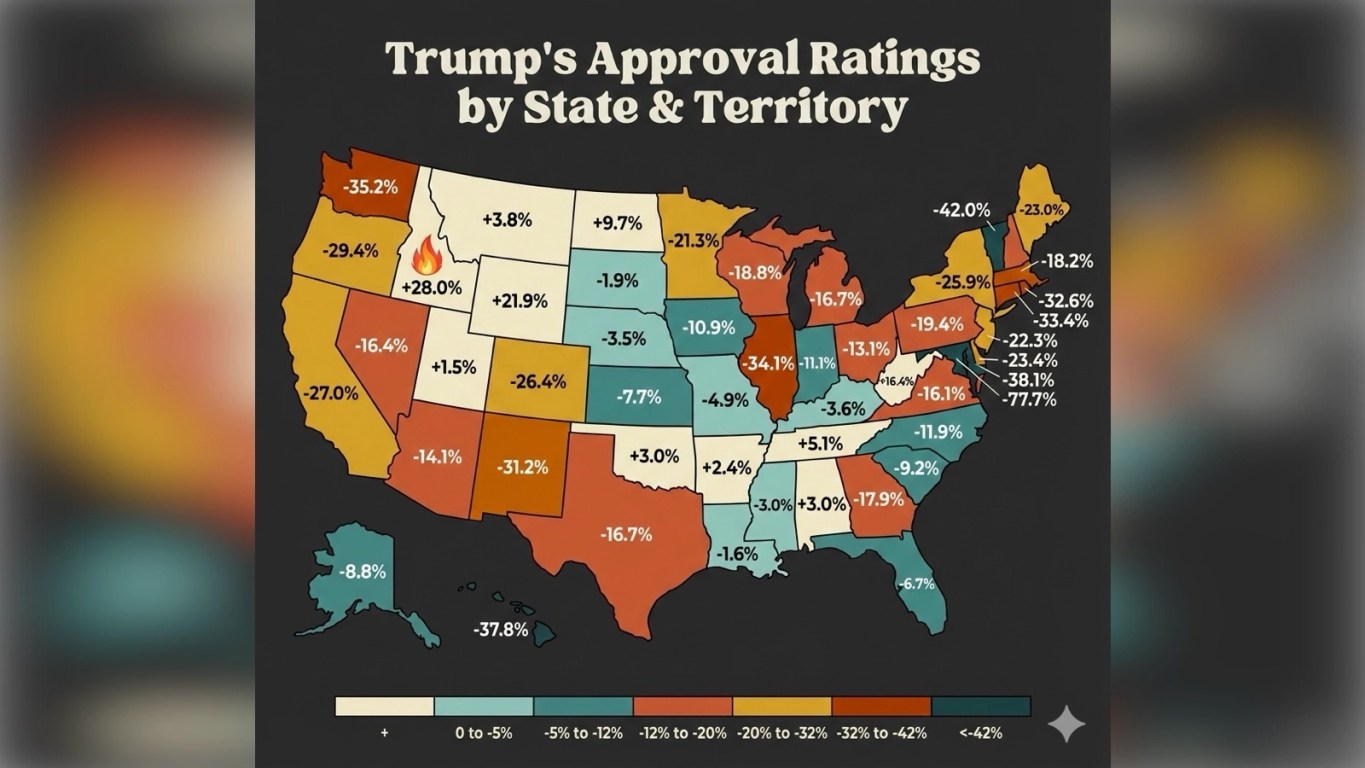
Trump is now underwater nationally, and the damage is not confined to swing states or traditional opposition strongholds. Tracking surveys show net approval is negative across large portions of the country, with only 10 l0w-population states remaining clearly positive. That means dissatisfaction is no longer regional. It is systemic.
According to YouGov and The Economist state-level approval tracker, the president is now underwater across most of the country, not just nationally, but geographically.
The data measures net approval by state, and the pattern is unmistakable: support is concentrated in a shrinking cluster of states with small populations, while negative ratings dominate the rest of the map. This is not a partisan snapshot. It is a structural national trend captured in one of the most comprehensive ongoing state-by-state approval datasets available.
Below is the current net approval landscape state by state:
Positive Net Approval
• Idaho: +28.0%
• Wyoming: +21.9%
• West Virginia: +16.4%
• North Dakota: +9.7%
• Tennessee: +5.1%
• Montana: +3.8%
• Alabama: +3.0%
• Oklahoma: +3.0%
• Arkansas: +2.4%
• Utah: +1.5%
Near Neutral to Mildly Negative
• Louisiana: -1.6%
• South Dakota: -1.9%
• Mississippi: -3.0%
• Nebraska: -3.5%
• Kentucky: -3.6%
• Missouri: -4.9%
Clearly Negative
• Florida: -6.7%
• Kansas: -7.7%
• Alaska: -8.8%
• South Carolina: -9.2%
• Iowa: -10.9%
• Indiana: -11.1%
• North Carolina: -11.9%
• Ohio: -13.1%
• Arizona: -14.1%
Deeply Negative
• Virginia: -16.1%
• Nevada: -16.4%
• Michigan: -16.7%
• Texas: -16.7%
• Georgia: -17.9%
• New Hampshire: -18.2%
• Wisconsin: -18.8%
• Pennsylvania: -19.4%
Severely Negative
• Minnesota: -21.3%
• New Jersey: -22.3%
• Maine: -23.0%
• Delaware: -23.4%
Political Rejection Territory
• New York: -25.9%
• Colorado: -26.4%
• California: -27.0%
• Oregon: -29.4%
• Massachusetts: -30.2%
• New Mexico: -31.2%
• Rhode Island: -32.6%
• Connecticut: -33.4%
• Illinois: -34.1%
• Washington: -35.2%
• Hawaii: -37.8%
• Maryland: -38.1%
• Vermont: -42.0%
Institutional Collapse
• Washington, D.C.: -77.7%
This is not polarization. This is erosion. And it cuts across ideological geography, including states that delivered Trump’s victory in 2024.

Map of Trump’s latest Approval Ratings By State for Decked Out Magazine
The Speech Didn’t Match Reality
During his address, the president repeated a familiar message, that the country is on the brink of a comeback and that prosperity is accelerating. But the public does not feel it. Economic approval remains negative, with Americans still deeply concerned about cost of living pressures and price instability. And immigration enforcement has become one of the most politically volatile issues of the administration, with aggressive federal operations and funding battles in Washington fueling national tension.
Meanwhile, Congress remains locked in conflict over Department of Homeland Security funding, raising the possibility of continued fiscal standoffs. So while the speech projected stability, the governing reality looks like confrontation, and Trump looked out of touch, tired, and weak.
The Tariff Shockwave
Last week delivered another major institutional blow. The U.S. Supreme Court ruled that the administration exceeded its authority when imposing emergency tariffs under the International Emergency Economic Powers Act.
Translation: The tariffs were illegal.
That ruling has triggered a cascade of consequences:
• FedEx Corporation is suing for a full refund of tariff payments.
• Multiple corporations, including major retailers and manufacturers, previously challenged the policy.
• Total tariff revenue collected may exceed $160 billion.
• New tariffs now require congressional approval beyond 150 days.
And political pressure is escalating.
Senators including Ron Wyden, Ed Markey, and Jeanne Shaheen are pushing legislation to refund roughly $175 billion to businesses and consumers.
Democratic leaders are no longer framing the tariff issue as a technical legal dispute. They’re framing it as money taken from Americans that now must be returned.
California governor Gavin Newsom argued that the tariffs functioned as unlawful price increases on everyday goods, saying the administration effectively imposed hidden taxes on necessities like groceries, furniture, and vehicles, and that Americans deserve repayment.
Senator Elizabeth Warren went even further, describing the tariffs in moral rather than economic terms. She argued that when money is taken without legal authority, it isn’t policy, it’s taking what doesn’t belong to you. In her view, Americans paid more for basic goods because of those tariffs, and the administration now has an obligation to return the money.
The message from both leaders is clear:
This isn’t just about trade policy anymore. It’s about restitution.
The Cultural Meaning — Halfway Clocked
Here’s what actually matters.
None of this is random. None of it is isolated. None of it is temporary noise.
The approval collapse. The legal rebuke. The economic anxiety. The immigration backlash. The funding standoff. The widening geographic rejection. These are not separate problems. They are symptoms of the same rupture.
The story being told from power no longer matches the country people are actually living in. And when reality and rhetoric split that far apart, messaging doesn’t repair the damage, it reveals it. That’s what this State of the Union did.
It didn’t reset momentum. It didn’t calm the public. It didn’t restore confidence. It clarified the situation.
Support is shrinking. Authority is being challenged. Economic trust is fragile. Institutional conflict is intensifying. Disapproval is spreading across the map, not consolidating, not stabilizing, not cooling off.
Spreading.
That is the real midweek snapshot and State of the Union. That is the governing atmosphere. That is the political climate heading forward.
The gap between what Americans are told, and what they experience, is no longer subtle. It’s structural. It’s visible. And it’s widening in real time.
Halfway through the week, halfway through the narrative cycle, halfway through the attempt to sell a comeback story…
…the country isn’t buying it.
Halfway Clocked. That’s the tea.
Author Bio
Andrew Greene is a quality-obsessed, results-driven powerhouse with nearly two decades of experience transforming complexity into clear, actionable solutions. His secret weapon? A mix of analytical sharpness, problem-solving precision and a communication and leadership style that’s equal parts clarity and charisma. From Quality Assurance to political data analysis, you can think of him as the Swiss Army knife of operational excellence, minus the corkscrew (unless it’s a team celebration).
One thought on “The Real SOTU: The State-by-State Collapse of Trump’s Approval”