Photo: Daktronics/LA Clippers
By Jael Rucker: Published: January 21, 2026
LOS ANGELES, CA — When the NBA All-Star Weekend arrives at the Intuit Dome on February 15, the spotlight won’t just be on the new “U.S. vs. World” round-robin format, which NBC describes as four separate games, each totaling 12 minutes. How will that happen? Well, the first three games will give each team the opportunity to play each other, and at the end of those three games, the two teams with the best records will head to a final 12-minute game to determine the All-Star Game champions. We’ll get there on February 15. For now, let’s look at the real technical marvel, which is the building itself. Simply put, Steve Ballmer didn’t just build an arena; he’s built a $2 billion local-area network where every seat is a high-fidelity input device.
In This Article:
- The Armrest Input: 18,000 Hardwired Controllers
- The Screen: One Acre of 4K LED
- Frictionless Logistics: GameFace ID
- The Future of the Fan Experience
Hardware Quick-Look: Intuit Dome All-Star Tech
- The Controller: 18,000 individual 4-button armrest inputs.
- The Screen: 1-acre double-sided Daktronics Halo Board (3.9mm pixel pitch).
- The Power: High-speed USB-C in every seat.
- The Entry: 100% “GameFace ID” frictionless biometric entry.
RELATED: The Equity Era: Why Top Athletes are Trading NIL Cash for Board Seats and Ownership
The Armrest Input: 18,000 Hardwired Controllers
The standout feature for the 75th Anniversary weekend is the PixMob Nova Armrest. Unlike traditional stadium seating, every chair in the Intuit Dome is hardwired with power and ethernet. Here are the specs:
- Tactile Control: Each armrest features a 4-button gamepad (Red, Blue, Green, Yellow).
- Zero Latency: By bypassing crowded stadium Wi-Fi in favor of a hardwired ethernet connection, the arena can handle 18,000 simultaneous inputs with zero lag.
- The 2026 Shift: During the All-Star Saturday night festivities, fans will use these controllers to interact with the Halo Board for massive (and I do mean massive), arena-wide gaming sessions and real-time voting on dunk contest scores.
The Screen: One Acre of 4K LED
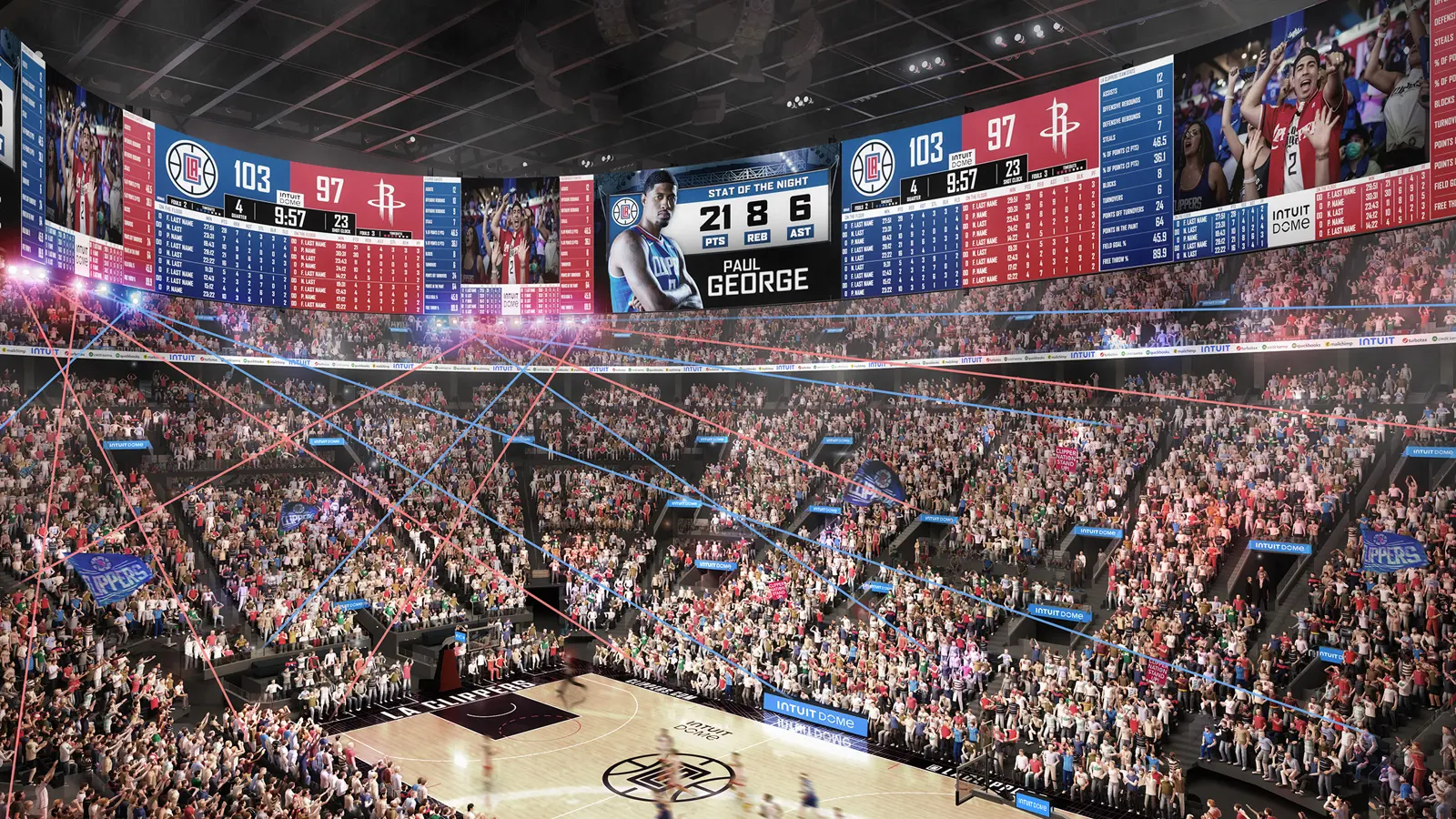
If the seats are the controllers, the Daktronics Halo Board is the monitor. Wrapping around the entire inner bowl, the double-sided display is the largest 4K UHD LED screen ever built for sports. Here are the deets:
- Specs: 38,375 square feet of digital canvas powered by over 233 million LEDs.
- Clarity: With an ultra-tight 3.9mm pixel pitch, the board delivers a cinematic 48K x 2.5K resolution.
- Intelligence: The system also utilizes machine learning to respond to crowd energy, as tracked by decibel meters installed at every seat.
Frictionless Logistics: GameFace ID
The real fan experience, however, starts at the plaza, as the Dome utilizes GameFace ID, a biometric entry system that allows fans to “Zoom Thru” gates without reaching for a phone. Pretty nifty, huh? Let’s check out some more details:
Biometrics: Using spatial intelligence AI, the system identifies enrolled fans via a selfie profile, reducing entry times to less than two minutes.
USB-C Ecosystem: To ensure fans stay connected to the Intuit Dome App—which handles everything from “Face-Pay” concessions to bathroom wait-times—every seat is equipped with a dedicated high-speed USB-C charging port.
The Future of the Fan Experience
The Intuit Dome is more than just a home for the Clippers; it is now a blueprint for the next decade of live entertainment. As we head into the 75th Anniversary All-Star Weekend, the focus will be on whether 18,000 fans can truly act as a single, interactive network.
Author Bio
Jael Rucker is the founder of Decked Out Magazine. She has previously worked as the Associate Commerce Editor at PureWow, focusing on analytics and trends to pitch stories and optimize articles that build and engage their audience. Her work has also been seen in Footwear News and WWD. Prior to 2024, she was the style and pop culture editor at ONE37pm for over three years, contributing numerous product reviews, brand profiles and fashion trend reports, which included interviewing Steph Curry, Snoop Dogg and more.
![[THE FILES] 083 | Ja Rule Put It on Me (2000): The Fast & Furious Connection](https://deckedoutmagazine.com/wp-content/uploads/2026/04/ja_rule_put_it_on_me_fast_and_furious_hero-1.webp)