
Clocking It: The Political Rundown — Halfway Clocked
Last week, Nick Cannon sat in a beach cruiser on his web talk show Big Drive and told Amber Rose something he clearly believed was a revelation.
“People don’t know that the Democrats are the party of the KKK,” he said. “People don’t know that the Republicans are the party that freed the slaves.” What is the real history behind Nick Cannon’s claim about Democrats and Republicans?
He is correct about the second part. The Republican Party was founded in 1854 by anti-slavery activists, and in 1863, Republican President Abraham Lincoln issued the Emancipation Proclamation. The 13th Amendment, ratified in 1865, abolished slavery entirely.
But the first claim, that the Democratic Party is the party of the KKK, requires a history lesson that Cannon’s brief viral clip omitted entirely. Because political parties are not frozen in amber. They evolve. They realign. And the Democratic Party of 2026 bears almost no resemblance to the Democratic Party of 1865.
This is Halfway Clocked. Here is what actually happened.
The Architecture of Realignment
Political scientists call it “party realignment,” the process by which the demographic and ideological coalitions underpinning America’s two major parties shift dramatically over time. These realignments are not accidents. They are the result of major historical events, demographic changes, and, most importantly, policy choices that reshape who votes for whom.
The United States has experienced several such realignments since its founding. The first came in the 1820s with the rise of Andrew Jackson’s Democratic Party. The second followed the collapse of the Whig Party and the emergence of the Republicans as an anti-slavery force in the 1850s.
But the realignment that matters for Cannon’s claim happened over the course of roughly four decades, from the 1930s through the 1960s, when the Democratic and Republican parties effectively swapped positions on civil rights, federal power, and the role of government in protecting the vulnerable.
The KKK Was Not a “Party” Institution
First, let us correct the record on the Klan itself.
The Ku Klux Klan was founded on December 24, 1865, in Pulaski, Tennessee, by six Confederate army veterans. Originally a fraternal social club, it soon evolved into a terrorist organization dedicated to intimidating newly enfranchised Black voters and restoring white supremacy in the defeated South.
The Klan was not founded by the Democratic Party as an institution. It was founded by Confederate veterans, men who had just lost a war fought, in large part, to preserve the institution of slavery. And yes, those men were overwhelmingly Democrats. But that fact reflects the regional and ideological composition of the South in 1865, not a formal party endorsement of white supremacist violence.
By the 1870s, the original Klan had been largely suppressed by federal action. It would be revived twice more, in 1915 and again during the civil rights era, each time drawing from the same well of white Southern resentment. But the party affiliations of Klan members would shift over time, just as the parties themselves shifted.
FDR and the Great Migration of Black Voters
The first major crack in the old order appeared in the 1930s and missing from the real history behind Nick Cannon’s claim.
Before Franklin Delano Roosevelt, Black Americans voted overwhelmingly Republican, the party of Lincoln, the party of emancipation. In 1932, FDR won just 23 percent of the Black vote, despite the fact that Black Americans were among the hardest hit by the Great Depression. The Republican Party, for all its historical symbolism, had done little to address their suffering.
Then came the New Deal. Roosevelt’s economic relief programs, the Civilian Conservation Corps, the Works Progress Administration, Social Security, were designed to help working-class Americans of all races. And while the New Deal was far from perfect on race (many programs were administered locally and excluded Black workers), the message was unmistakable: the Democratic Party was beginning to position itself as the party of the common person.
By 1936, 70 percent of Black voters supported Roosevelt’s re-election. The realignment had begun. Black voters recognized that the Democratic Party, despite its Jim Crow legacy in the South, was beginning to change. Over the following decades, they would move from being swing voters to becoming the most reliably Democratic bloc in the country.
The Dixiecrats Break Away
Also missing from the real history behind Nick Cannon’s claim is the 1948 election revealed the fault lines that would eventually shatter the old Democratic coalition.
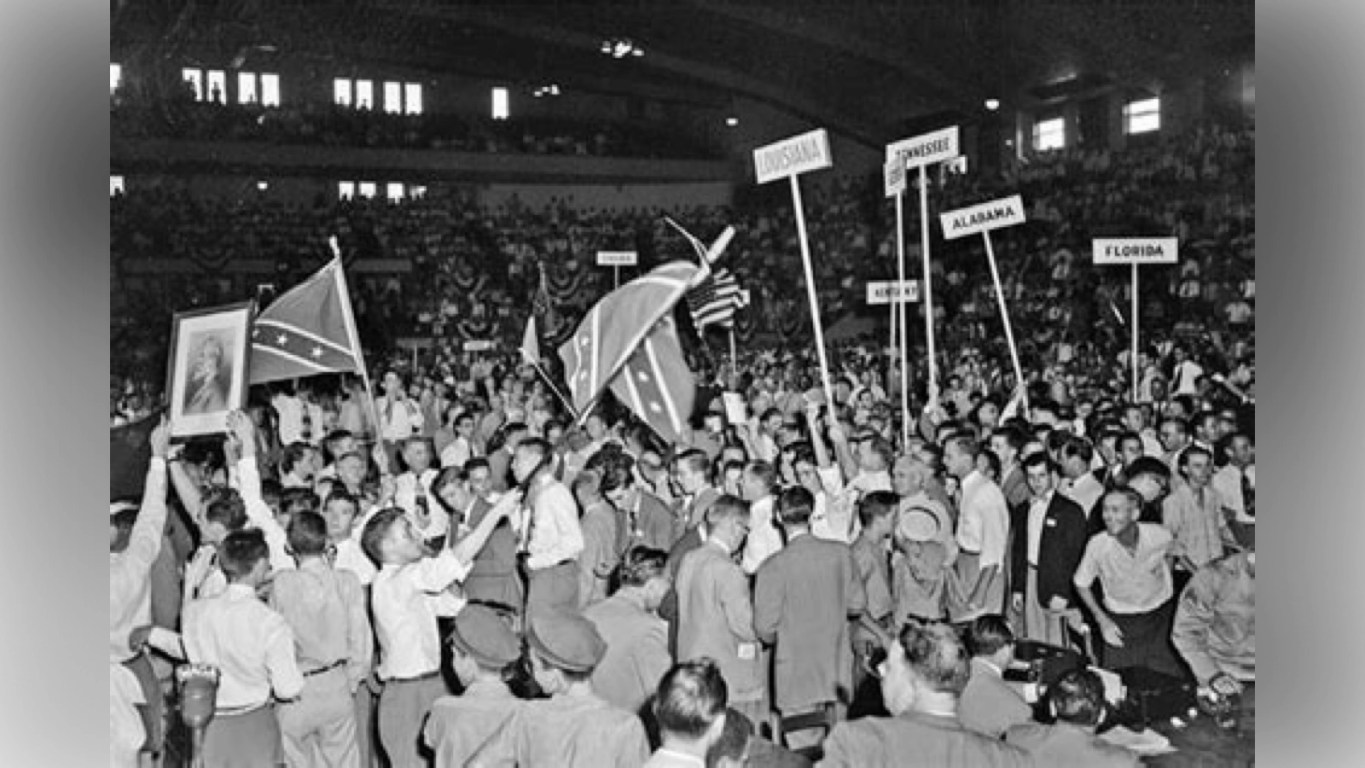
That year, a faction of Southern Democrats, furious at President Harry Truman’s support for a civil rights plank in the party platform, walked out of the Democratic National Convention and formed their own party. They called themselves the States’ Rights Democratic Party. History knows them as the Dixiecrats.
Their presidential candidate was Strom Thurmond, then the governor of South Carolina. He ran on a platform of racial segregation and states’ rights, capturing 39 electoral votes. Thurmond did not become a Republican. He remained a Democrat for another sixteen years. But his campaign signaled something important: white Southerners were no longer “in the bag” for the Democratic Party.
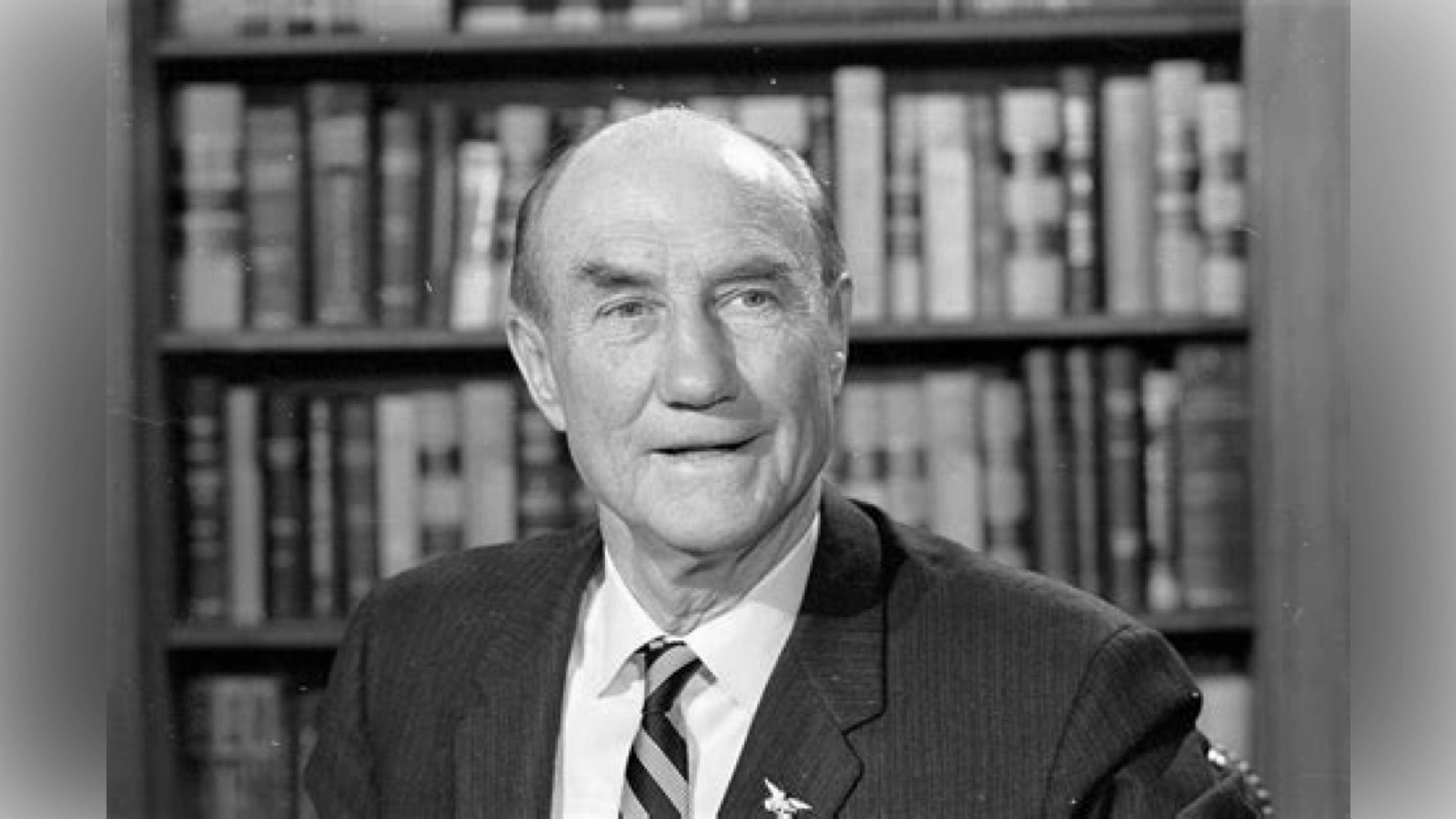
A black-and-white portrait of U.S. Senator Strom Thurmond, captured from the chest up.
The Dixiecrat revolt was not an abandonment of the Democratic Party. It was an attempt to capture it, to drag it back toward segregation and away from the civil rights commitments that were slowly gaining traction nationally. And when that effort failed, the exodus began.
1964: The Year Everything Changed
The Civil Rights Act of 1964 was the tipping point and is probably the most important factor missing from the real history behind Nick Cannon’s claim .
President Lyndon B. Johnson, a Texas Democrat who had grown up in the segregated South, made a calculated decision. He knew that pushing for comprehensive civil rights legislation would cost his party the South for a generation. He did it anyway.
After signing the bill, Johnson reportedly told an aide:
I think we just delivered the South to the Republican Party for a long time to come.
He was right.
That same year, Republican presidential nominee Barry Goldwater voted against the Civil Rights Act. He opposed the legislation on libertarian grounds, he believed it infringed on property rights, but the effect was unmistakable. Goldwater was signaling to white Southerners that the Republican Party was open for business.
The scene that September was almost theatrical. On September 17, 1964, Goldwater landed in Greenville, South Carolina. Standing at the bottom of the plane’s steps to greet him was Strom Thurmond, still a Democratic senator at the time. The day before, Thurmond had issued a “scalding denunciation of the Democratic Party,” announcing his new status as a “Goldwater Republican.”
Goldwater went on to win five Deep South states, including Alabama and Mississippi, where he took 69 and 87 percent of the vote respectively. It was the first time white Southerners had voted in significant numbers for the party of Lincoln.
Thurmond Switches — And the Floodgates Open
The formal switch came shortly after.
In September 1964, the same month he stood beside Goldwater on that tarmac — Strom Thurmond officially joined the Republican Party. He had spent his entire career as a Democrat. He had run for president as a Dixiecrat. But he could no longer align himself with the party that had just passed the Civil Rights Act.
Thurmond was not alone. Over the next decade, a wave of Southern Democrats, almost all of them white, almost all of them conservative, almost all of them opposed to civil rights, would follow him into the Republican Party. Jesse Helms of North Carolina switched in the early 1970s. Trent Lott of Mississippi stayed Democratic until 1972, then switched. The trickle became a flood.
By the time Richard Nixon implemented his “Southern Strategy” in 1968 and 1972, appealing to white Southern voters’ racial grievances with coded phrases like “law and order” and “states’ rights,” the realignment was already well underway. The Republican Party had become the home of white Southern conservatism. The Democratic Party had become the party of civil rights.
What This Means for Cannon’s Claim
Here is the cultural reality that matters most and is the real history behind Nick Cannon’s claim about Democrats, Republicans, and the KKK.
Nick Cannon is not wrong that Democrats in the 1860s were the party of the slaveholding South. He is not wrong that the original Ku Klux Klan was composed of Confederate veterans who were overwhelmingly Democrats. He is not wrong that the Republican Party freed the slaves.
Where Cannon goes off the rails, where his claim becomes not just simplistic but actively misleading, is in the assumption that those facts tell us anything meaningful about the parties today.
The Democratic Party of 1865 is not the Democratic Party of 2026. The Republican Party that freed the slaves is not the Republican Party that nominated Donald Trump. The parties realigned. The coalitions shifted. The ideologies swapped.
This is not opinion. This is political science. And it is documented in every credible history of American political development from the past half-century.
When Cannon says “the Democrats are the party of the KKK,” he is using a half-true statement about the 1860s to imply a complete falsehood about the 2020s. The Klan’s descendants did not stay Democrats. They became Republicans, Strom Thurmond Republicans, Jesse Helms Republicans, Barry Goldwater Republicans. The racism did not disappear. It just changed addresses.
What Comes Next
This Halfway Clocked has laid out the historical record: the founding of the Klan, the New Deal realignment, the Dixiecrat revolt, the Civil Rights Act, and the great political migration of white Southern conservatives from the Democratic Party to the Republican Party between 1948 and 1980. We also provide the real history behind Nick Cannon’s claim.
But history is only half the story.
The question that remains, and the question that will drive Part 2 of this examination, is why a talking point this easily disproven continues to circulate. Why do otherwise intelligent people repeat it? What cultural and political work does it do? And what does its persistence tell us about the state of American political discourse in 2026?
The verdict arrives later this week.
Halfway Clocked. That’s the tea.
Sources
· “Nick Cannon Calls the Democratic Party the ‘Party of the KKK’ and Says ‘I F— With Trump,'” Yahoo News, March 28, 2026
· “Nick Cannon Dubs Democrats the ‘Party of the KKK’ While Revealing MAGA Pivot,” Billboard, March 30, 2026
· Party Realignment in the United States, Simple English Wikipedia
· “Activities of hate group sporadic since late 1860s,” StarNews, August 20, 2013
· “The Ku Klux Klan founded,” History Today, December 24, 1865
· Southern Strategy, Wikipedia
· “GOP pundits rewrite history,” MySanAntonio, April 11, 2013
· “A Black/Non-Black Theory of African-American Partisanship,” University of North Texas, 2008
· “Chapter 6: The African American Realignment and New Deal Liberalism,” Princeton University Press, via Project MUSE
· “Goldwater in Dixie: Race, Region, and the Rise of the Right,” University of Arizona Press, via Project MUSE
· “Strom Thurmond,” Britannica Kids
· “Strom Thurmond: A Featured Biography,” United States Senate
About the Author
Andrew Greene is a quality-obsessed, results-driven powerhouse with nearly two decades of experience transforming complexity into clear, actionable solutions. His secret weapon? A mix of analytical sharpness, problem-solving precision and a communication and leadership style that’s equal parts clarity and charisma. From Quality Assurance to political data analysis, you can think of him as the Swiss Army knife of operational excellence, minus the corkscrew (unless it’s a team celebration).