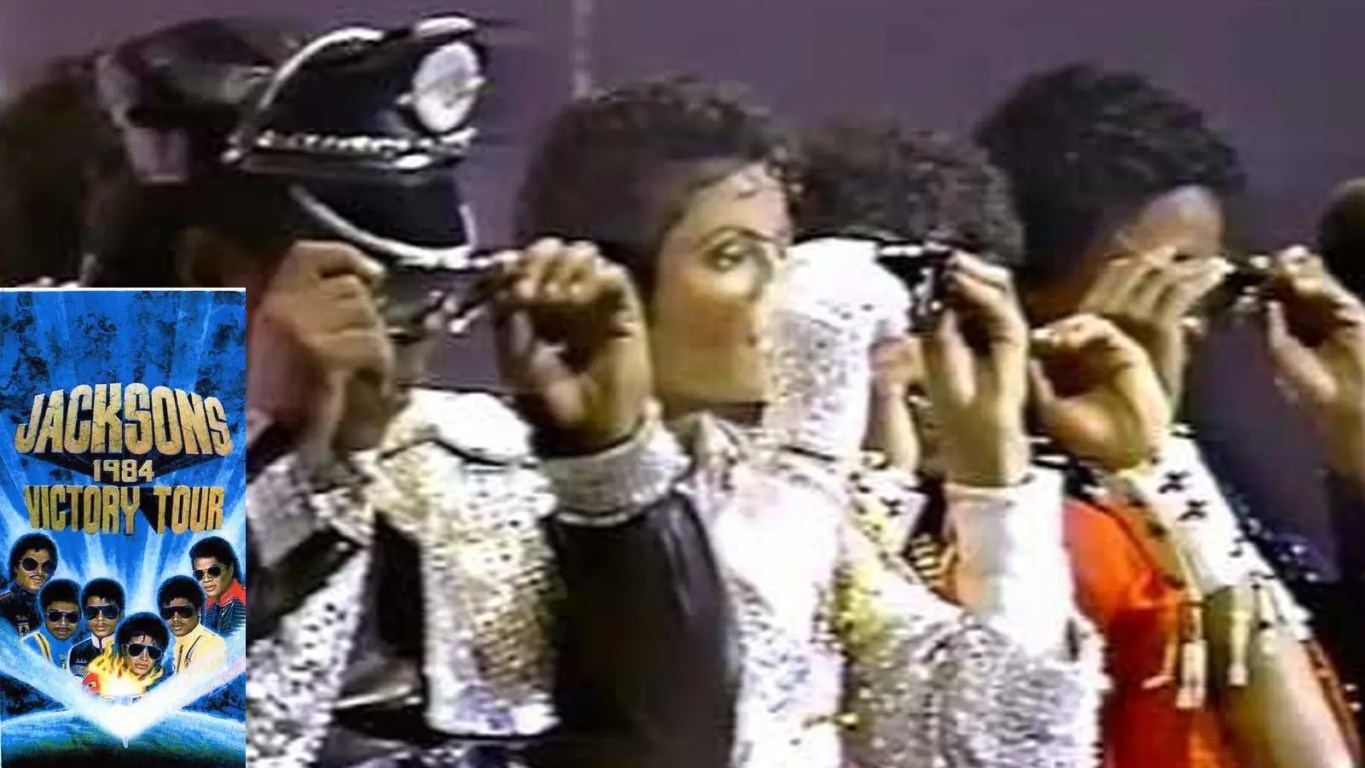
In 1984, the music industry didn’t just witness a concert tour; it witnessed the birth of the modern stadium spectacle. The Victory Tour was the physical manifestation of Michael Jackson’s Thriller era dominance, but behind the sequined gloves and moonwalks was a logistical “Hardware” operation that broke every existing rule of live entertainment.
Running from July 6 to December 9, 1984, the tour was the last time all six Jackson brothers shared a stage as far as an official tour, grossing a then-record $75 million (approx. $230M in 2026 dollars) and proving that music could fill the largest arenas on Earth.
RELATED: The ‘Michael’ (2026) Format Guide: From 70mm Film to Haptic Choreography
Table of Contents
Engineering a Five-Story City
Before 1984, most stadium shows were just scaled-up versions of arena sets. The Victory Tour changed the “OS” of production by building a structure that was literally part of the architecture.
- The 365-Ton Stage: Designed to Michael’s exacting specifications, the stage weighed 700,000 pounds. It stood five stories tall and occupied nearly 20,000 square feet—roughly one-third of a professional football field.
- Logistics & Transport: Moving this “city” required a fleet of over 30 tractor-trailers. Because of the stage’s massive footprint, many venues (including Neyland Stadium and Arrowhead) had to remove a significant portion of their available seating, sometimes cutting capacity by 25% just to fit the equipment.
- The Construction Crew: A team of 300 workers was required to assemble the stage at each stop. It was a 24/7 operation that turned local stadiums into high-tech construction zones days before the Jacksons arrived.
The Business: Redefining the Stadium Model
Promoted by Don King and managed by Chuck Sullivan (then-owner of the New England Patriots), the Victory Tour was a high-stakes financial experiment that paved the way for the billion-dollar tours of the 2020s.
- The $1 Million Weekly Overhead: The tour costs a staggering $1 million per week to keep running. This included insurance, legal fees, and the massive payroll for the technical crew.
- In May 1984, tour promoter Chuck Sullivan and Don King implemented a ticketing system designed to “prevent scalping,” but it backfired completely.
- The Rule: You couldn’t just go to a box office and buy a ticket. You had to clip a coupon from a newspaper, fill it out, and send a postal money order to enter a lottery.
The Correction: The July 5th Press Conference
The breaking point was a letter Michael received from an 11-year-old fan named Ladonna Jones, who wrote that she had saved her money but couldn’t afford the $120 four-ticket minimum.
On July 5, 1984—just 24 hours before the first show in Kansas City—Michael held a solo press conference to make the corrections:
- Ending the Lottery: He ordered the mail-order-only system to be scrapped in favor of more traditional sales (though mail-order remained for some cities, the “lottery” requirement was eased).
- The “No Pay” Rule: He insisted that fans should not have to pay for a ticket unless they were guaranteed to get one.
- The Charity Pledge: In a move that shocked the promoters and his own family, Michael announced: “I want you to know that I’ve decided to donate all the money I make from our performance to charity.”
The Official Victory Tour Schedule (1984)
- July 6, 7, 8: Kansas City, MO – Arrowhead Stadium
- July 13, 14, 15: Irving (Dallas), TX – Texas Stadium
- July 21, 22, 23: Jacksonville, FL – Gator Bowl Stadium
- July 29, 30, 31: East Rutherford, NJ – Giants Stadium
- August 4, 5: New York, NY – Madison Square Garden
- August 10, 11, 12: Knoxville, TN – Neyland Stadium
- August 17, 18, 19: Pontiac, MI – Pontiac Silverdome
- August 25, 26: Orchard Park (Buffalo), NY – Rich Stadium
- September 1, 2: Philadelphia, PA – John F. Kennedy Stadium
- September 7, 8: Denver, CO – Mile High Stadium
- September 17, 18: Montreal, QC – Olympic Stadium
- September 21, 22: Washington, D.C. – RFK Stadium
- September 28, 29: Philadelphia, PA – John F. Kennedy Stadium
- October 5, 6, 7: Toronto, ON – Exhibition Stadium
- October 12, 13, 14: Chicago, IL – Comiskey Park
- October 19, 20: Cleveland, OH – Municipal Stadium
- October 26, 27: Atlanta, GA – Fulton County Stadium
- November 2, 3: Miami, FL – Orange Bowl
- November 9, 10: Houston, TX – Astrodome
- November 16, 17, 18: Vancouver, BC – BC Place
- November 30: Los Angeles, CA – Dodger Stadium
- December 1, 2, 7, 8, 9: Los Angeles, CA – Dodger Stadium
The Legacy
By the time the Victory Tour reached its 55th and final show at Dodger Stadium on December 9, 1984, the landscape of live music had been permanently altered. What began as a family reunion had evolved into a blueprint for the modern stadium industry—proving that music, when paired with high-level engineering and a massive logistical “Hardware” operation, could fill NFL-sized gaps in the cultural calendar.
Author Bio
Jael Rucker is the founder of Decked Out Magazine. She has previously worked as the Associate Commerce Editor at PureWow, focusing on analytics and trends to pitch stories and optimize articles that build and engage their audience. Her work has also been seen in Footwear News and WWD. Prior to 2024, she was the style and pop culture editor at ONE37pm for over three years, contributing numerous product reviews, brand profiles and fashion trend reports, which included interviewing Steph Curry, Snoop Dogg and more.
![[THE FILES] 065 |Finding Nemo (2003): The Ultimate Rendering of an Ocean](https://deckedoutmagazine.com/wp-content/uploads/2026/03/finding_nemo_collectors_dvd_screenshot.webp)

![[THE FILES] 064 | NBA 2K9 (2008): The Year the Virtual Hardwood Came Alive](https://deckedoutmagazine.com/wp-content/uploads/2026/03/nba_2K9_game_still_and_dvd.webp)