

03/13/2026
Clocking It: The Political Rundown — The Verdict
Earlier this week, Halfway Clocked laid the foundation. We examined the numbers, the housing gap that has pushed homeownership out of reach for a generation, the wealth concentration that has left the top 1% holding nearly one-third of the nation’s assets, the quiet redefinition of success from “accumulation” to “survival.” We documented a system that has stopped delivering for most of the people living inside it.
The data told a story of structural drift. Of ladders removed. Of promises made to one generation and broken for the next. But data only measures what has happened. It does not answer the question readers have been asking all week: Does the American Dream still exist?
The answer, as we will now deliver in The Verdict, is not simple. But it is definitive. The American Dream exists, but it exists for a few, not for the many. And that distinction changes everything about what the dream means, who gets to claim it, and whether the country that invented it can still call itself a land of opportunity.
The Dream That Never Died, It Just Moved Upstairs
Let us begin with what still works.
For those born into wealth, the American Dream remains fully operational. The children of the top 1% inherit not just money, but networks, educational advantages, down payments, and safety nets. They attend schools that feed into elite universities. They graduate with minimal debt, or none at all. They enter job markets where their parents’ connections open doors that remain closed to equally qualified peers from different zip codes.
This is not speculation. It is structural.
According to new research from the London School of Economics, inherited inequality now accounts for 36% of total inequality in the United States. That means more than one-third of where you end up in the income distribution is determined by where you started, before you ever made a single decision, before you ever worked a single hour, before you ever had a chance to prove what you could do.
The World Inequality Report 2026, the most comprehensive global study of its kind, finds that fewer than 60,000 people, less than one-thousandth of the world’s population, now hold three times as much wealth as the poorest half of humanity combined. The top 10% globally earn 53% of total income, while the bottom 50% receive just 8%. In almost every region, the richest 1% are wealthier than the entire bottom 90% combined.
This is not a market outcome. This is a class structure.
The American Dream, in this telling, has not disappeared. It has been privatized. It still exists, but only for those who were already inside the gates when the gates closed.
What Gen Z Sees When They Look Up
And this is where Gen Z enters the frame.
If you were born after 1997, you have never known an America where the dream felt accessible to everyone who worked for it. You came of age during the 2008 financial crisis, watching your parents lose homes and retirement savings. You entered the workforce during the slowest wage recovery in modern history. You lived through a pandemic that reset every economic baseline. You watched the cost of housing outpace wage growth by margins that make the math of adulthood feel like a cruel joke.
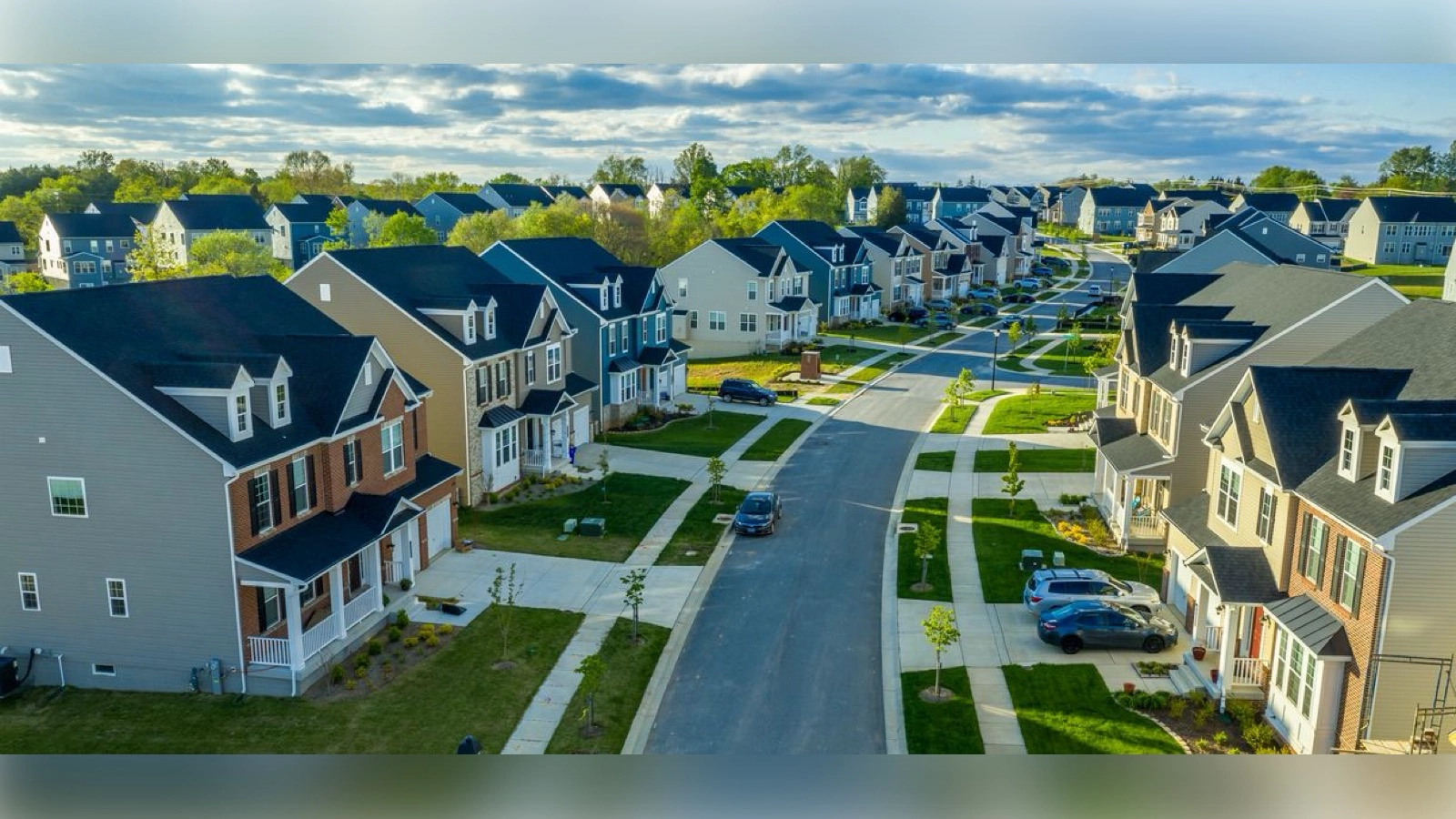
A wealthy American neighborhood with modern homes and manicured streets, symbolizing opportunity concentrated at the top.
And now you are being told, by those who still occupy the heights, that if you just work harder, the market will eventually reward you.
The market has not kept its end of the bargain.
A June 2025 survey of active-duty troops, a group not known for political radicalism, found that only 9% would “obey any order.” When asked to describe unlawful orders in their own words, one respondent captured something larger than military ethics: “orders that clearly break international law, such as targeting non-combatants, are not just illegal, they’re immoral. As military personnel, we have a duty to uphold the law and refuse commands that betray that duty.”
The language of betrayal appears repeatedly in how young Americans describe their relationship to the economic system. They were told that education would pay off. It did… for the previous generation. They were told that homeownership was a matter of discipline. It was… when homes cost three times income instead of five or six or ten. They were told that if they played by the rules, the rules would protect them.
Instead, they watched the rules get rewritten for those at the top.
Between 1989 and 2022, U.S. households in the top 1% gained at least 101 times more wealth than the median household, according to Oxfam, and at least 987 times more than households in the bottom 20% . In 2025 alone, America’s top 15 billionaires got $1 trillion richer. Meanwhile, a 2026 Credit One Bank survey found that 33% of U.S. consumers now define financial success as being debt-free, regardless of income or assets. Another 34% say their ideal financial future is becoming debt-free first, with wealth-building coming later.
The order matters. Stability before scale. Relief before growth. For a generation that has never known economic security, the dream is no longer about getting ahead. It is about not falling behind.
The Communities Where the Dream Never Arrived
If the dream has become exclusive, it has also remained uneven.
According to research published in the Russell Sage Foundation Journal, Black households have seen little upward mobility within the White income distribution over the past five decades. Rural households have made some progress at the low end, but none at the top.
The Economic Policy Institute documents how the Southern economic development model, rooted in policies designed to extract labor with minimal compensation, has produced persistently higher poverty rates across the region. In 2023, the South’s poverty rate stood at 12.4%, compared to 11% in the West and 9.8% in the Northeast and Midwest. The South’s child poverty rate of 18% is the highest of any region, with Black children facing a rate of 30.1%, almost three times that of white children.
“Efforts to continue exploiting Black workers have led to racist anti-worker policies that continue to maintain high rates of poverty, low economic mobility, and high levels of inequality for workers of all racial and ethnic backgrounds in most Southern states,” said EPI report author Chandra Childers.
These are not accidental outcomes. They are the accumulated residue of policy choices made over decades.
The Government That Did Not Show Up
Which brings us to the question of what government has done… and not done.
The mechanisms to address concentrated wealth and restricted opportunity exist. The tax code could be more progressive. The safety net could be more robust. Housing policy could prioritize affordability over investor returns. Anti-poverty programs could be expanded rather than constrained.
Instead, the opposite has happened. The Congressional Budget Office projects that recent federal policies, including tariffs, immigration restrictions, and tax cuts heavily skewed toward the wealthy, will keep inflation high while slowing employment growth. The “One Big Beautiful Bill” gave $1 trillion in tax cuts to the richest 1% over a decade while cutting federal Medicaid funding by roughly the same amount. As Senator Jeff Merkley put it, these policies “steal from working families to hand billionaires massive tax breaks.”
The share of U.S. gross domestic product going to workers as compensation has fallen to its lowest level in more than 75 years. The tax and transfer systems, while providing some redistribution at the bottom, do nothing to address the structural forces pulling the top away from everyone else.
And yet, at the state level, something is stirring.
In the 2026 legislative session alone, lawmakers from at least 19 states have introduced more than 100 bills targeting wealth hoarding. Washington has proposed a 9.9% tax on income above $1 million. Illinois is considering a 3% surcharge on income exceeding $1 million. Connecticut is looking at a 1.75% capital gains surcharge for high earners. Massachusetts’s “Millionaires Tax” has become a national model, funding education and transit through progressive taxation.
“The affordability crisis is not an accident,” said Florida State Representative Anna Eskamani. “It’s the result of intentional policy choices that protect concentrated wealth over working families.”
The question is whether these state-level efforts can scale fast enough to matter for a generation that has already been told, repeatedly, that the system does not work for them.
The Cultural Meaning: What Gen Z Knows That Boomers Didn’t
Here is the cultural reality beneath the numbers.
Every generation forms its understanding of how the world works by watching what happens to the people just ahead of them. Baby Boomers watched their parents buy homes, build pensions, and retire with dignity. They grew up believing that the arc of American life bent toward security.
Millennials watched their older siblings graduate into a recession, carry student debt for decades, and delay every milestone, marriage, children, homeownership, until “later.” They grew up believing that the arc bent toward delay.
Gen Z is watching something else entirely. They are watching their older peers, the ones who did everything right, still struggling. Still renting. Still anxious. Still one emergency away from falling through a crack that the safety net was supposed to cover.
And they are drawing conclusions that their predecessors never had to face.
A SCAD survey on the future of the American Dream found that Millennials and Gen Z are “fundamentally redefining” the concept as “economic landscapes shift and trust in traditional institutions erodes.” The report identifies four distinct scenarios for the dream’s future, ranging from the ideal “Equity Engine” to the exclusionary “Gated Future,” and notes that the path chosen will determine whether opportunity remains available to the next generation of creators and innovators.
What Gen Z knows, what they have learned by watching, is that the dream is not a guarantee. It is not even a promise. It is a lottery ticket that costs everything to buy and pays out only for the few.
And they know that this is not an accident of markets. It is the result of choices made by people in power, over decades, who decided that concentrated wealth was acceptable collateral damage for economic growth.
The Verdict: The Dream Exists for a Few. But a Dream That Exists Only for a Few Is Not a Dream. It Is a Inheritance.
Halfway Clocked laid out the architecture of diminishing returns. The housing gap. The wealth concentration. The generational weight. The communities left behind.
Now comes the verdict.
The American Dream still exists. It exists for the children of the top 1%, who inherit not just money but momentum. It exists for those born into the right zip codes, with the right schools, the right networks, the right safety nets. It exists for the 60,000 people whose combined wealth exceeds that of half the planet.
But for everyone else, for the millennial who has given up on homeownership, for the Gen Z graduate carrying debt into a job market that does not pay enough to service it, for the rural worker whose industry left and never came back, for the Black family whose upward mobility has been stalled for fifty years, the dream is not dead. It is worse than dead.
It is visible. It is right there, on screens, in magazines, in the Instagram feeds of people their own age who somehow made it through the gates before the gates closed. It is close enough to see, but too far to reach.
That is the cruelty of the current moment. Not that the dream has disappeared, but that it has become a taunt. A thing that still exists, but exists elsewhere. For other people. With other parents. Other zip codes. Other luck.
The economists call this “inherited inequality.” The sociologists call it “opportunity hoarding.” The politicians call it, depending on their party, either “the greatest economy in history” or “a crisis of affordability.”
But Gen Z has a different word for it. They call it “being seen.” They call it “being heard.” They call it “finally, someone said it.”
And what they are saying is this: We did everything we were told to do. We stayed in school. We avoided debt when we could. We worked. We waited. We played by rules we did not write. And the rules still broke us.
The verdict is not that the American Dream is dead. The verdict is that it has been privatized. It has been moved upstairs, into penthouses and gated communities and trust funds, while everyone else is left to fight over what falls through the cracks.
The question now is whether the fight will change anything.
In at least 19 states, lawmakers are trying. More than 100 bills targeting wealth hoarding have been introduced this year alone. The conversation is shifting from whether inequality exists to what to do about it. The World Inequality Report’s authors call for an international panel to monitor disparities and provide evidence-based recommendations. Nobel laureate Joseph Stiglitz insists that “progressive taxation, strong social investment, fair labor standards, and democratic institutions have narrowed gaps in the past, and can do so again.”
But for Gen Z, watching from the outside of a dream they were promised but never received, the question is not whether change is possible. The question is whether it will come in time.
The dream exists. It exists for a few. But a dream that exists only for a few is not a dream. It is an inheritance. And inheritances, by definition, are not for everyone.
That is the verdict. That is the moment. And that is what this generation, the one that has been told to wait, to work, to hope, now knows with a certainty their predecessors never had to feel.
The American Dream is not gone. It was just never meant for them.
Clocked. That’s the tea.
Sources
· Credit One Bank. “For One in Three U.S. Consumers, the New American Dream is About Escaping Debt.” January 27, 2026
· SCAD.edu. “The Future of the American Dream.” Winter 2026
· World Inequality Report 2026. World Inequality Database. December 2025
· DID Press Agency. “Global Wealth Soars in 2026, but Inequality Hits Historic Peak.” January 2, 2026
· U.S. Senate Committee on the Budget. “CBO Projects Inflation to Remain High, Labor Market to be Weaker Due to Trump Administration Policies.” January 8, 2026
· Brunori, P., Ferreira, F., & Salas Rojo, P. “Inherited inequality and the distribution of opportunities in the United States, China, India, and South Africa.” London School of Economics, January 2026
· British News Agency. “Report: 60,000 people own three times the wealth of the poorest half of humanity.” December 10, 2025
· Governing. “States Target Wealth Hoarding With 100-Plus Bills.” March 3, 2026
· Economic Policy Institute. “The South’s high poverty rates and low economic mobility are the result of racist, anti-worker policies.” April 3, 2025
· RSF: The Russell Sage Foundation Journal of the Social Sciences. “Stalled Progress? Five Decades of Black-White and Rural-Urban Income Gaps.” January 2025
About the Author
Andrew Greene is a quality-obsessed, results-driven powerhouse with nearly two decades of experience transforming complexity into clear, actionable solutions. His secret weapon? A mix of analytical sharpness, problem-solving precision and a communication and leadership style that’s equal parts clarity and charisma. From Quality Assurance to political data analysis, you can think of him as the Swiss Army knife of operational excellence, minus the corkscrew (unless it’s a team celebration).