
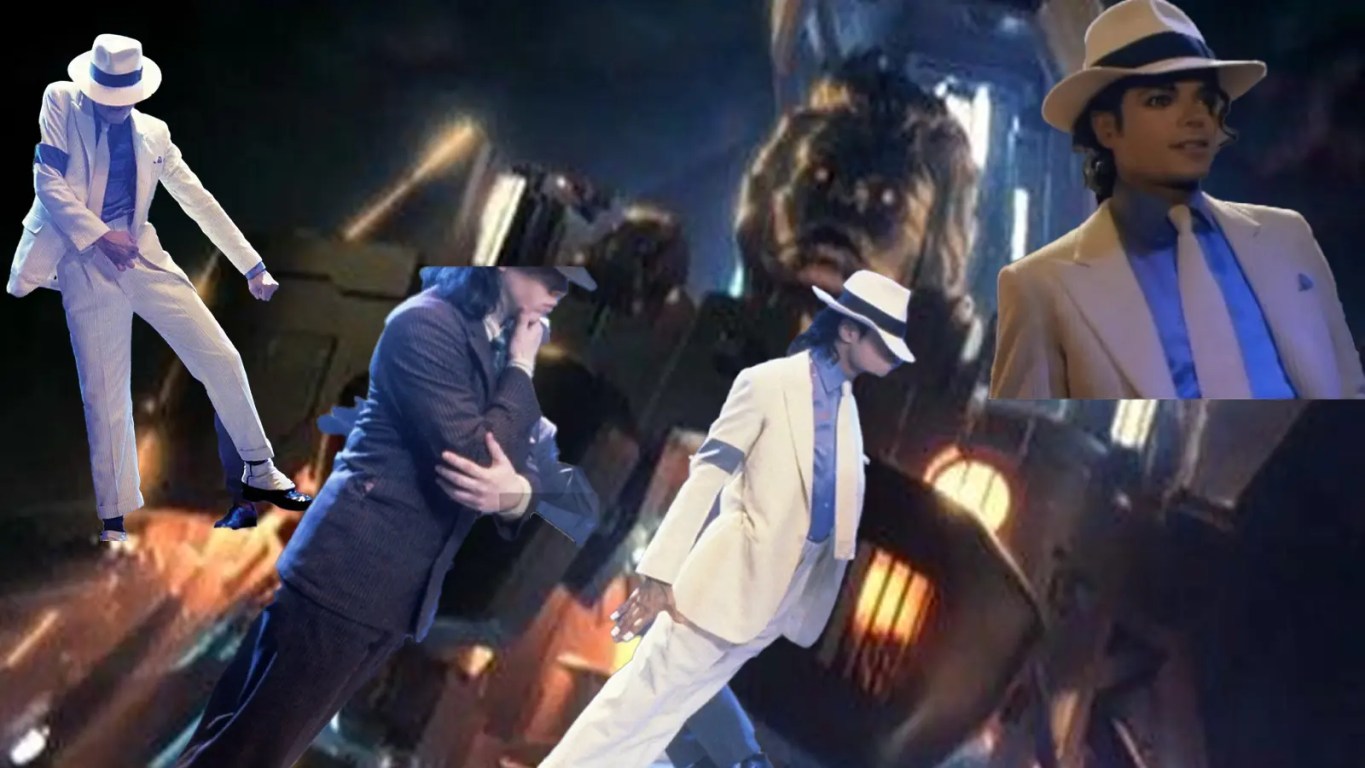
The lean happens forty minutes in.
The lean happens forty minutes in, and reality quits. Michael Jackson and his dancers snap forward forty-five degrees and hold it. Hold it. Physics screaming. Bodies don’t bend like that. They’re doing it anyway, heels locked to the floor, suits sharp, impossible. Then they shuffle back as if nothing happened. It was probably here that you thought magic was real for the first time, that flesh and blood men were capable of doing only what a man made of tin in the land of Oz could do.
If you were eight years old at the time “Moonwalker” was released on home video, you rewound that bit fifty times. You paused it. You got your face right up to the telly trying to spot the wires. You grabbed your mates and made them watch it. “Look at this. LOOK AT THIS.”
And that was just one moment in a ninety-three-minute fever dream that sat on top of Billboard’s Video Chart for twenty-two consecutive weeks at number one, from January through June 1989. It became the VHS tape that sat next to everyone’s TV, tracking worn out from rewinding, picture going fuzzy from being watched to death.
RELATED: The 33-Inch Flex: Michael Jackson’s ‘MoonWalker’ Supercar
Table of Contents
The 1988 Vision: More Than Just a Movie
Warner Bros. cancelled the US theatrical release. But that didn’t matter. The film shifted 800,000 copies in America by April and went 9x Platinum in the UK. And MichaelMania is coming back. Antoine Fuqua’s biopic drops in April, and Netflix US is releasing “Moonwalker” alongside it. Those who wore the tape out the first time around get to relive those memories. Those who missed it are about to understand what all the fuss was about.
The year was 1988, and Michael Jackson was operating on a frequency the rest of humanity couldn’t access. Bad had just broken records for the most number one singles from one album. MTV played him hourly. Pepsi threw money at him. Kids who’d never experienced Thriller’s cultural detonation were about to get their own.
It started in 1985 as a ten-minute short. Jackson invited Ron Howard — fresh off Cocoon — and Back to the Future’s special effects man Kevin Pike to breakfast in Encino to pitch the idea. Howard turned it down; he needed rest. Pike brought in his Back to the Future colleague Robert Zemeckis. Zemeckis also passed. Eventually, the job landed with Colin Chilvers, who had won an Oscar for his effects work on Superman. Before a single frame was shot, Jackson wrote a letter dated April 11, 1986, signed and dedicated to Chilvers and Pike. It read like a battle cry. “We owe it to God, we owe it to ourselves and the forefathers of this field, to do our best,” he wrote. “I want our film to be of quality and excellence that those who are considered masters of our field will become student to our creation. This means giving our souls to the project, pushing beyond our ability until it cries for mercy. Our goal is to make the most powerful short of our time. Setting a standard never to be equalled.” By the time they finished, the ten-minute short had grown to 93 minutes and cost $27 million. Jackson wrote, financed and produced the whole thing himself.
“Moonwalker” arrived, and all bets were off.
The Smooth Criminal Core: A Masterclass in Visual Texture
The film opens with Jackson, drenched in sweat, belting out “Man in the Mirror” at a live concert, as the screen cuts between African children, Martin Luther King Jr., Mother Teresa, Gandhi, Desmond Tutu and Jesus Christ. Within ten minutes, you’ve gone from live concert to career retrospective featuring twenty-one songs, Jackson 5 through Bad, then straight into Badder, a shot-for-shot recreation of the Bad video performed entirely by children, including Jackson’s nephews.
Speed Demon arrives like a panic attack directed by someone who’d just discovered claymation. Young Michael walks through the smoke and transforms into adult Michael. Tourists spot him. Chase begins. He disguises himself as an animatronic rabbit called Spike. The rabbit’s bicycle becomes a motorcycle. The paparazzi become claymation creatures driving increasingly cartoonish vehicles. Even the Noid — Domino’s Pizza’s advertising mascot — joins the pursuit.
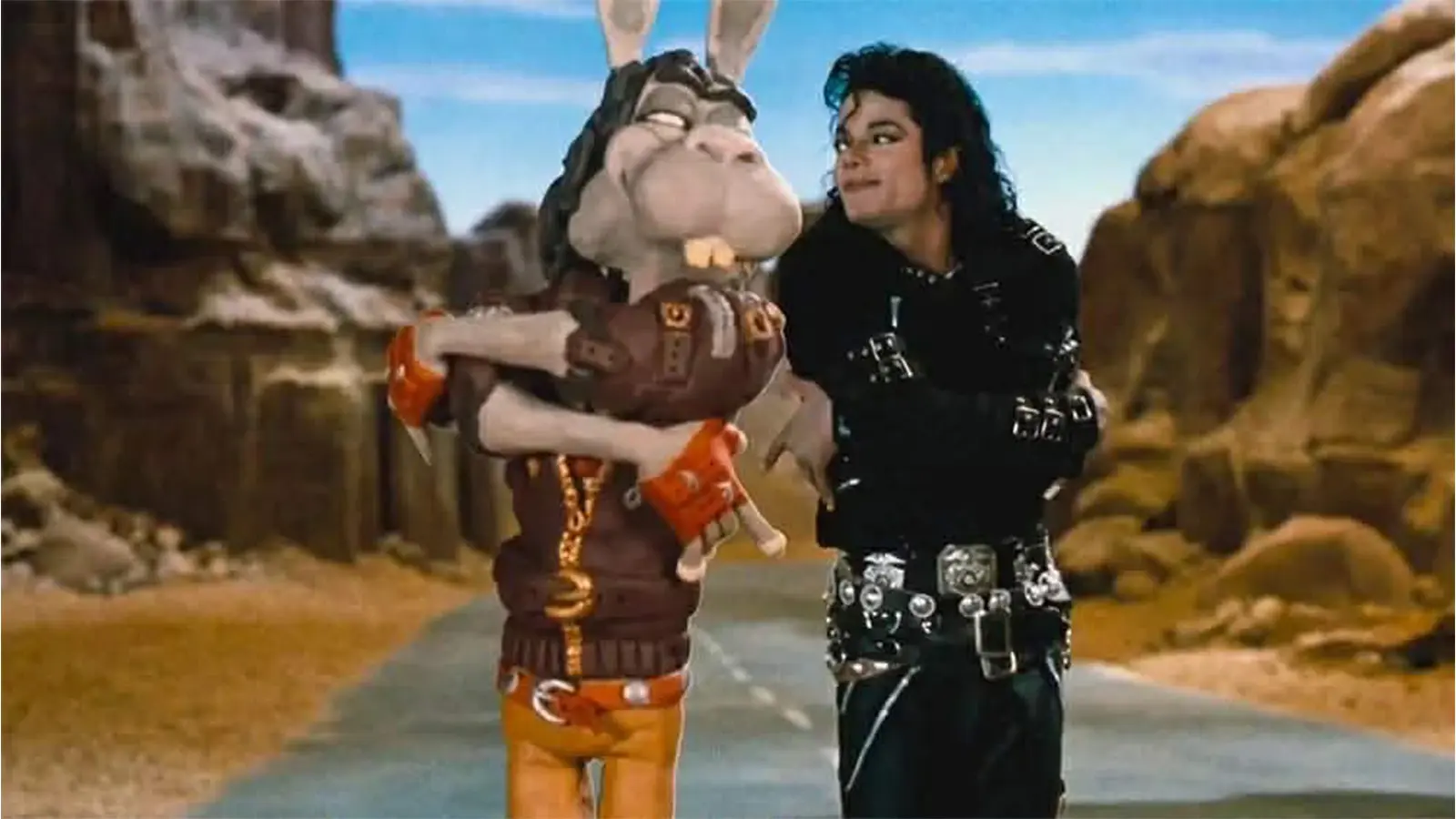
Photo: Warner Bros. Entertainment; Michael Jackson
The claymation was produced by Will Vinton’s studio in Portland, Oregon. Vinton is the man who created the California Raisins. His head of animation, Doug Aberle, said they worked on Speed Demon for six months and had to invent entirely new techniques to handle the volume of characters. At one point during the chase, Jackson stumbles onto a western being filmed on the studio lot, directed by Steven Spielberg — who was also, in real life, among the guests who turned up to watch Jackson rehearse.
Michael escapes to the desert, only to remove the rabbit costume, which immediately comes to life and challenges him to a dance-off. A traffic cop interrupts them in a “No Dancing Zone.” The rabbit vanishes. Then its head materialises on a rocky mountain, nods at Michael, and winks.
None of this makes sense. None of it needs to.
Then comes “Leave Me Alone,” and reality gives up entirely.
Director Jim Blashfield spent three days shooting Jackson on 35mm film, then nine months animating the result using a technique that belonged in an asylum. They turned the film into stills, cut the figures out with X-Acto knives, and layered them by the dozens on sheets of glass. Every element required its own separate shoot.
The result is Jackson’s life portrayed as an amusement park where the press has dog heads and tabloid rumours become literal carnival rides. It’s surreal, self-aware, and genuinely unsettling. Blashfield later said he saw it at the time as a fun fantasy adventure. Only in retrospect did it look like something else entirely — a prophetic vision of what was coming. The song, incidentally, wasn’t about the press at all. It was about a girl Jackson wanted to leave him alone. Blashfield just let the words fly as they wanted. The most pointed piece of media criticism in the whole film was built on a misreading of the lyrics, and Jackson approved it anyway.
The centrepiece runs forty-two minutes on pure dream logic. Chilvers screened The Third Man for Jackson before filming. You can feel it in every frame: noir shadows, empty city streets at night, something corrupt hiding just out of sight. But the darkness Jackson was drawing from wasn’t only cinematic. Smooth Criminal was inspired by Richard Ramirez, the Night Stalker, a serial killer who terrorised Los Angeles and San Francisco between 1984 and 1985, forcing his way into homes and leaving fourteen people dead. Jackson kept that inspiration hidden for obvious reasons.
Three orphans sneak through that darkness to watch Michael leave his apartment. Gunmen open fire on him.
Cut to flashback: Michael and the kids are playing in a meadow. Their dog runs away. Michael and Katie chase it, stumble upon the secret lair of Frankie “Mr Big” Lideo, a drug kingpin (played by Joe Pesci) running an operation called “Bugs and Drugs.” His plan: get every child on Earth addicted to narcotics. But first, get them out of church. Mr Big tells his men to stop kids from praying in schools before the drugs move in. Dismantle faith, then fill the void. His motivation beyond that is simply to have everyone know his name. The spider at the centre of the web: his henchmen wear spider crests on their uniforms, tarantulas around the lair, and a globe in his operations room shows the creepy crawlers engulfing each territory his empire seeks to conquer.
The Surrealist Shift: From Claymation to Mecha-Michael
Back to the present: Michael, cornered in an alley, wishes on a falling star and transforms into a Lancia Stratos Zero sports car. He mows down several henchmen while shaped like a vehicle. The children find an abandoned nightclub called Club 30s. Michael arrives, and Katie sees his silhouette morphing from car back into human form. The door opens with a gust of wind. Inside, the abandoned club is suddenly packed with suited men and swing dancers.
What follows is the dance sequence that justifies the entire film’s existence.
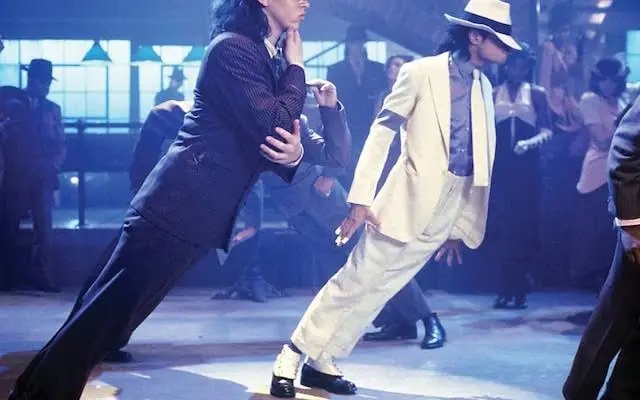
Photo: Warner Bros. Entertainment
Jackson wanted to pay tribute to Fred Astaire — he even wears a costume mirroring Astaire’s in The Band Wagon. Chilvers used the same piano wire technique he’d developed to make Christopher Reeve fly in Superman, this time fixing Jackson’s heels to the stage floor. The dancers wore shoes with slots in their heels that locked into the ground. When they came back up from that impossible angle, you can see them shuffle their feet as they unlock. Forty-six dancers. A crew that watched dailies every lunchtime like they were at a party, screaming at what they saw. Michael would either cheer or say, “We can do better than that.” Producer Dennis Jones kept checking his watch. Co-director Jerry Kramer told him, “Dennis, with Michael, you don’t need a watch, you need a calendar.”
Jackson’s dancing was so formidable that Hollywood kept making pilgrimages to the set to watch him rehearse. Robert De Niro came and spent time with Pesci and DiLeo. Gregory Peck came. Jimmy Stewart came. Elizabeth Taylor came. Yoko Ono came. Bruce Willis came. Spielberg came. James Cameron was brought in specifically to consult on the robot sequence — Cameron, reportedly, was too polite to tell Jackson what he actually thought. Fred Astaire’s choreographer, Hermes Pan, visited and told Jackson that Fred would’ve been happy and proud to be copied by such a wonderful person.
Jackson saw RoboCop and decided his robot needed the same guns. The producer said no. Jackson went to his manager, Frank DiLeo. DiLeo went back to the producer. The producer came back to Chilvers: “Let’s do something with the guns.” Rick Baker — who had transformed Jackson into a monster for Thriller — was brought in to build the robot face and moulds because Jackson felt the transformation wasn’t “pompous enough.” Baker charged a million dollars. Jackson paid it. Then Mr Big attacks the club and kidnaps Katie. Michael follows, gets surrounded, and watches Mr Big threaten to inject Katie with heroin. A falling star passes by. Michael transforms into a giant robot and kills most of the soldiers. Then he becomes a spaceship. Mr Big fires a hillside-mounted energy cannon at him. The spaceship crashes into a ravine. Mr Big targets the children. The spaceship returns, fires a beam at the cannon, and destroys it along with Mr Big.
The children return to the city believing Michael’s gone forever. Katie sits in a corner crying, clutching a paper star. She wishes for him. The star flies from her hand. Michael emerges from the fog. He takes them to Club 30s, now transformed into a concert backstage area. Staff return the kids’ dog. Michael performs “Come Together” while the children watch from the wings.
Roll credits featuring Ladysmith Black Mambazo performing “The Moon is Walking” over behind-the-scenes footage. They turned up on set one lunchtime, heard Jackson was there, and wanted to meet him. They started singing. Chilvers said, “Get behind the set,” and started an improv session. Jackson saw it in dailies and lost his mind. That’s why they’re in the film. Nothing about this makes narrative sense. A man with the gentility of a child, dressed like Al Capone, transforms into a killer robot to fight a child-abusing drug dealer whose lair houses a building-sized laser cannon operated by hand cranks. It’s barmy beyond measure. And it was magnificent because of it. Pure. And that’s not a fault.
“Moonwalker” didn’t make a lick of sense to adults back then. It may not make sense to them now. And that’s because Michael Jackson didn’t make much sense to people who didn’t live his life. But if you approach the film innocently rather than cynically, and slow down to read what he actually said rather than what others were saying about him, you come away with a much clearer understanding of what “Moonwalker” was about and what Jackson was trying to convey.
Simply put: it’s the story of a boy in an adult’s body — perhaps an alien in human skin — lost and alone in a cold, empty world where evil and corruption lurk in every wholesome corner, always waiting to pounce on the innocent. The only sunshine we see in the film is when Jackson plays soccer with the orphaned children in his care. And the film makes it clear: he’s a child, a protector, and a performer. But there’s something else so many miss: a victim, a helpless child on the run from adult corruptive forces that want him silenced. It’s power of innocence vs the power of the elite.
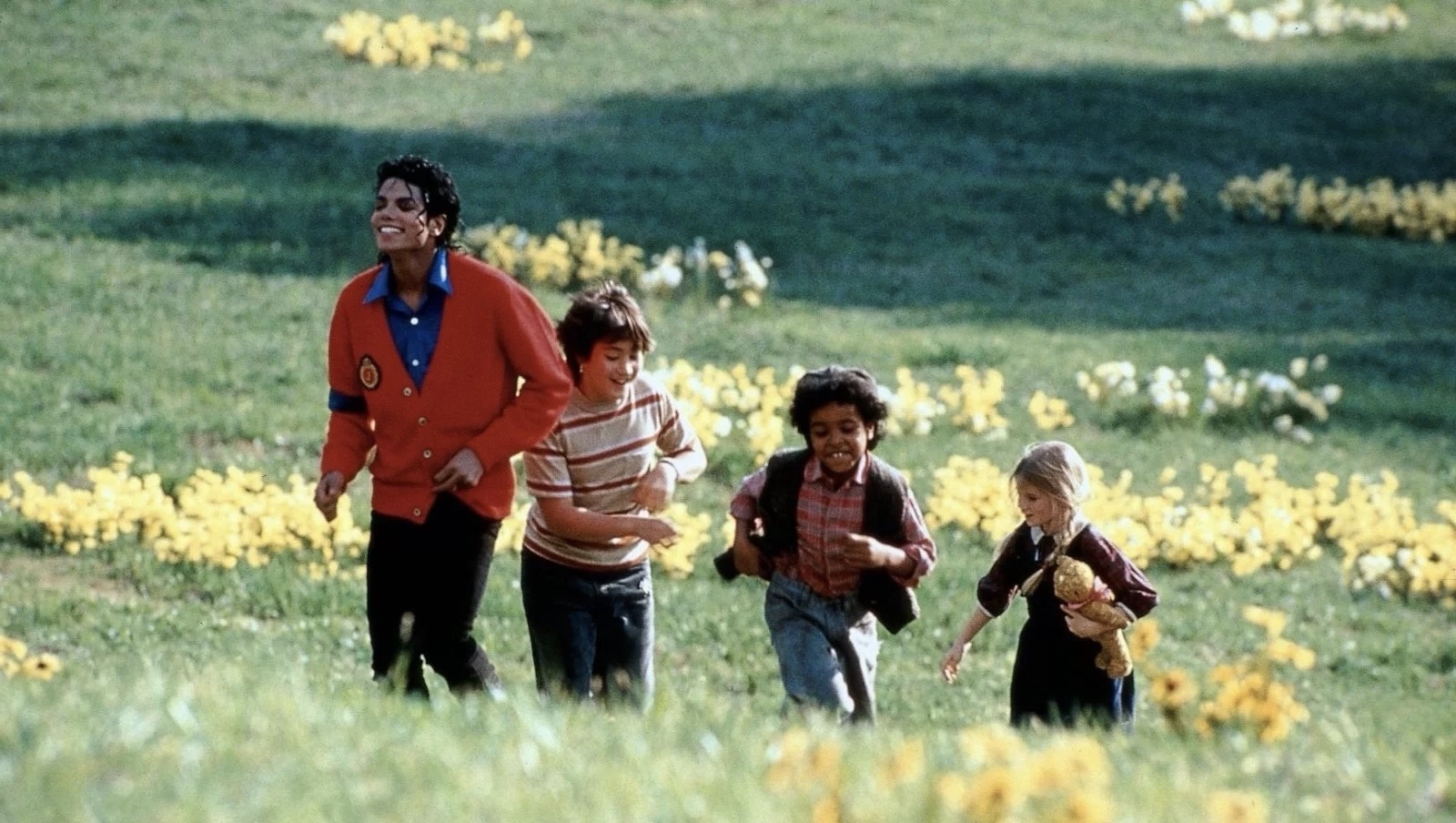
The city Jackson conjured for Smooth Criminal wasn’t Gotham City exactly, but it operated on the same logic: no law, no institutions, no protection for the innocent. It’s silent, neglectful — conditions that open the door to abuse of power. Batman at least had allies. Commissioner Gordon. Alfred. Robin. The whole apparatus of Gotham’s remaining institutions was partially on his side. Jackson had three kids and a dog. He had no Commissioner Gordon coming to clear his name, no Alfred in the shadows keeping him standing. In the film and in life, he was alone. The powerful wanted him silenced, not because he was a threat, but because the rat had stumbled through the woods, followed a dog, and accidentally found the web.
Mr Big spends the film screaming that Michael is a rat. He means it as an insult. Jackson meant something entirely different. Ben, his 1972 Oscar-nominated hit, was a love song to a rat. A lonely boy whose only real friend was the creature everyone else feared and despised. Jackson had been publicly identifying as the rat for sixteen years before “Moonwalker”. The spider calls the rat vermin, and the institution decides what the individual is worth.
There’s a slow-motion shot during the chase that shows vicious Dobermans hunting Jackson down. On the surface, it’s just a dramatic effect. But Jackson was genuinely uneasy around certain dogs — not because of the animals themselves, but the people who owned them. “People instil what they believe, and all their anger and frustration is embedded in that dog,” he once said. “I don’t know what kind of package he is bringing to me when he comes up to me and sniffs me. So it’s like another adult. That’s why I get afraid.” The Dobermans weren’t just visual flair. Jackson had put his actual fear on screen.
After this, Jackson is cornered in an alley — scared, desperate, helpless, like a child waiting for the adult to give them a beating. Then he looks up. A star shoots across the sky. He transforms into a car. That’s not the power of the star. Jackson becomes something other to escape. His final transformation comes when he witnesses child abuse. Mr Big slaps Katie. Jackson fights to protect her, but she gets knocked down. Mr Big screams for his men to kill the girl. She calls out for help. “Leave her alone!” Jackson screams. The spotlights shatter. The clouds form overhead. Without a star this time, he transforms into a monster machine and tears the place apart.
In this world — the one Smooth Criminal depicts — Jackson is the only adult who makes any sense at all.
The Lasting Impression: Why the Magic Doesn’t Fade
What set “Moonwalker” apart from every other music film was its demand that you pause and analyse. The transformations demanded rewinding. Speed Demon needed frame-by-frame examination to catch every morphing detail. Leave Me Alone contained so many layers of imagery that you could watch it fifty times and still spot new elements. Jackson and his team designed the entire thing to colonise your VCR.
“Moonwalker” arrived at a specific technological moment: VHS had been around long enough that everyone owned a player, but home video was still magical. You could pause reality. You could rewind the impossible. You could watch the King of Pop transform into a spaceship as many times as you wanted, trying to spot the moment where reality gave up, and visual effects took over. It was the last gasp of an unhinged creative vision meeting unlimited budgets and zero executive oversight. Jackson at the absolute apex of his fame, with enough clout to make whatever he wanted, surrounded by people who’d worked on Superman and claymation car commercials, all of them enabled by a star who wanted perfection and had the calendar to get it.
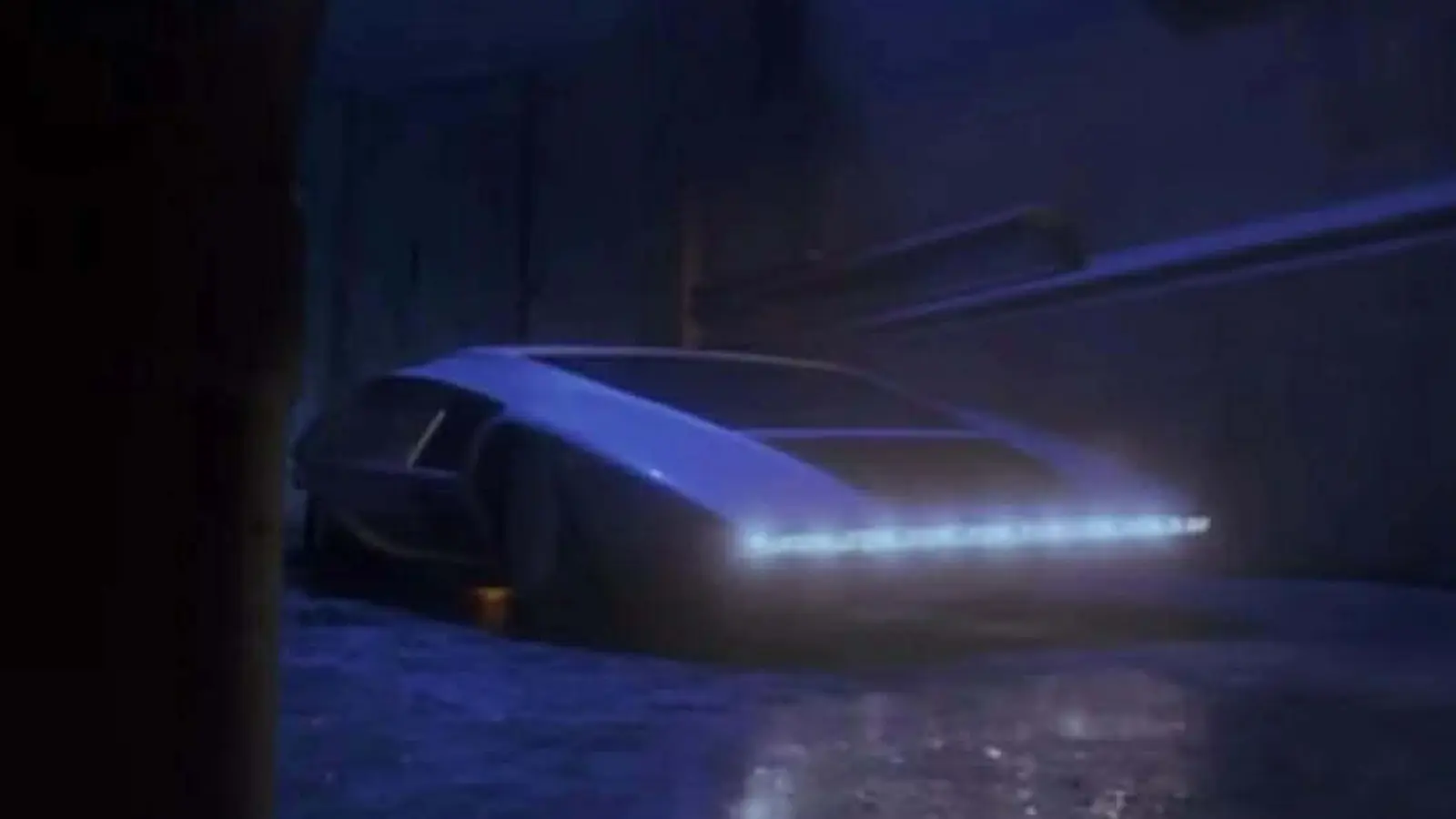
Photo: Warner Bros. Entertainment; Michael Jackson
Nothing since has matched it because nothing since could. The cultural conditions no longer exist. You can’t have that level of unchecked creative freedom, that level of fame, and that level of technological limitation. Modern CGI makes the impossible routine. Streaming platforms don’t allow for tape-warping obsession. Studios don’t hand out blank cheques to artists and say, “Do whatever.” But there’s another reason nothing’s matched it. Critics at the time dismissed Moonwalker as vanity, ego run amok, Jackson worshipping himself on screen. Variety called it “unsure of what it was supposed to be.” They saw the fans screaming in Man in the Mirror, the impossible transformations, and the messianic imagery, and wrote it off as self-celebration. They got it wrong. They didn’t understand Jackson’s language. His language takes time. And the world is just now deciphering it.
The film wasn’t a vanity project. It’s a piece of the Rosetta Stone in understanding Jackson’s language. It was Jackson’s plea. A plea to make people see who he was, what he cared about, what drove him. Jackson once said something he’d never admitted before: “I have wanted success and fame because I wanted to be loved. That’s all. That’s the real truth. I wanted people to love me, truly love me, because I never really felt loved. I said I know I have an ability. Maybe if I sharpened my craft, maybe people will love me more.”

Photo: Warner Bros. Pictures; Michael Jackson
That’s what “Moonwalker” was. The craft sharpened to its sharpest point. Every transformation, every impossible dance move, every frame designed to make you rewind and watch again — it was Jackson saying, look at what I can do, look at what I care about, please see me for what I truly am and what I’ve been through. “Moonwalker” was lightning in a bottle shaped like a VHS cassette. It was the biggest star on the planet using film as a canvas to paint his internal logic onto the world. It was Fred Astaire meeting film noir meeting Transformers meeting tabloid anxiety meeting kid-friendly drug war propaganda, all filtered through the mind of someone who genuinely believed he could transform into a spaceship if the story required it — and more importantly, someone who needed you to believe it too, because that belief meant love.
And then he walked back onstage and performed “Come Together”. In 1985, three years before “Moonwalker”, Jackson had paid $47.5 million for the Beatles’ catalogue. The man who spent much of the film being hunted through a godless city, alone, cornered, forced to become inhuman to survive and protect himself, ended the film performing a song called “Come Together.” It was the most sincere statement of everything he believed music could do: dissolve every barrier, every border, every division. The “Bad” tour had already proved it worked everywhere on Earth. The film begins with “Man in the Mirror.” One man asking himself to be better. It ends with “Come Together.” The world responds through the crowd. The children spent the whole film protecting and watching from the wings as he did the one thing he always believed could save it.
The spider called him a rat. The critics called it ego. Nobody noticed the truth.
But for those ninety-three minutes, Michael Jackson knew it.
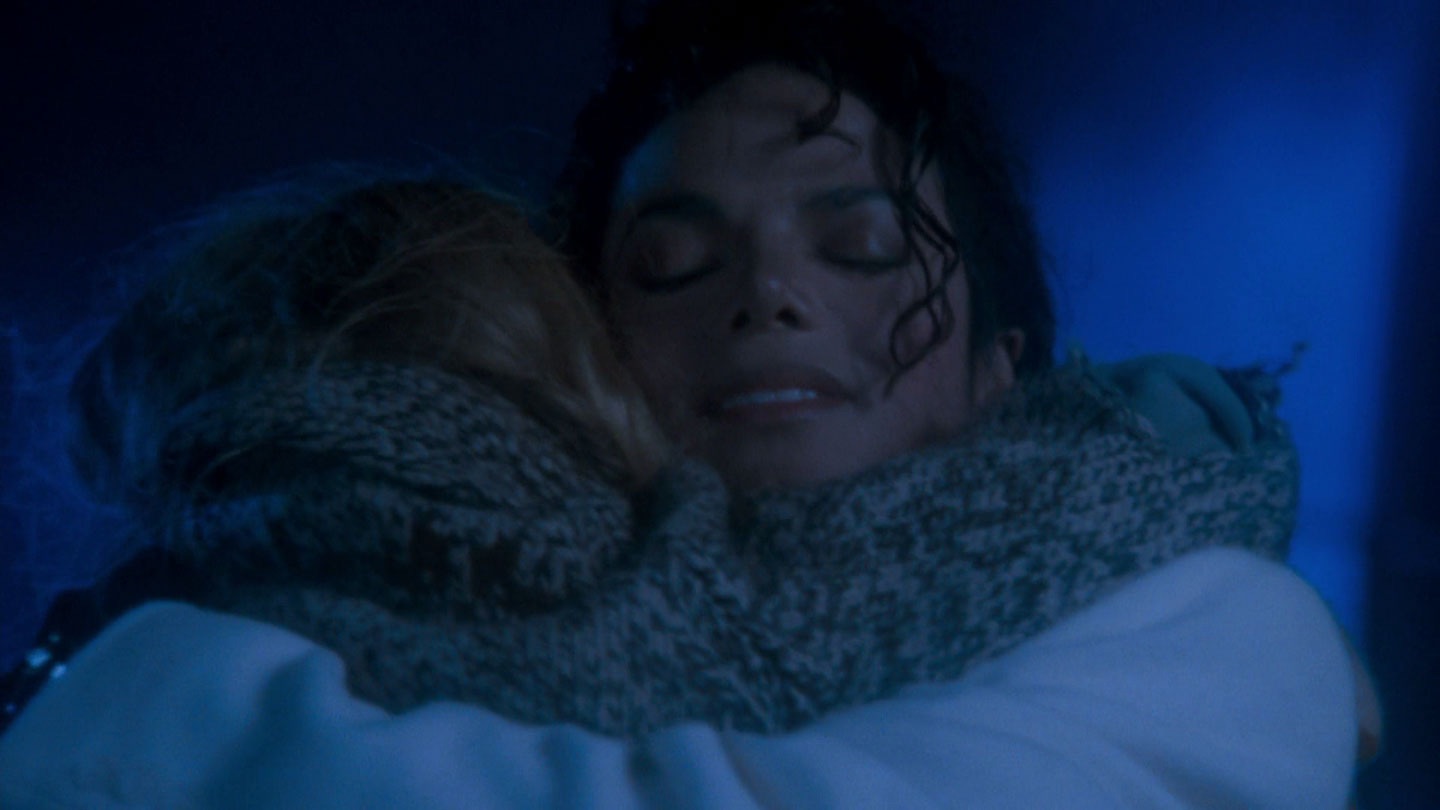
Featured Photo: Warner Bros. Pictures; Michael Jackson
Author Bio
As a freelance journalist, Ryan Smith’s work is driven by a commitment to restoring what has long been absent from institutions meant to uphold truth and accountability: honesty and transparency. Alongside his analysis works on the life, career, trials and tribulations of Michael Jackson, whose unfair treatment over the years paved the way for the path he is on, Smith also dissects and examines popular culture, such as books, movies and video games, always aiming to shed light on what’s beneath the surface.


![[The File 002] The Concrete Crusader: How 1986’s ‘The Dark Knight Returns’ Built the Modern Hero](https://deckedoutmagazine.com/wp-content/uploads/2026/02/batman_the_dark_knight_returns_1986_issue-1-cover_featured_image.webp)
