
By Jael Rucker: Published: January 13, 2026
Editor’s Note: This deep dive originally appeared on MJ Medium. It has been moved to its permanent home here at Decked Out.
LOS ANGELES, CA — Since we’ve covered the subject of Michael Jackson’s vitligo and lupus, we’ll now take a deep dive into a chapter of Jackson’s life that is a critical part of understanding him, but often overlooked—his time as a Jehovah’s Witness. Now we know from the on-set pictures captured from the biopic that the film is probably covering Jackson’s time as a witness. As such, there may be some questions/curiosity before the premiere or afterwards. Hopefully, this can provide some clarity regardless of when you are reading.
The Early Years
Michael Jackson first became a member of the Jehovah’s Witness organisation as a child by way of his mother, Mrs. Katherine Jackson, in the 1960s. In 1991, Mrs. Jackson released an autobiography entitled My Family, The Jacksons, and it was here that she would detail the experience of the family becoming witnesses:
“It all started with a knock on my door. The visitor was a field worker with the Jehovah’s Witnesses. In a way I had been waiting for that knock for fourteen years, ever since as a twelve-year-old I was invited by my next-door neighbors to sit in on a Bible lesson taught by a Witness. I learned more about God in that one lesson than I had in all my Bible studies to that point. I was especially interested in what the teacher had to say about death, taking us to the Bible to back up the Witnesses’ claim that when man dies he knows and feels nothing.“
Mrs. Jackson continued:
“So when I opened my front door and saw the Witness on my porch, I was respective. I invited her in. That first day, she, Joe, and I talked for an hour. What especially impressed me was the fact that, like the teacher had done fourteen years earlier, she took us to the Scriptures to back up each statement she made. Among the subjects we discussed were the Witnesses’ belief in the approaching Armageddon, and the need for believers to be teachers like Jesus, taking the Word from door to door. At the end of the meeting, Joe and I agreed to begin Bible studies in our home.“
Mrs. Jackson goes on to state that while Joe eventually decided he wasn’t ready to commit to becoming a witness, she, in turn, pursued her studies wholeheartedly, becoming baptized in 1963. While she encouraged her children to join her at the Kingdom Hall, it was important for her not to force them into joining the religion.
“The good thing about Joe’s getting involved to the degree that he did is that he understood what the Jehovah’s Witnesses are all about. So he not only supported my baptism, but also made a decision to expose Witnesses’ teaching to our children. I did that by conducting the Bible studies in our living room, as well as by encouraging the children to accompany me to meetings at Kingdom Hall. But I was careful not to force the religion on them. When they were older I wanted them to come in because they wanted to be Witnesses.
However, regarding the Witnesses’ belief the Christmas, Easter, Thanksgiving, and Halloween are pagan holidays, I felt that I had to go with the teachings in our household. With Christmas, especially, that amounted to a big change for us.”
While some of Jackson’s siblings elected not to continue being witnesses as they got older, Jackson wound up becoming a devout member of the organization, continuing to attend meetings and go door-to-door in disguises, even once his superstardom reached historic heights, as confirmed by his sister La Toya:
“By this time most of our siblings had basically given it up. Five days a week the two of us and Mother studied the Bible at home and attended the Kingdom Hall. (Randy always wanted to go to the meetings with us but could never get dressed in time) Every morning Michael and I witnessed, knocking on doors around Los Angeles, spreading the word of Jehovah. As my brother’s fame grew, he had to don convincing disguises, like a rubber fat suit he bought years later, around the time of Thriller.“
“Adults were easily fooled by Michael incognito, but it was a rare child who didn’t see through his costume in seconds. “Good morning,” my brother would say cheerily to whomever answered his knock. “We’d like to talk to you about the state of the world today and how man can cope with the problems we all face. May I have a minute of your time?” Reactions to this stranger differed, but in- variably a youngster standing in the doorway pointed and blurted excitedly, “That’s Michael Jackson!” “Honey, don’t be silly,” the parent replied. “But it is! It is!” the child insisted, staring wide-eyed at Michael, who desperately avoided eye contact. “Sweetheart, what would Michael Jackson be doing here?” The parent would flash us one of those looks that say, You know how kids are. I can’t tell you how many times this happened. Children seem to regard Michael as a sort of Pied Piper, and it never ceased to amaze me how easily they saw through his disguises, yet their parents never did.”
The 1980s
It was in the 1980s, however, that Jackson began to have some issues when it came to the creative endeavors of his work, and potentially crossing the rules of the organization. According to Jackson himself, during a conversation with Rabbi Schmuley Boteach (I know…he is not the best source, but this is what Jackson told him directly), some of the early conflicts stemmed from Jackson’s dance moves being deemed too suggestive:
“When I did certain things in the past that I didn’t realize were against the religion and I was reprimanded for it, it almost destroyed me. Certain things that I did as an artist in my music I didn’t realize I was crossing a line with them and when they chastised me, it really hurt me. It almost destroyed it. My mother saw it.“
“When I did the Moonwalk for the first time, Motown 25, they told me I was doing burlesque dancing and it was dirty and I went for months and they said, “You can never dance like that again.” I said 90.9 percent of dancing is moving the waist. They said, “We don’t want you to do it.” So I went around trying to dance for a long time without moving this part of my body.”
Jackson continued by explaining the trouble he got into with the witnesses for his Thriller short film, essentially having Halloween and horror elements.
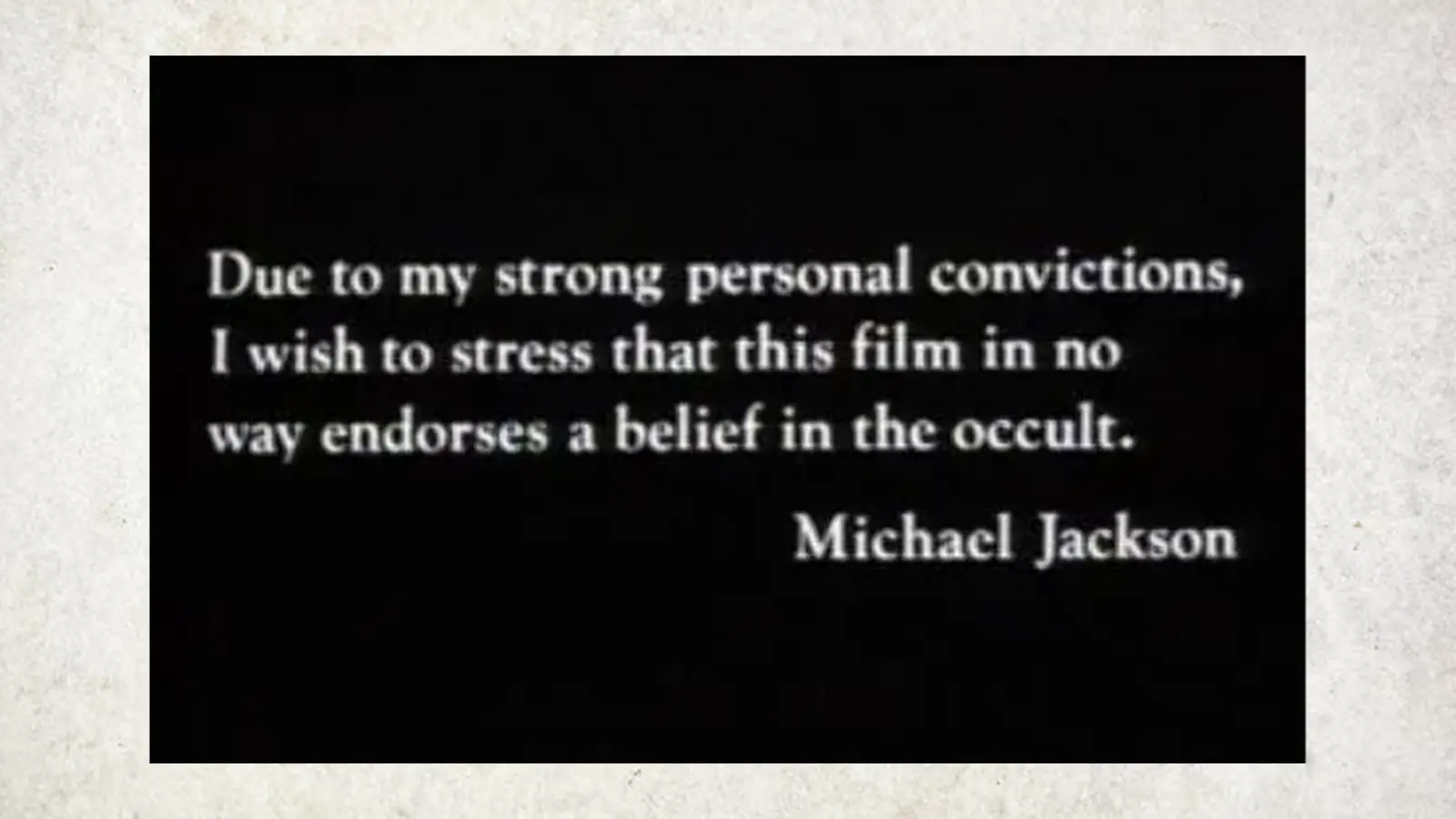
Of note: This is the reason why you see the disclaimer at the beginning of the film:
“Then when I made ‘Thriller’ with all the ghouls and ghosts, they said that it was demonic and part of the occult and that Brother Jackson can’t do it. I called my lawyer and was crying and I said, “Destroy the video, have it destroyed.” And because he went against my wishes people have ‘Thriller’ today. They made me feel so bad about it that I ordered my people to destroy it“
1987
In June 1987, approximately two months before the release of his Bad album, it was announced by an official of the Woodland Hills congregation Jackson was once a part of that he was no longer a member of the Jehovah’s Witness organization. The article I linked above cited a letter they had received a month prior, and noted there was no official reason given for the departure.
While I obviously cannot speak for Jackson, based on his later statements, if I had to assume as to why he left, I would imagine that it probably came down to the restrictions within his artistry. As somebody who grew up a Jehovah’s Witness myself and was a part of the organization until my teens, I can point out a couple of things within the Bad era that almost certainly would have gotten him into trouble with the Witnesses, considering he had been in hot water with them for less in years prior.
The concept of both the “Smooth Criminal” song and short film would have been a ding—especially since the setting of the film was in a gangster club and involved him shooting guns. I definitely think “Dirty Diana” would have been another ding based on the lyrical content of Diana being an aggressive groupie trying to seduce him. Oh, and I also think the dance break in “The Way You Make Me Feel” probably would have been another ding as well. All of the above would have likely led to him being reprimanded, and I believe that he would have been forced to choose between his career and the Jehovah’s Witness church by the Witness organization anyway. Again, these aren’t things that were ever directly stated from Jackson or the Witness organization; it’s just my general assumptions from having grown up in the religion as a kid.
That said, this is essentially everything you need to know about Michael Jackson’s time as a Jehovah’s Witness.
Read the current analysis on the 2026 Biopic’s visual authenticity:
Forensic Authenticity: How Jaafar Jackson is Reconstructing the MJ Blueprint
Author Bio
Jael Rucker is the founder of Decked Out Magazine. She has previously worked as the Associate Commerce Editor at PureWow, focusing on analytics and trends to pitch stories and optimize articles that build and engage their audience. Her work has also been seen in Footwear News and WWD. Prior to 2024, she was the style and pop culture editor at ONE37pm for over three years, contributing numerous product reviews, brand profiles and fashion trend reports, which included interviewing Steph Curry, Snoop Dogg and more.


![[THE FILES] 188 : Bratz Beach Party (2002)](https://deckedoutmagazine.com/wp-content/uploads/2026/05/Bratz_beach_party_hero.png)
![[THE FILES] 187: System of a Down “Chop Suey!” (2001)](https://deckedoutmagazine.com/wp-content/uploads/2026/05/shop_suey_system_of_a_down_hero_image.webp)